
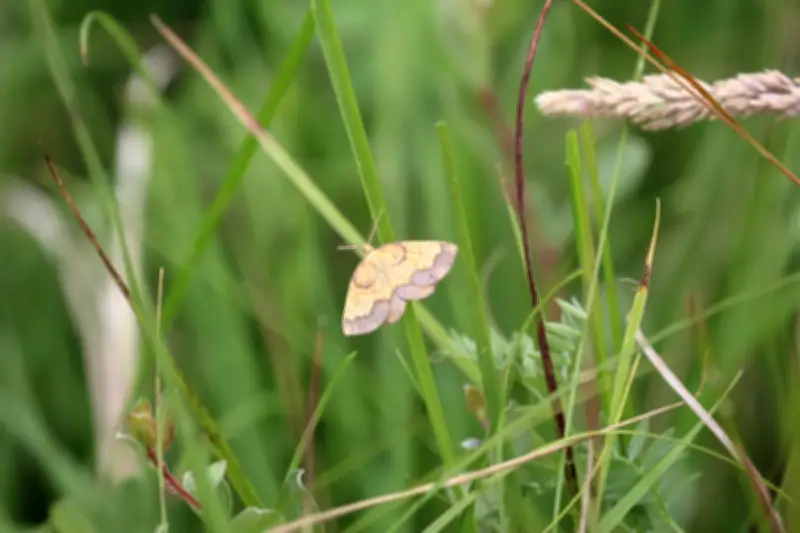
A hidden population of one of England's rarest moths has been discovered at a site where it had not been seen for 70 years, by a conservationist who has spent his life searching for them.
Dr Dave Wainwright, of Butterfly Conservation, found the dark bordered beauty moth at the National Trust's Wallington Estate in Northumberland, only the second known site for the species in England.
Second English site discovered
For decades, the only place in England where the custard and chocolate coloured day-flying moth was found was Strensall Common in North Yorkshire. However, that population has declined rapidly, with numbers falling from hundreds 20 years ago to barely reaching double figures last year, according to Butterfly Conservation.
The Strensall site is being affected by climate change, making drought and wildfire more common. A blaze that tore through part of the nature reserve, managed by Yorkshire Wildlife Trust and the Ministry of Defence, last year put the moth in an even more perilous situation.
Habitat transformation
The discovery of a second population in England gives new hope for the rare species, especially because the landscape at Wallington differs from the Yorkshire site, raising the possibility that the moths may be found in other places.
The moth was once widespread across northern England and Scotland, but has declined seriously due to habitat loss and is now restricted to two small areas on Deeside and Speyside in Scotland, as well as the two sites in England.
A key challenge for conserving the moths is that their caterpillars only eat two plants: aspen and creeping willow.
Dr Wainwright has been searching for new English colonies since he started work at Butterfly Conservation in 2004, both at work and in his own time. He first visited Wallington Estate in 2004, where the dark bordered beauty had previously been found but not since 1952, but he failed to track down any moths.
This time, however, the habitat had been transformed by the National Trust and its tenant farmer through nature-friendly farming, reducing livestock grazing in key areas and restoring peatland.
Relief and hope
Dr Wainwright said: “I looked at that site in 2004 and it was quite heavily grazed and wasn’t in the right condition for dark bordered beauty.”
“This time the site looked a hell of a lot better – really lush vegetation with lots of wildflowers. It only took 10 minutes to find the first one, then we all started picking them up quite regularly. I think the others were excited, but perhaps not as excited as I was.”
He added: “I was hopeful – I’m always hopeful – but I definitely didn’t expect it because I’ve been to so many sites to look for this species over the years, so my heart and my head were in two different places.”
Finding one within minutes was “one of the highlights of my career”. He said: “Overwhelmingly it was just a feeling of relief that we weren’t just fighting the fight at one site any more.”
Emily Johnson, ranger at Wallington, said: “We couldn’t be more excited to find that Wallington is a stronghold for such a rare species. We have been working hard to manage the land better for nature, and it seems to be paying off.”
The team behind the “Wilder Wallington” nature recovery project hope to expand potential habitat for the rare moth, with advice from Butterfly Conservation.
Butterfly Conservation is also working with Yorkshire Wildlife Trust to manage habitat at Strensall Common and is planning to trial a captive breeding programme, but the charity says the moth is clearly struggling at the site.
Dr Wainwright said the discovery at Wallington – a different environment to Strensall, on which conservationists had based their idea of “good habitat” for the moths – opened up a new front in their knowledge of the species. He said other sites came to mind that experts would not have thought of as prime dark bordered beauty habitat before.
“The thing that’s kept me going all these years is I always felt there was a chance of finding Dark Bordered Beauty on the Northumberland/Cumbria border – now it feels like there could be other colonies out there waiting to be discovered which would be brilliant,” he added.




