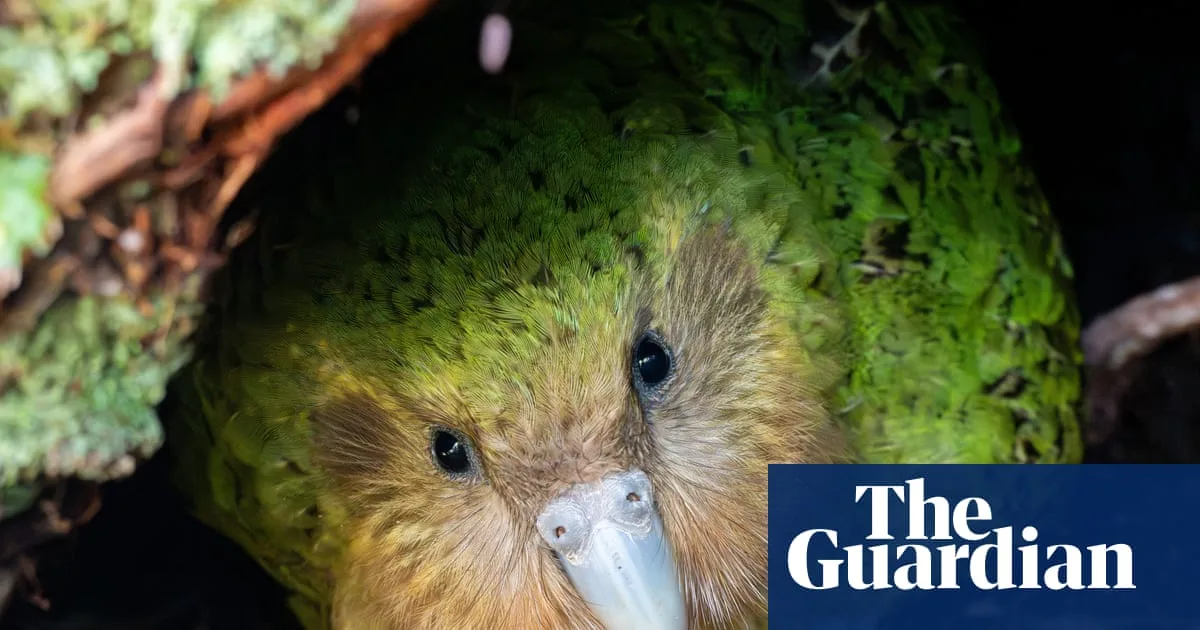
More than 100,000 people have watched a live stream of a kākāpō – the world's heaviest parrot – caring for her chicks on a remote island in New Zealand. The camera, launched by the Department of Conservation in mid-January, shows the mother named Rakiura sleeping, tidying her nest and fending off intruders.
The rare nocturnal and flightless parrot is one of the strangest in the world. On the live stream, a fluffy chick with a kazoo-like squeak jostles for food from its mother's beak. Viewers from the United Kingdom, Finland, Germany and across New Zealand have tuned in, with more than 100 people watching at any given time. A chat forum attached to the stream has become a space for fans to congratulate Rakiura and suggest names for her chicks.
Kākāpō were once abundant in New Zealand, but their population collapsed after the introduction of predators such as cats and stoats. By the 1900s they were nearly extinct. A recovery programme established in 1995 has rebuilt the population from 51 to 236 birds, including 83 breeding-age females.
This year's breeding season is the first in four years, triggered by a mass fruiting of the rimu tree berries that the birds feed on. So far there have been 78 nests, 247 eggs laid and 57 chicks hatched. Dr Andrew Digby, the Department of Conservation's science adviser for kākāpō, said the birds are on track for a record season: "It will be the biggest kākāpō breeding season we've had on record."
The conservation team has begun to step back from more intensive methods, including not feeding the adult birds. "We're moving from individual recovery to population recovery – and that's what this breeding season signifies: a turning point," Digby said. Nests are still monitored, and eggs and chicks – which weigh about 30 grams on hatching – are moved between mothers to ensure the best chance of survival. The chicks grow quickly, developing from fluffy white balls into a "gangly and awkward" phase with outsized feet and legs.
Digby helped set up the live stream partly as an educational tool for the recovery effort and partly to feed public curiosity. "People love the characters and the relationship between the birds," he said.