
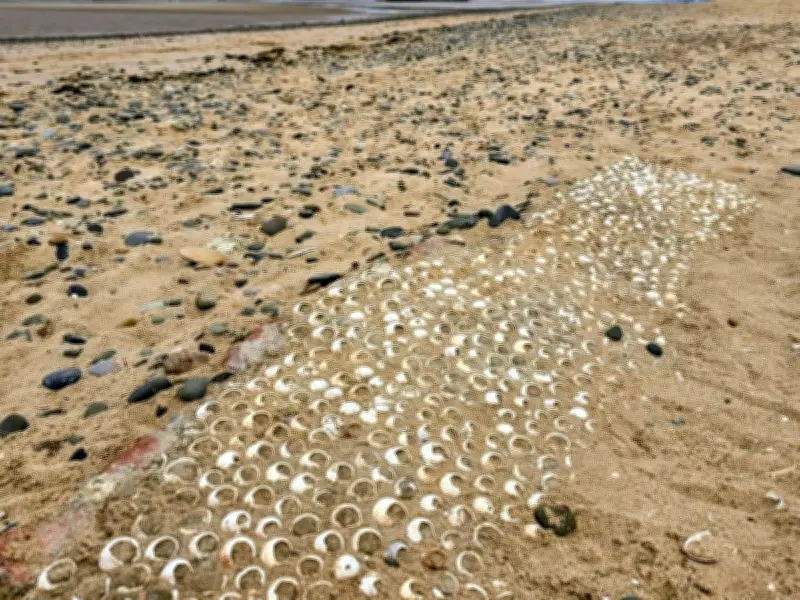
A patch of seashells exposed by the wind on a Flintshire beach has emerged as a poignant reminder of a vanished town consumed by sand and dismantled by disapproving authorities. Fifty years ago, the beach and its dunes housed 3,000 structures sheltering those seeking an idyllic lifestyle, holiday home proprietors, and former refugees.
The Hidden Valley Community
Referred to as the "Hidden Valley" among the dunes, it was branded a "slum by the sea." Nevertheless, youngsters raised at Talacre Warren recall the location as a "magical playground." They scavenged for bullets discharged by World War II Spitfires and coexisted with vast numbers of rabbits that tunnelled beneath chalets and frightened them while they attempted to sleep.
Nowadays, there are scant visible traces of the substantial community that packed into Hidden Valley. Oddly, a chimney stack protrudes from the dunes, buried for nearly 80 years and spared from the clearances that occurred in the 1960s. This week, a rectangle of shells adhering to a brick foundation was revealed on Talacre beach—a memento of joyful times when Hidden Valley inhabitants could open their back doors and wander out onto the sand.
It also served as a cautionary tale from history about the dangers of interfering with nature—how the community inadvertently unleashed the force of the dunes to swallow properties standing in their path. Hidden Valley on Talacre Warren featured a road cutting through it and even boasted a modest gift shop operated by Mrs. Marks.
A Shanty Town by the Sea
Nevertheless, it was unmistakably ramshackle, crammed with worn-out caravans, disused railway carriages, and retired double-decker buses. Certain residents constructed impressive timber chalets; others occupied structures barely superior to garden sheds. Scarcely any possessed modern conveniences of any kind. To outsiders, it resembled a "shanty town." Despite this, it was a contented community renowned for its vibrant personalities and straightforward lifestyle. Within months, much of it had vanished.
Reflecting on it now, a local woman remarked online: "Seems so sad a whole way of life has gone." Today, the dunes at Talacre and neighbouring Gronant remain as beloved as ever among holidaymakers and those seeking permanent coastal living. And despite what transpired here during WWII, the coastline has preserved its globally significant wildlife habitats. Still standing proudly after 250 years is Talacre's iconic Point of Ayr lighthouse.
War-Time Evacuees
During the 1930s, the first self-built holiday homes started emerging on the Warren, territory reclaimed from the sea during the 19th century. When war commenced, the local population expanded dramatically as evacuees escaped Manchester and, particularly, Liverpool. Some arrived with resources to construct their own rudimentary homes; others were destitute and depended on local generosity. Many were single mothers determined to protect their children.
Until they adapted, English youngsters faced teasing in local Welsh-speaking schools. However, by and large, they cherished their new existence away from the bombardment targeting Liverpool docks. Occasionally, evacuated families would scale the tallest dunes and gaze sadly at the glow in the sky above their home city as it endured relentless attacks.
A former Hidden Valley resident remembered: "There were dog fights overhead and occasional plane crashes but, for the youngsters at least, the dunes were a wonderful playground and they felt safe and sound, despite the war." A woman added: "You could hear the planes overhead at night as they came up the estuary towards Liverpool. It didn't seem to affect us though as we were in a little cocoon of our own. I know it sounds daft as there was a war on, but it was a wonderful life."
War Footing
Throughout the conflict, Talacre beach underwent dramatic transformation. Facing the threat of invasion by Hitler's forces, defensive bunkers were positioned overlooking the shoreline, while rows of larch posts were embedded into the sand to thwart enemy glider landings. Barbed wire and landmines blocked coastal access.
Following the war, the bunkers became children's hideouts or served as picnic locations. Some remain visible today. Local Dad's Army-style patrols were organised, armed with pickaxe handles and minimal training. Nevertheless, legend has it that a German spy was discovered and apprehended within the Hidden Valley community.
The beach was utilised as an aircraft firing range. Fighter planes flew over the area daily, targeting wooden structures positioned in the dunes. Trainee Spitfire pilots also practised shooting at flags—flat lengths of canvas—and windsock-like "drogues" towed by aircraft on 1,000-foot-long cables. Following each session, these were deposited near the lighthouse to assess the pilot's accuracy.
When targets weren't available, Spitfires would simply discharge their weapons into the dunes, purely to familiarise themselves with the substantial recoil of the aircraft's cannons. A former resident remembered: "Us lads would sit under the huts and when they'd finish firing we used to run out and collect all the spent bullets—the brass cartridges and the metal clips. We'd put them all together and go home looking like Mexican bandits—great fun!"
Talacre beach was also employed for trialling new equipment such as "window," the British codename for anti-radar foil now more widely recognised as chaff. Remarkably effective, it comprised small strips of aluminium foil released from Allied bombers to generate vast clouds of false echoes on enemy radar screens. During testing, it was reported the entire village was frequently blanketed in silver.
Following the war, numerous evacuees were hesitant to return to their "flattened and smelly" cities. Accompanied by others seeking respite from 1950s monotony, the Hidden Valley community continued expanding. Numerous difficulties existed. Sanitation was rudimentary at best. The location had no mains drainage, electricity, or gas supply. Each summer, obtaining drinking water posed a significant problem: stand-pipes were installed but, with minimal pressure, water merely trickled out.
Trouble Brewing
Many inhabitants cultivated their own vegetables. For meat, rabbit was abundant: in 1906, an aristocratic shooting party of eight guns shot 510 rabbits on Talacre Warren in just one day, alongside 45 hares. More frequently than not, the residents waged ongoing battles with local rabbits over their vegetables. Despite this, by early 1949 Hidden Valley residents had succeeded in designing and constructing their own church. It required merely three months, though such was the scarcity of chairs that worshippers were frequently compelled to bring their own.
By that point, the permanent population had reached 500, swelling to 1,500 each summer when holidaymakers descended. However, warning signs were emerging. In July 1953, the Liverpool Echo documented a visit by a Housing Ministry engineering inspector evaluating the prospects for local sewage disposal. He observed developing issues. The newspaper stated: "The sand dunes, which used to be more or less stabilised by a heavy growth of dune grass, are becoming weather-eroded as the grass is worn away by campers crossing the dunes to the beach. Whether the protecting barrier of dunes will eventually disappear and let in the sea will have to be taken into account when making any long-term plans for the area."
Engulfed by Sand
The inspector would have been cognisant that the destabilised dunes were already shifting. Sands had engulfed one of two former lifeboat cottages on the Warren, inhabited by the Terry family. For 32 years they'd resided in the stone cottage, previously one of two used to accommodate the captain and crew of a light ship anchored off Talacre in 1883.
In 1948, the Liverpool Evening Express reported: "Shifting sands are slowly covering their cottage home, mounting the walls and filling the gardens. Windows which once looked out to sea now gaze upon a massive sandbank towering high above the roof. In less than three years they have seen the growing mound of sand bury the next-door cottage, leaving only the fire chimneys like lonely grave stones. The menace is now at their own doorstep, growing larger as each gale shifts the sand nearer and higher. At night the Terrys go to bed wondering whether the morning will find their house buried." During the day they desperately removed sand and planted brushwood hedges in futile attempts to halt the drifts.
Slum Clearances
Sand wasn't the sole hazard. By the mid-1950s, local district councils were growing impatient with the "very unsightly development" that "spoils the look of the coast." Sanitation was also a significant concern. Conversations commenced regarding the compulsory purchase of the site's "hutments" and other buildings. Modern, better-equipped caravan sites were proposed.
By the early 1960s, it was estimated that 3,000 chalets, caravans, buses, carriages, and other structures sprawled across 500 acres. "Slum clearances" commenced shortly afterwards. Permanent residents were offered alternative housing. Some contested the process, requesting temporary planning extensions. All appeals were dismissed amid concerns it would establish a precedent and jeopardise prime caravan development land.
Certain residents received compensation, with the Prestatyn Weekly reporting: "Merseysiders are predominant among the owners and occupiers, and removal of the chalets could create havoc among the holiday habits of thousands of people." Hidden Valley was rapidly demolished. A holiday camp called Morfa, whose earliest owners had originally vacationed in the Warren's "bungalows," subsequently occupied part of the site. Today this location is home to the five-star Talacre Beach Resort.
Elsewhere, a wide cycle path now winds through the Warren, echoing the road that once served Hidden Valley. Scattered throughout, fragments of brick and timber protrude from the earth as haunting reminders of a community that disappeared almost overnight.




