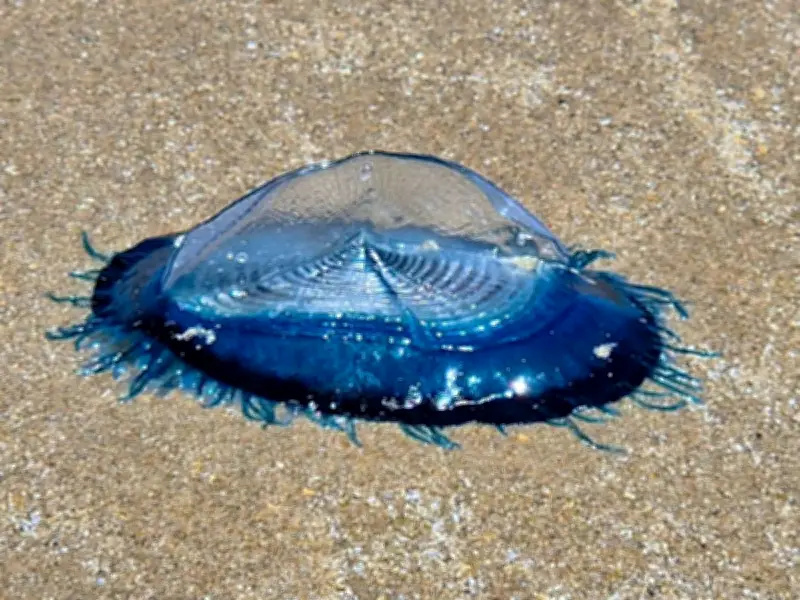
Beachgoers have been urged to look but not touch after hundreds of electric blue marine creatures washed up on UK shores during the summer heatwaves. The animals, thought to be Velella velella, also known as by-the-wind sailors, have been appearing in large numbers since temperatures rocketed.
Visitors to St Bees beach in Cumbria spotted several over the weekend, while hundreds were found on the Welsh coast at the start of the summer. The creatures are closely related to the Portuguese man o’ war, whose stings can cause nasty welts and even death in rare cases. Although Velella velella are understood to be less dangerous, experts have told beachgoers not to touch them.
Warning over ‘alien jellyfish’
They are usually found in the Atlantic, Indian and Pacific oceans, but UK temperatures have recently reached nearly 40C. It remains warm, with 27.8C recorded in Charlwood, Surrey, on Saturday, but an unsettled period is expected this week. Nevertheless, experts believe beachgoers will see more of the electric blue creatures this summer.
Marine biologists say the creatures, sometimes dubbed “alien jellyfish”, are usually seen elsewhere in autumn and winter. Beachgoers who have encountered them so far expressed their surprise. Louise Nicholson mistook one for seaweed at St Bees beach recently.
‘Do not touch them’
Speaking to BBC Cumbria, she said: “There were hundreds of them and there were lots of visitors to the area taking photos. They are absolutely beautiful, only about 2ins in size. It was a great find on a beautiful day.”
Georgia de Jong Cleyndert, Head of Marine at the Cumbria Wildlife Trust, said: “Although they are not jellyfish, they do have a very mild sting, even after they have washed up so do not touch them. Each by-the-wind sailor is made up of hundreds of tiny, specialised animals working together as a single floating colony.”
What to do if you see one
Marine specialist Frankie Hobro, owner of Anglesey Sea Zoo in Bynsiencyn, said their sting is generally “very mild” in comparison to Portuguese man o’ war – but also said it was unwise to touch them.
“You probably wouldn’t feel it through normal fingers because human skin is fairly thick,” she said. “But if you touched your lips, face or another sensitive area, it could be quite painful and cause a tingling sensation. I would always recommend covering up when in the sea.
“By-the-wind-sailors are not dangerous but their stings can irritate and you wouldn’t want to touch your face or eyes if you’ve been in contact with one. We’ll soon be seeing reports of more dangerous creatures like Weever fish and Portuguese Man o’War. It can be difficult to avoid contacts but a rash vest will help and swim socks or booties are good idea.”
“What is slightly worrying is that Portuguese Man o’ War are arriving earlier in the year and more frequently, overlapping with marine creatures like By-the-wind-sailors. It shows how climate change is affecting ocean currents,” Hobro added.