
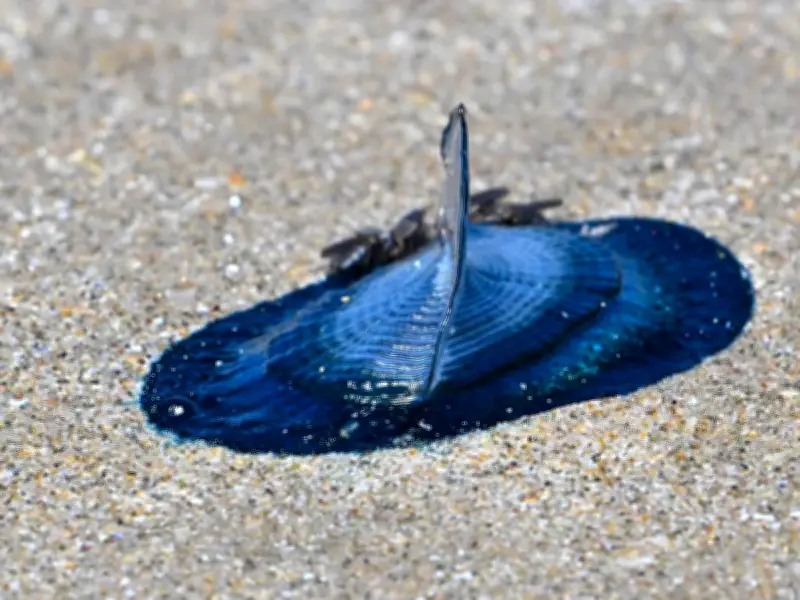
Visitors to popular Welsh beaches have been left shocked by the appearance of "alien jellyfish," which have turned up on their shores. Hundreds of the peculiar creatures have been appearing on beaches across northwest Wales. Known as By-the-wind-sailors, they share a close relationship with the Portuguese Man o' War.
Reports online suggested strandings on beaches throughout Anglesey and along the west Gwynedd coastline. In Barmouth, one woman reported "hundreds" scattered across the town's beach alone.
The emergence of this "blue tide" took many beachgoers by surprise. Some compared them to "alien jellyfish," while one individual described them as "among the most bizarre things" he'd witnessed washed ashore.
They are, in fact, relatively common - though typically during autumn and winter months. Marine expert Frankie Hobro, proprietor of Anglesey Sea Zoo in Brynsiencyn, explained: "They blow in on winter storms and are therefore noticed less often. June is late in the season to see them. We had a warm spell in late May followed by an unsettled start to June, which may be why they're appearing now."
"What is slightly worrying is that Portuguese Man o' War are arriving earlier in the year and more frequently, overlapping with marine creatures like By-the-wind-sailors. It shows how climate change is affecting ocean currents," she added.
Electric blue By-the-wind-sailors are scientifically known as Velella velella. Similar to Portuguese Man O'War, they are "colonial hydroids" – rather than being a single organism, they comprise a colony of minuscule individual animals. They are not genuine jellyfish. Measuring roughly 7cm in length, they possess a small, rigid sail that harnesses the wind. These diminutive colonies drift wherever the breeze carries them – where they wash up is entirely down to chance.
Under particular circumstances, they beach in their thousands in what's termed a "blue tide." This occurred several years ago in Tywyn, Gwynedd. Another mass beaching took place at Treath Penllech beach on the Llŷn Peninsula. Online, a local woman remembered: "There were so many washed up one year the beach looked blue and the smell was awful."
Not all By-the-wind-sailors travel in the same direction. Based on how their sails are positioned, some veer left, while others head right. They have small stinging tentacles hanging beneath to capture prey.
Frankie explained that, unlike Portuguese Man O'War, their stings are very mild. However, she warned: "I would always recommend covering up when in the sea. By-the-wind-sailors are not dangerous but their stings can irritate and you wouldn't want to touch your face or eyes if you've been in contact with one."
"We'll soon be seeing reports of more dangerous creatures like Weever fish and Portuguese Man O'War. It can be difficult to avoid contacts but a rash vest will help and swim socks or booties are a good idea," she concluded.




