
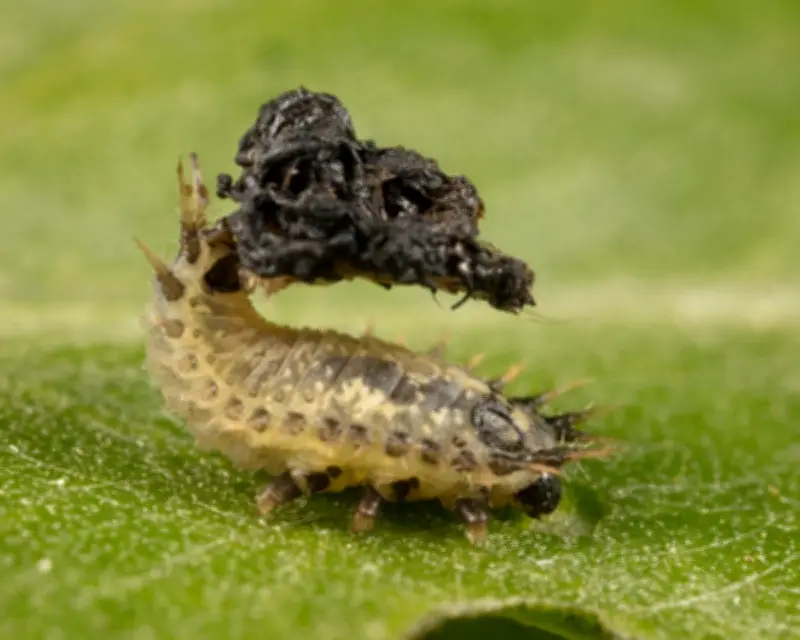
During a Wildwatch recording morning in Ceredigion, a tortoise beetle larva was spotted on knapweed, showcasing an unusual survival strategy: it collects its own waste to form a faecal shield, brandished to protect itself from predators. The tiny emerald green spiked creature has a prehensile anus, a detail admired by volunteers through a hand lens.
Volunteer recorders make discoveries possible
The sighting was made possible by local wildlife recorders, who move slowly and look hard, gathering vital data. Carys May of the West Wales Biodiversity Information Centre identified two horsefly species before the walk began: the dark giant horsefly (Tabanus sudeticus) and the notch-horned cleg (Haematopota pluvialis), which bit the author.
At Pencoedtop, a former conifer plantation being restored to moorland, Carys spotted a mining bee that can only be identified under a microscope. This bee exits flowers covered in pollen powder, which the female seals into her nest with her eggs. In a bank of brambles, she pointed out marmalade hoverflies (Episyrphus balteatus), which migrate at great heights from the continent.
Recorders as unsung heroes
Ceredigion, like most areas, has experts on everything from moths to dragonflies who identify species, coordinate sightings, and keep records. These recorders are unsung heroes of conservation, working voluntarily on hands and knees to gather data, spot trends, and inform the public about local wildlife.
On another recording day, the author joined Steve Chambers, Ceredigion's botanical recorder, walking around 19 acres of rough mesotrophic grassland near Cwm Tydu. Steve identified a Rosa micrantha, small-flowered sweet briar, whose crushed leaves smelled of apples. He mentioned he might send the identification to the rose referee, another specialist.
No ordinary field
Recorders show that there's no such thing as an ordinary field. Without their expertise, the tortoise beetle larva's outrageously inventive survival strategy would have gone unnoticed.




