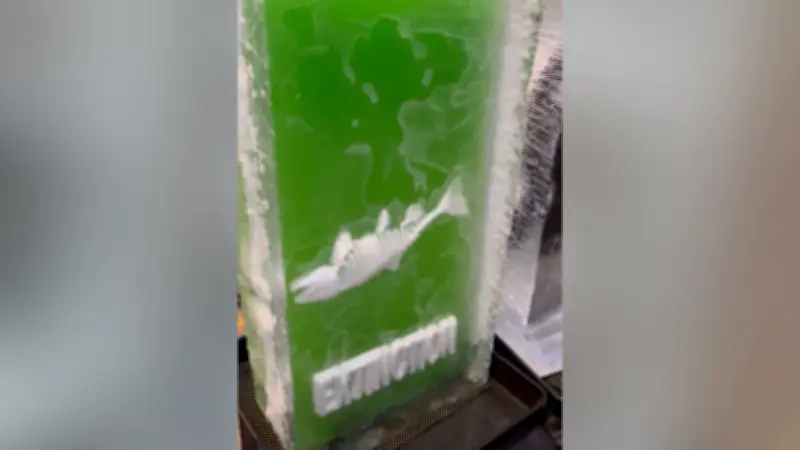
Paul Whitehouse unveiled an ice sculpture of Andy Burnham in Manchester city centre this morning (November 26) as part of a campaign to protect a rare species of fish in Lake Windermere.
The comedian and experienced angler, who hosts a fishing show on the BBC with fellow comedian Bob Mortimer, was campaigning outside Number 10 North as part of the 'Save Windermere' campaign.
Arctic charr decline in Windermere
Lake Windermere has been home to four distinct types of Arctic charr, a cold water fish from the salmon family, for around 10,000 years. They have long been considered reproductively isolated, with limited interbreeding allowing them to develop distinct characteristics over thousands of years.
While they are found in other lakes across Cumbria, those in Windermere have long been recognised as an 'internationally exceptional' example of the species. However, new research from the Freshwater Biological Association (FBA) says its populations have declined and that their survival is threatened by deteriorating spawning grounds and other environmental pressures.
Research findings and environmental pressures
The research shows that no Arctic charr have been detected in historic spring spawning sites in Windermere or in the south basin of the lake. It also found fewer detections of Arctic charr and poorer 'eDNA' signals of genetic material from the fish in the water of Windermere in 2025 than in previous surveys in 2017.
Surveying shows the lakebed habitat in which the fish lay their eggs has declined markedly since 2017, with an increase in algae and silt. The researchers have warned that sewage from wastewater treatment works and poorly managed private sewer systems, along with agricultural runoff, are increasing nutrients in the lake and driving the growth of algae.
Invasive species of fish such as ruffe and roach are putting extra pressure on Arctic charr, while rising water temperatures caused by climate change are also harming the cold water fish.
Campaigners urge government action
Campaigners have released a film showing how a once-thriving fishery for Arctic charr has all but vanished. Taking part in a demonstration outside Heron House in Albert Square, the former Fast Show star linked the threat of extinction to pollution of the Lake District's biggest lake.
"The spawning grounds for this beautiful species are covered in algal sludge that is a direct result of sewage pollution. It's a crime that the char could be lost on our watch. This government needs to act now," he said.
Matt Staniek, founder of the Save Windermere campaign, said it was 'abundantly clear' that the government led by Mr Burnham needed to 'stop the sewage to save the char.' "Anything less would mean a government continuing to allow pollution with impunity while our environment is destroyed around us, threatening our communities, our economies and our cultural heritage," he said. "The Arctic charr in Windermere is the canary in the coal mine and is dying as a result of government inaction."
Downing Street have been approached for comment. The research on Arctic charr has been carried out by the FBA as part of the Lake District Charr Recovery and Management (LD-CHARM) partnership, funded by government conservation agency Natural England.
A spokesperson for the Department for Environment, Food and Rural Affairs (DEFRA) said the government 'shared the public's determination to protect this iconic lake.' "This government is already acting to reduce sewage discharges, including deploying 33 additional Environment Agency specialists in the region, increasing inspections, and, through our regional water council, giving the local community in Windermere a greater say in decision-making," they said.
"Our strengthened Water Bill will bring in tougher regulation, stronger enforcement and greater accountability, so water companies deliver for customers and the environment."