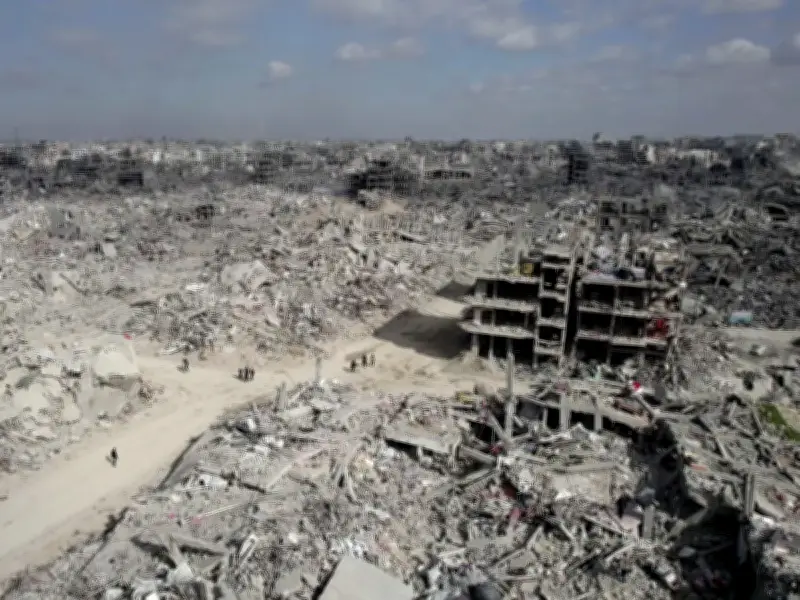
Gaza has become a "toxic wasteland" due to Israel's "environmental war crimes", according to a report by Oxfam and the Conflict and Environment Observatory. The report, released today, says more than 99% of Gaza is environmentally contaminated from Israel's military assault.
The report warns that future generations of Palestinians face living with deadly toxins in the air, water, and food as a result of missile strikes, fires, and general destruction. It says human survival across the region is under threat, and the full consequences will not be truly felt for many years.
Death toll and contamination
More than 74,000 Palestinians have been killed by Israeli forces since the start of the war in Gaza in 2023, following an invasion launched by Israeli premier Benjamin Netanyahu in response to a terror raid by Hamas fighters on October 7 which claimed the lives of 1,200 civilians. Thousands are also still missing under building rubble.
In June, the United Nations accused Israel of genocide, crimes against humanity, and war crimes throughout the war in the Gaza Strip. The report found that raw sewage is pouring into the sea and leaking into the ground, with just 19% of sewage pumping stations still working.
Faecal coliforms were found in nearly 20% of all drinking water wells, compared with just 2% before the October 7 terror attack. Gaza City, Jabalia and the North Gaza Governorate face the highest risk of air contamination, with pollution spread by wind, vehicles, and debris clearance.
Health risks and long-term impact
People in Gaza face numerous health risks from dust and pollution caused by the destruction of buildings and the burning of waste. This pollution could irritate respiratory systems and make asthma significantly worse. There are wider concerns about the safety of children after long-term exposure to these air pollutants.
Oxfam's International Executive Director, Amitabh Behar, said: "Palestinians living in Gaza are being exposed to toxins in multiple ways through air, food, water and via direct contact with contaminated soils and debris. These risks will persist for generations to come, unless clean-up, remediation and recovery actions are prioritised."
He added: "Israel's ongoing genocide in Gaza includes military assaults on its environment, which are environmental war crimes threatening life now and for generations to come. The destruction and contamination of Gaza will have fundamentally degraded the environmental conditions necessary for human safety and survival."
Impact on food and water
Contaminated soil means food crops could be unsafe to eat when farming restarts after the war. Excessive flooding and sewage overflow also mean drinking water is at high risk of contamination, particularly in areas of heavy shelling where debris has damaged groundwater systems.
The report used satellite data, remote sensing analysis, and conflict databases to map contamination risks across Gaza. Israeli restrictions on entering Gaza meant conducting tests was impossible, Oxfam said.
The report read: "The scale of destruction in Gaza demands an urgent and decisive response. The Government of Israel must end its genocide in Gaza, immediately cease unlawful attacks, comply fully with the Geneva Conventions and applicable International Humanitarian Law, and respect all ceasefire arrangements."
Oxfam also urged the Israeli government to lift all restrictions on humanitarian aid so environmental assessment teams and essential materials can start to rebuild Gaza. It said the consequences of Israel's military campaign in Palestine would "extend far beyond the period of active hostilities".
Conditions in Gaza are now incompatible with civilian survival, and the local environmental systems are being pushed into systemic collapse. The charity added that it is vital to launch recovery and reconstruction talks with Palestinian authorities, as the war-related contamination places the entire survival of Gaza's civilian population at risk.
Fishermen's accounts
Fisherman Darwish lives in a tent by Gaza Port with his family after his home was destroyed by bombs. Fishing has been part of his family for generations, but since October 7, the fish in the port have dried up. Sewage is pouring into the water close to shore, meaning there is nothing except the occasional baby sardine and some crabs.
Darwish said: "We fish around the port, 200m to 300m from the shore. No more than that. The nets we fish with are the remains of our old nets; the ones that were hit and burned. We salvage a piece here, repair one there, and that's what we fish with. Nothing comes in through the crossings, no new nets, nothing like that is allowed in to us."
He added: "Now there's nothing except the odd tiny fry. Baby sardines, they call them. That's all. Nothing else except some crabs. Right now, fishermen catch nothing but crabs. There simply are no fish."
Darwish estimated his losses at about $1.5 million after losing the house and almost all of his business. He fears for his kids' futures without any fish in the port. He wouldn't advise any children to swim in the water around the port, as it's just sewage, which is likely why the fish have dried up.
"There's no alternative," said Darwish. "Catch, or no catch... here we sit. It's been two or three days now, and there's been no catch. In the sea, [sewage] harms the fish, it harms people, it harms every living creature. It's not just the fish, not just the fishermen. It harms everything, every living thing."
Fisherman Zakaria also lives next to Gaza Port in Gaza City. The smell of sewage is overpowering in the summer months and sparks a horde of flies and mosquitoes. "Before we sleep, I leave the tent door open and go round at night swatting the flies with a rag," he said. "In the morning, the flies are unbearable. That's how it is; mosquitoes, flies, insects... and then the smell. The smell is terrible in summer."
In winter, there's a lot of water next to the outfall on the north side, and the low ground fills completely with water. Kids swimming in the water came out with rashes owing to the sewage. "Most of the time I'm sitting at the port, watching the fishing gear, sitting on the shore. When children come to swim, I chase them away. Little ones, I tell them: 'This water is polluted', and I don't let them swim in it."