Swiss Research Team Shatters Solar Efficiency Record with Innovative Material
Researchers in Switzerland have achieved a groundbreaking milestone in renewable energy technology, developing a new type of solar cell that has surpassed the critical 30 per cent efficiency mark for the first time. This remarkable advancement combines conventional silicon cells with perovskite, a material often described as a 'miracle' substance for its potential to revolutionise photovoltaic performance.
Record-Breaking Efficiency at a Fraction of Space-Grade Costs
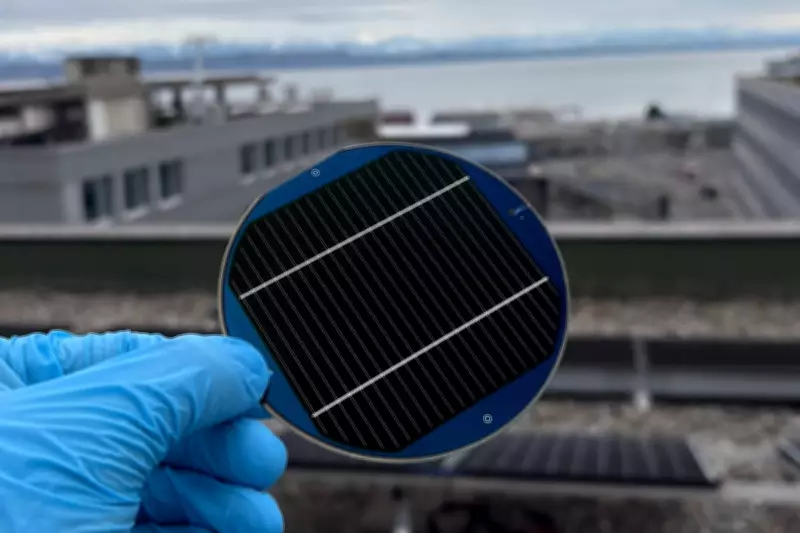
A collaborative team from the Ecole Polytechnique Fédérale de Lausanne (EPFL) and the Swiss Center for Electronics and Microtechnology (CSEM) has created a triple-junction solar cell device that achieved an efficiency rate of 30.02 per cent. This significant achievement surpasses the previous record of 27.1 per cent and approaches the performance levels of expensive satellite-grade solar panels that typically cost around one thousand times more per watt.
Kerem Artuk, a researcher at CSEM who contributed to this breakthrough, explained the importance of their work. "We demonstrate that through intelligent design and processing techniques, we can approach performance levels traditionally reserved for the most expensive III–V multi-junction solar cells used in space applications," he stated. "Our approach paves the way for a new generation of industrially viable, high-efficiency multi-junction photovoltaics that could transform terrestrial solar energy production."

The Perovskite Advantage: Capturing More of the Solar Spectrum
The integration of perovskite with silicon represents more than just a cost-saving measure. This innovative combination allows solar cells to capture and convert a broader portion of the solar spectrum into usable electricity, significantly enhancing overall energy generation potential. While perovskite has been recognised as increasingly important for photovoltaic research in recent years, scaling these technologies beyond laboratory settings has presented substantial challenges until now.
Recent upgrades to the triple-junction design have substantially improved both the performance and resilience of these advanced solar cells. Christophe Ballif, who leads the Photovoltaics and Thin-Film Electronic Laboratory at EPFL, highlighted the remarkable progress made since their initial demonstration. "Our first prototype in 2018 achieved only 13 per cent efficiency, so reaching over 30 per cent efficiency today in a triple-junction device represents an extraordinary achievement," he remarked. "Triple-junction solar cells possess even greater efficiency potential compared to single junction and tandem designs – potentially exceeding 40 per cent in future developments."
Publication and Future Implications for Renewable Energy
The research findings were published this week in the prestigious scientific journal Nature, in a paper titled 'Triple-junction solar cells with improved carrier and photon management'. This publication marks a significant step forward in solar technology development, offering promising prospects for more affordable and efficient renewable energy solutions.
The breakthrough demonstrates that terrestrial solar cells can now rival the performance of space-grade panels while remaining economically viable for widespread implementation. As global demand for clean energy continues to accelerate, this advancement in perovskite-silicon hybrid technology could play a crucial role in meeting renewable energy targets and reducing dependence on fossil fuels.