
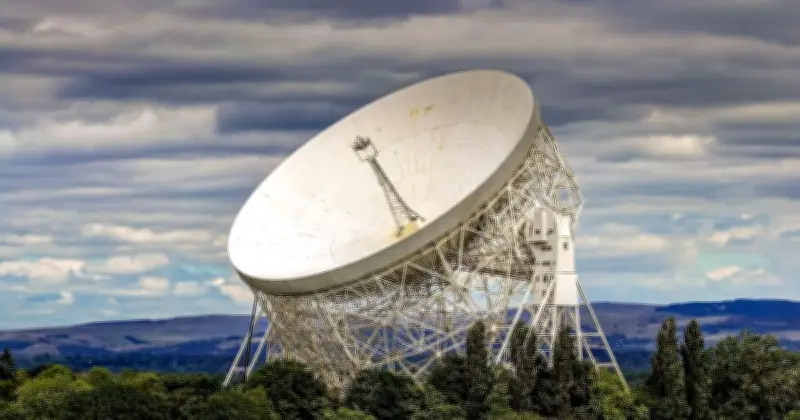
Jodrell Bank Observatory, a Unesco World Heritage site near Macclesfield, will cease scientific work in April 2028 unless funding is restored. The government cancelled support for the e-Merlin telescope network, which maintains the iconic Lovell Telescope as a working radio facility.
Funding cancellation
The Lovell Telescope, which opened in 1957 and produced the first images of the Moon's surface, is the world's largest steerable radio telescope. It also served as a Cold War warning system. The cancellation of e-Merlin funding means the telescope cannot remain operational after March 2028, according to Prof Sarah Sharples, Dean of Science and Engineering at the University of Manchester, which manages Jodrell Bank.
“The impact of the ending of the e-Merlin funding means that unless we find alternative funding, then from the end of March 2028, we will not be able to maintain the Lovell Telescope as a working radio facility,” she said. “There are 28 people who are employed by the e-Merlin grant and the e-Merlin grant funds an array of telescopes.”
Political reaction
Senior Labour MP Graham Stringer called the situation the “first test” of Prime Minister Andy Burnham's “promise to rebalance the country”. He said: “Jodrell Bank has to be saved. It has to be saveable if No 10 in the North and rebalancing the country - Andy Burnham's projects - are to survive.”
Local MP Tim Roca is seeking alternative funding. He said: “I will continue pressing for clarity and the best possible outcome for Jodrell Bank, its staff and the wider scientific community.”
Impact and context
The decision does not affect Jodrell Bank's engagement centre, which attracts school trips and generates £4.7m annually. However, ending research funding could affect around 3,000 scientists nationwide. The University of Manchester said it is “looking at the implications of this news carefully and working with our partners to secure the future of the Lovell telescope and e-Merlin”.
The Science and Technology Facilities Council (STFC), which made the funding decision, cited a 2.7% budget cut over four years. Professor Michele Dougherty, executive chair of STFC, said: “These are never easy choices, but we have made what we feel are the right decisions to bring STFC to a sustainable financial position by 2029/30.”




