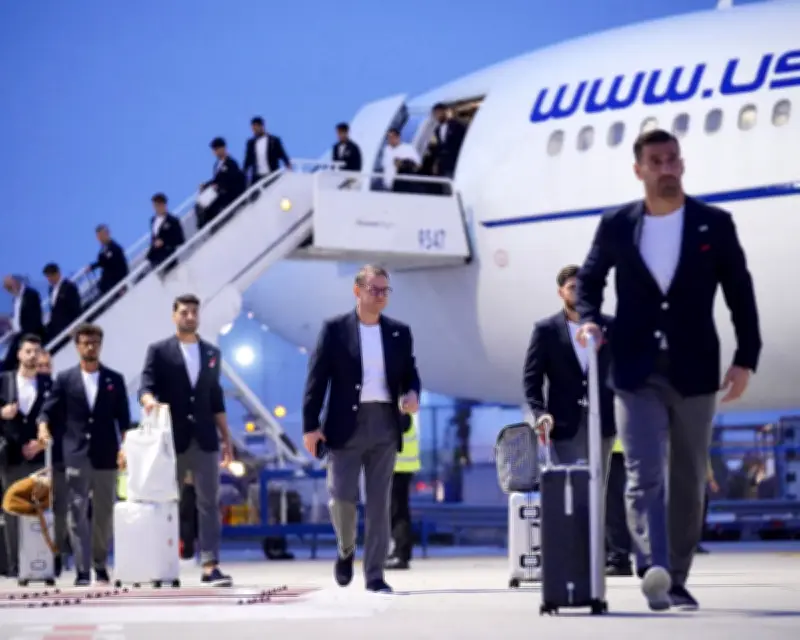
The Iran national football team arrived in Mexico on Sunday for the 2026 World Cup, but the occasion was overshadowed by a bitter diplomatic dispute after the United States denied visas to some support staff members. The squad, along with coaching staff, landed at Tijuana airport early in the morning following a flight from Turkey, where they had been training.
Coach and Captain Express Frustration
Iran's head coach, Amir Ghalenoei, voiced his displeasure upon arrival, stating, 'We should have been here last week because a 12-hour time difference needs two weeks of adjusting.' He added, 'Usually in these tournaments, before technical matters, ethical and human considerations must be respected – which I think for us it was not the case.'
Team captain Ehsan Hajsafi also criticized the delay, asking, 'Why so late?' He referenced the challenges faced by Iran, saying, 'In the last year, we experienced two imposed wars in our country.' Despite the setbacks, Hajsafi insisted the team is '100% ready' and capable of advancing from Group G.

Security and Fan Reception
The team's arrival was marked by tight security, including Mexican National Guard troops. Only a small group of fans waving Iranian flags were present to welcome the players from a distance. The dispute has erupted just days before the tournament's kick-off on Thursday, which is jointly hosted by the US, Mexico, and Canada.
Visa Issues and Political Tensions
Iran's squad spent nearly three weeks in Turkey, applying for visas to enter the US, Mexico, and Canada. While players received their US visas on the eve of departure, according to Washington's envoy to Turkey, Tom Barrack, support staff were denied. Iran's embassy in Turkey condemned the 'deliberate and discriminatory treatment' and called on FIFA to hold the US accountable.
Adding to the confusion, Iran's ambassador to Mexico stated that visa conditions require the team to enter and leave US soil on the same day as matches, contradicting earlier statements from the team's spokesman. Iran's football federation, whose chief was reportedly among those denied a visa, labeled the decision 'political interference in sport in its worst form.'
A US administration official defended the move, saying, 'We will not allow the Iranian team to abuse this system to sneak terrorists into the United States under false pretences.' Iran's group-stage games include matches against New Zealand, Belgium, and Egypt, all held in US cities.