
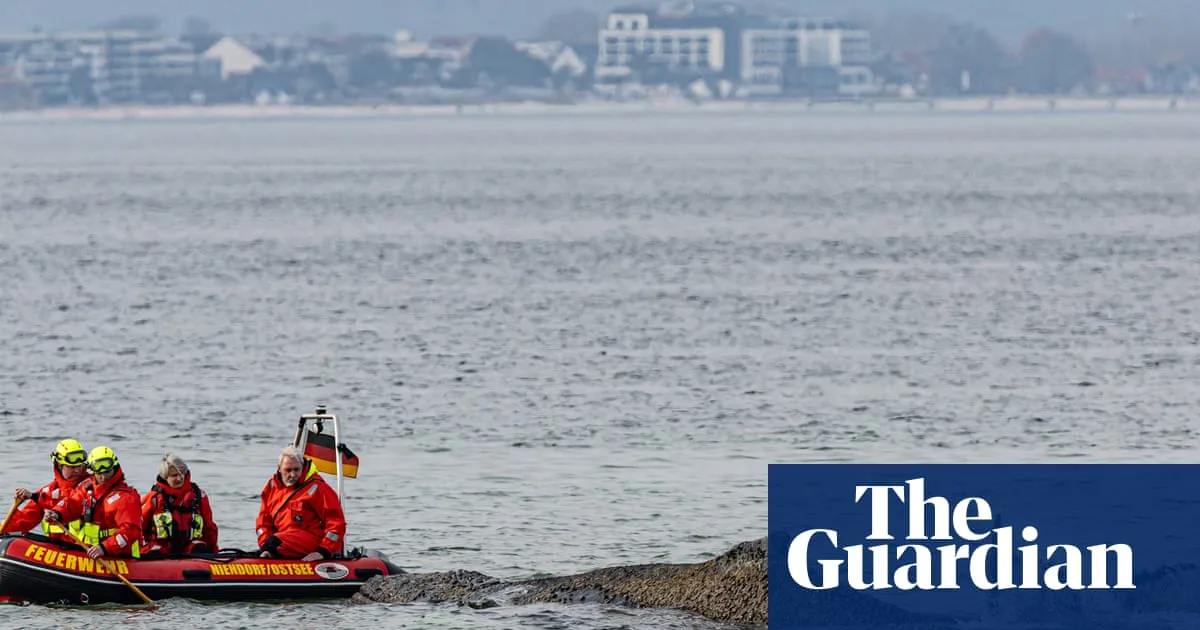
A 10-metre-long humpback whale stranded on a sandbar in the Baltic Sea is in danger of dying if rescue workers do not manage to help it move into deeper waters soon, experts have said. Believed to be a young male, the mammal was spotted by guests of a hotel in Niendorf in Lübeck Bay, northern Germany, on Monday after they heard its deep moans and alerted police.
Since then, teams from the local coastguard, fire brigade and marine rescuers have been trying to ease the whale’s path back into deeper waters. Their efforts have included removing netting from parts of its body and trying to create waves to help it swim away. Experts have said the whale, which is thought to need only one or two fin strokes to shift into deeper water, appeared to be getting weaker by the hour.
“Every passing hour means a deterioration in his condition,” Sven Biertümpfel, of the sea protection organisation Sea Shepherd, told the broadcaster NDR. “It’s only a question of time as to how long he’s got to live if he continues to stay lying there.” Dr Stephanie Groß, of the Institute for Terrestrial and Aquatic Wildlife Research (ITAW) in Büsum, said it was possible the whale had accidentally landed in the shallow water area during a search for fish and “either didn’t try to move on because he had enough to feed on, or simply lost its way”.
On Monday night the teams briefly managed to get the mammal to turn so that its head was in the direction of the shipping channel and away from the beach, allowing it to head back towards the Atlantic. Shortly afterwards, however, it turned back again. One challenge rescue workers face is trying to avoid being struck by the whale’s flailing tail fin, officials said.
Rescue efforts were temporarily paused after the whale appeared stressed and exhausted from the attempts to help it. Hopes that higher water levels around midnight would help the animal fight its way back to the sea on its own were dashed. Niendorf’s mayor, Sven Partheil-Böhnke, urged onlookers to stay away amid reports some were hindering the rescue effort. In some cases people had tried to approach the whale in small boats, he said, while in others, they had accused the rescuers of not doing enough to save it. The beach in the immediate vicinity has been sealed off to the public.
Vets and other marine experts on site rejected calls from the public to give the animal a lethal injection. “Nature has to be allowed to take its course,” Robert Marc Lehmann, a marine biologist, told local media. “Human intervention isn’t always helpful.” The stranding is one of a mounting number in northern Europe in recent weeks. According to the Norwegian broadcaster NRK, at least 10 sperm whales have become stranded in Denmark, Norway and off the UK coast in the last month. In Denmark, eight whales have arrived within just a few weeks. In most cases, the mammals also strayed into too shallow water.




