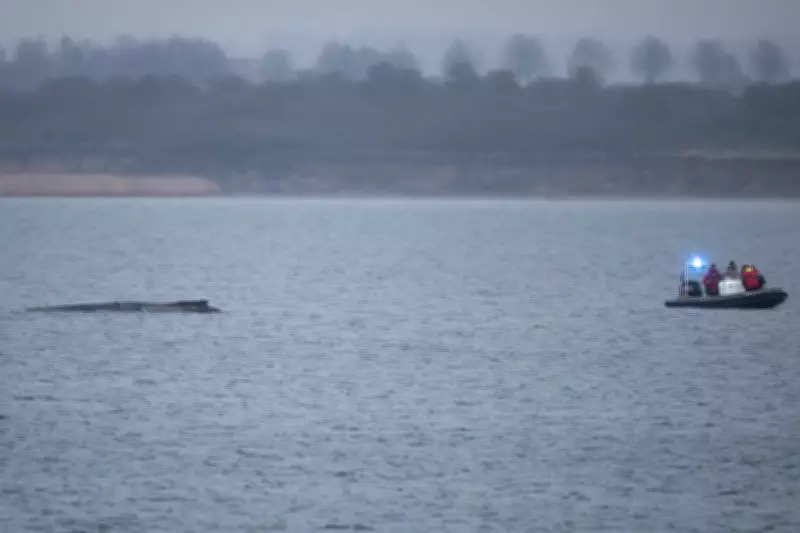
A humpback whale that became stranded in the shallow coastal waters of the Baltic Sea has successfully swum free once more, though marine experts caution that the animal still confronts an arduous journey ahead to reach its natural habitat.
Rescue Efforts and Initial Freedom
The whale, measuring between 12 and 15 meters in length, managed to free itself late on Monday from a location near the German port of Wismar, where it had been trapped since the weekend, according to regional officials. After initially heading toward the harbour, the whale turned and moved toward the open sea. By Tuesday morning, there were no further sightings of the animal, raising hopes that it is continuing its journey.
Previous Rescue Attempts
Last week, a concerted rescue operation was launched to free the whale from an underwater sandbank at Timmendorfer Strand, a nearby resort town. This effort eventually succeeded with the assistance of an excavator. However, the whale, which appeared exhausted, soon found itself in difficulty again, albeit in somewhat deeper water. Officials decided to allow the whale peace and quiet to regain its strength and swim away independently.

Public Fascination and Ongoing Challenges
The dramatic situation captivated the German public, with crowds gathering on shore to witness the events. Media outlets provided detailed updates and streamed live video from the scene. Despite the whale's newfound freedom, it remains far from its natural habitat and must navigate a significant challenge to find its way to the Atlantic Ocean through the North Sea.
Expert Insights and Future Prospects
Burkard Baschek, the scientific director of the Ocean Museum Germany and the scientific coordinator of the rescue effort, expressed cautious optimism in an interview with ZDF television. He stated, "The whale swimming free yesterday is a first very good sign, but the way to the North Sea is still long and we can only keep our fingers crossed that it makes it there."
Baschek explained that it would not be practical to attempt to escort the whale on its journey of several hundred kilometres, highlighting the whale's ability to dive. He added, "That means that in principle we can only hope that it will make it under its own steam."
Health Concerns and Tracking Limitations
No tracking device has been attached to the whale due to the poor condition of its skin, which has suffered from prolonged exposure to the relatively low salt concentration of the Baltic Sea. The whale was first observed swimming in the region on March 3, and it remains unclear why it ventured into the Baltic Sea. Some experts speculate that the animal may have lost its way while pursuing a shoal of herring or during migration.
The whale's journey to safety is far from over, and marine authorities continue to monitor the situation closely, hoping for a successful outcome as the animal navigates the challenging waters ahead.