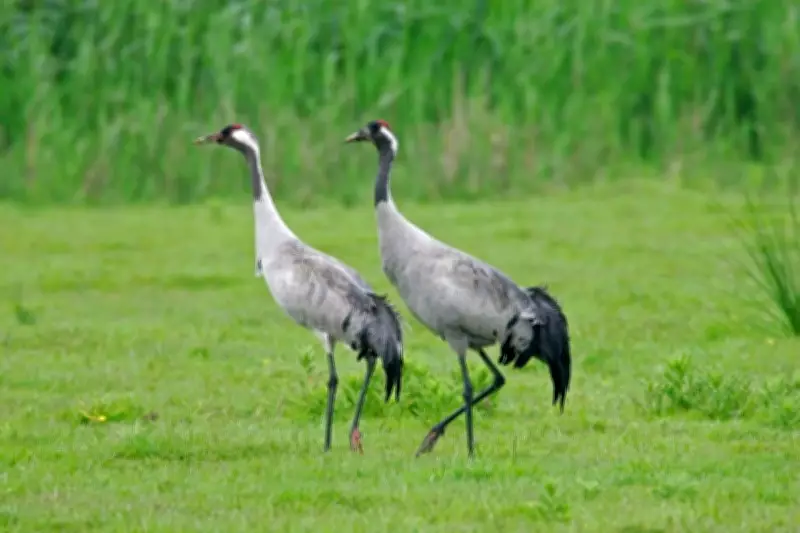
Record Crane Breeding Year in 2025 Marks UK Conservation Triumph
Conservationists have announced that cranes, the UK's tallest bird, experienced their best breeding year on record in 2025, with a remarkable 87 pairs raising 37 young. This achievement brings the total population across the country to approximately 250 adults and younger non-breeding birds, a significant milestone in the species' recovery from near extinction.
A Comeback from Extinction
Cranes vanished from the UK around 400 years ago, primarily due to over-hunting and the widespread loss of their preferred wetland habitats. However, a wild recolonisation from Europe began in the late 1970s, supported by dedicated conservation efforts. These include protecting existing wetlands, creating new habitats, and a concerted reintroduction scheme where conservationists dressed as cranes to hand-rear young birds, all contributing to the bird's dramatic resurgence.
Standing a metre tall with a two-metre wingspan, cranes are known for their complex courtship displays and loud bugling calls that can be heard from several miles away. Flocks of over 100 birds are now commonly observed in the Fens during winter, and their range has expanded as far as Scotland. In 2025, a record 10 pairs in Scotland fledged nine chicks, up from just six pairs the previous year.

Conservation Efforts and Habitat Restoration
The Royal Society for the Protection of Birds (RSPB) highlighted that cranes have benefited significantly from the efforts of individual landowners and conservation organisations. These groups have focused on protecting and restoring drained wetlands, which are crucial for rearing chicks. Historically, cranes were featured at royal banquets, with 115 reportedly served at Henry III's Christmas feast in 1251, underscoring their cultural significance.
Today, at least 80% of the breeding population resides on protected sites, with one-third found on RSPB reserves alone, such as West Sedgemoor in Somerset and Lakenheath Fen in Suffolk. The Great Crane Project, a partnership between the RSPB, Wildfowl and Wetlands Trust (WWT), and the Pensthorpe Conservation Trust, has been instrumental in boosting numbers. This initiative involved hatching, hand-rearing, and releasing cranes in the Somerset Levels and Moors, while also creating nesting habitats with the support of local farmers.
Expert Insights and Future Challenges
Dave Rogers, reserve manager at Lakenheath Fen, noted that cranes have thrived in the mix of young reeds and open water at the site, originally created for another rare bird, the bittern. As the reeds have matured, conservation teams now cut areas in winter to create landing spots and secluded nest sites in shallow water. Rogers emphasised that creating wetlands, minimising human disturbance, and managing habitats have made a tangible difference, alongside the removal of hunting pressure and population growth in Europe.
He told the Press Association, "We talk about the UK as being a very nature-depleted country, so getting something back as iconic as cranes shows we can change the fortunes of a landscape and a species. It's good for the soul to see something back in the UK that's been lost for 400 years, demonstrating that humans can reverse some of their impacts."
John Oliver, South East Lincolnshire warden for the Lincolnshire Wildlife Trust, reported that this year marks the seventh breeding season for cranes at the Willow Tree Fen reserve, with the population growing from one to four breeding pairs and over 50 individuals roosting there. He stated, "The recovery of cranes in the UK is a real conservation success. It demonstrates the resilience of nature and what can be achieved by working together. To reach a population of 250 is a phenomenal achievement, but we still have a way to go."
However, Martin McGill, reserve manager at WWT Slimbridge in Gloucestershire, issued a cautionary note. Despite the record breeding year, cranes remain vulnerable due to the increasing impacts of climate change on their habitats. He warned, "Their habitats are at risk from the ever-increasing impacts of climate change – making it more important than ever to come together across sectors, to protect and restore bigger, more connected wetlands, so this iconic bird can thrive long into the future."

This record-breaking year underscores the power of coordinated conservation action and offers hope for other endangered species in the UK.