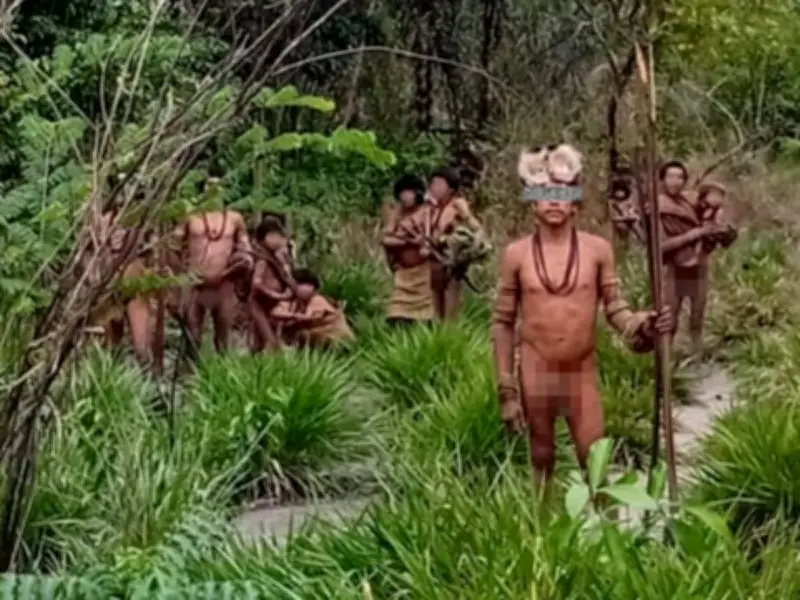
Around 20 members of the uncontacted Awá indigenous group emerged from the Amazon rainforest on Monday to meet with local government workers and request food, in an extremely rare encounter that has raised concerns for their safety.
The images, believed to have been taken near the village of Tawari in Maranhão State, Brazil, show the group asking for yams. The incident has prompted action by local government in the Arariboia Indigenous Territory, with authorities activating emergency plans to assess health risks for the group, 100 of whom are believed to have no contact with the outside world.
Pressure on the Awá Territory
According to Survival International, a UK-based charity that works to stop loggers, miners, and oil companies from destroying indigenous lands, the Awá people asked a team of government workers for yams.
Advocates for Indigenous rights say the moment highlights the human impact of loggers, hunters and ranchers and the grave risk it poses to previously uncontacted Indigenous groups, including Brazil's Awá.
Survival International's director, Caroline Pearce, says they released the images at the request of Guardians of the Amazon, a Brazilian-based group that works to protect indigenous people. She says: "The uncontacted Awa are under extreme pressure as intruders encroach from all sides of their territory, driving them into an ever-smaller island of the Amazon rainforest, surrounded by destruction."
Background of the Awá
Brazil's Awá live in northwestern Maranhão in northeastern Brazil. It is thought there are 350 members, 100 of whom have no contact with the outside world. They speak Guajá, a Tupi–Guaraní language, and it is thought that in the 1800s they adopted a nomadic lifestyle to escape the invasions of Europeans.
This week numerous charity organisations have stepped in to express concern and are working to preserve the privacy of the Awá.
Government and NGO Response
FUNAI, the National Indian Foundation, part of the Brazilian government, is reportedly reviewing footage on social media showing the Awá interacting with a local village. The Brazilian state is adhering to its policy of no contact with the group.
A separate organisation, known as COAPIMA, says the encounter shows the need for charities and governments to take responsible action to reduce the risk unplanned contact poses to isolated groups.
The main risk to the Awá and indigenous groups is exposure to diseases. In the 1980s around 40 per cent of the isolated Nukak tribe in Colombia died from diseases after they came into contact with outsiders.