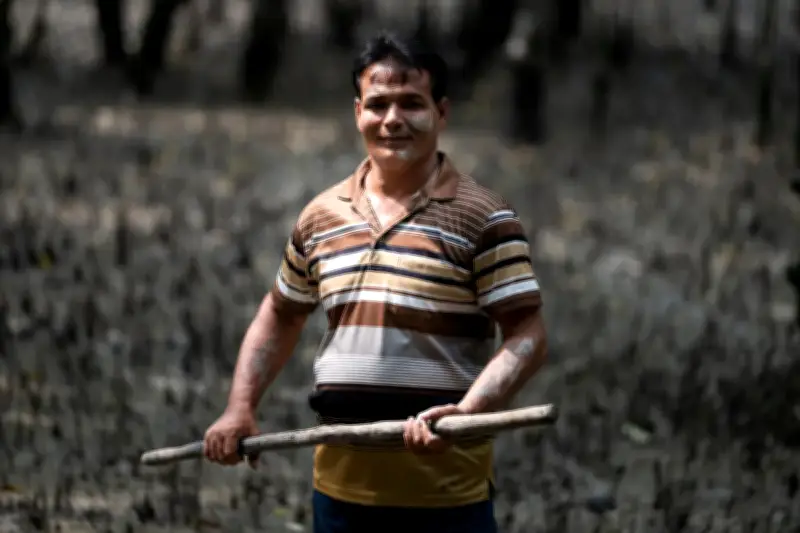
Abdul Goni Gazi, a 45-year-old from Bangladesh, has dedicated his life to promoting coexistence between humans and Bengal tigers in the Sundarbans. Known locally as "Goni Tiger," he uses non-lethal methods to save tigers and recover victims of attacks.
First Encounter With a Tiger
At 15, Gazi's life changed during a fishing trip with his brother in the Sundarbans, a vast mangrove forest across the tidal delta of Bangladesh and India. "We went to the riverbank to cut firewood for cooking," he says. "I was standing there holding the boat in place, while looking towards the bank."
Closing his eyes for a moment, he opened them to find a fully grown Bengal tiger stalking the brothers. "I quickly loosened the boat and moved out toward the middle of the river. My elder brother saw the tiger, dived into the river, swam toward the middle, and climbed into the boat. By then, I had fainted from fear."
His early terror turned to fascination, inspired by his father's stories. "I heard stories from my father about protecting people from tigers," he says. "From those stories, a passion for protecting tigers grew in me."
Saving Tigers and Recovering Bodies
Gazi's work began around 2007 when a tiger killed two people in Satkhira, Bangladesh. He accompanied the Forest Tiger Response Team to recover bodies, during which two workers were killed and another severely injured. Despite this, he continued, later providing unofficial support to Wild Team before being offered a role.
He estimates he has helped save 36 tigers and recovered the bodies of 106 attack victims. His methods are low-tech and non-lethal. "If the tiger becomes aggressive in a neighbourhood, we pretend to be aggressive back," he says. "When it roars, we roar back. Because the tiger thinks us scary now, it leaves the neighbourhood, or the individual. And so it survives."
By 2019, funding for Wild Team had dried up, so Gazi created a 21-person crew, mostly volunteers, that he trains himself. "And we rescue everything: tigers, snakes ... everything."
The Danger Remains Real
Gazi describes recovering the body of a man called Nab Dada, walking miles through a dry canal following blood and signs left by the tiger. Finding the body, the tiger was still nearby. "Although we couldn't see it, we could hear it," he says.
As he lifted the body, his friend Shahin warned, "'Goni, there is a tiger behind you.' I turned around and saw the tiger," Gazi recalls. "I became very frightened, but I shouted and looked directly into the tiger's eyes. I used my stick to frighten it." The tiger roared, but Gazi and his team stood their ground, and the big cat gave up. "As we were walking back, the tiger came after us two or three times. Each time, we drove it away again and continued carrying the body."
"The force of a tiger's roar and its appearance when you are standing there facing it is something extremely difficult. It is very, very difficult to describe in words."
Changing Attitudes in the Community
Tiger numbers in Bangladesh were estimated at 106 in 2015, 114 in 2018, and 125 in the 2024 census. Habitat loss, poaching, and climate breakdown remain significant concerns, with rising sea levels, stronger storms, and greater salinity degrading land, while human development pushes people further into tiger habitat.
Gazi believes his work has helped change local attitudes. "At one time, the people in my area wanted there to be no more tigers," he says. "But I wanted the tigers to survive. When a tiger comes from the Sundarbans into our villages, the people in my community now also help send it back into the Sundarbans instead of killing it."
The shift has not come without resistance. "In trying to save tigers, I have been insulted many times and I have even been beaten," he says. "Even so, my goal is to save them. This is work that I have to do for my country. Wildlife belongs to every one of us."
"If the tiger survives, the Sundarbans survives," he says. "If the Sundarbans survives, the people of the world survive."