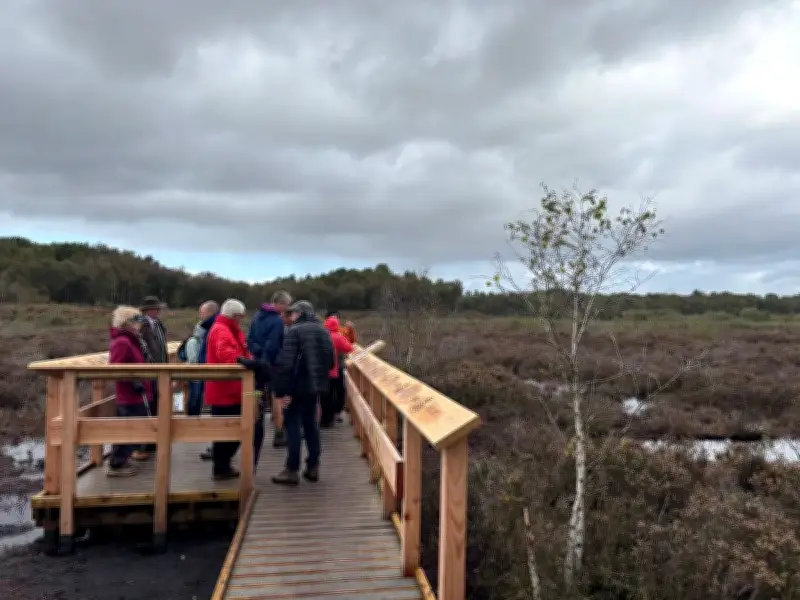
A new boardwalk and viewing platform at Lindow Moss near Wilmslow, built by volunteers and restoration specialists, now brings visitors closer to the site where Lindow Man was discovered in 1984. The feature, nicknamed the “Lindow Lookout,” includes an oak-etched timeline and interpretation boards explaining the discovery and the landscape's history.
A landscape of national significance
Lindow Moss is the site of one of Britain's most famous archaeological discoveries. The remarkably preserved remains known as Lindow Man were found there in 1984, making the site one of the country's most significant archaeological locations. Radiocarbon dating placed the man's death in the late Iron Age or early Roman period, and his remains are now held at the British Museum.
Professor John Handley, closely involved in the project, described the landscape as having a character that sets it apart from other peat bogs. “Peat bogs are often talked about as being typically rather dull places, dull black expanses,” he said. “But this one is completely different. It’s got this sense of enclosure, this sense of mystery.”
Years of planning and restoration
Behind the boardwalk lies years of planning and environmental restoration. Brian Donohue, chair of the Lindow Moss Landscape Partnership, explained that a neighbourhood plan identified opportunities to end peat extraction, restore the water table, improve wildlife habitats, and better explain the landscape's history. In 2018, Croghan Peat was granted planning consent to build 14 houses on the peat-processing site, conditional upon restoring the remaining area to a raised bog habitat.
The restoration work involves blocking drains, creating peat dams and bunds to slow water leaving the site, and managing trees that draw moisture away from the bog. Martin Cooper, who oversees much of the practical hydrological work, described the process as highly specialised and painstaking. “It’s monumentally frustrating, but kind of very rewarding when it happens,” he said.
Community involvement and future plans
The Friends of Lindow Moss group and Transition Wilmslow volunteers have helped organise bat walks, moth-trapping events, and wildlife surveys. School visits and community activities have introduced younger residents to the site, while oral histories have been gathered from people who have lived in the area for much of their lives. “Everyone’s got a different story. Everyone remembers it differently. Everyone’s got some childhood story of it,” one volunteer reflected.
In 2024, the project received a £250,000 grant from the National Lottery Heritage Fund, with work supported by the funding beginning in 2025. Two routes help people explore the wider area: the 3.5-mile Heritage Trail and the 7.5-mile Lindow Moss Loop. Both begin and end at Lindow Common. There are no visitor facilities on site and parking is limited, so visitors should plan ahead. Dogs should be kept on leads.
The new “Lindow Lookout” is a visible result of years of planning, community involvement, and restoration work. Peatland vegetation cannot recover overnight, and the success of the restoration will be measured over years through changes in water levels, habitats, and wildlife. The boardwalk gives visitors a chance to see what has already been achieved and understand the work still to come.