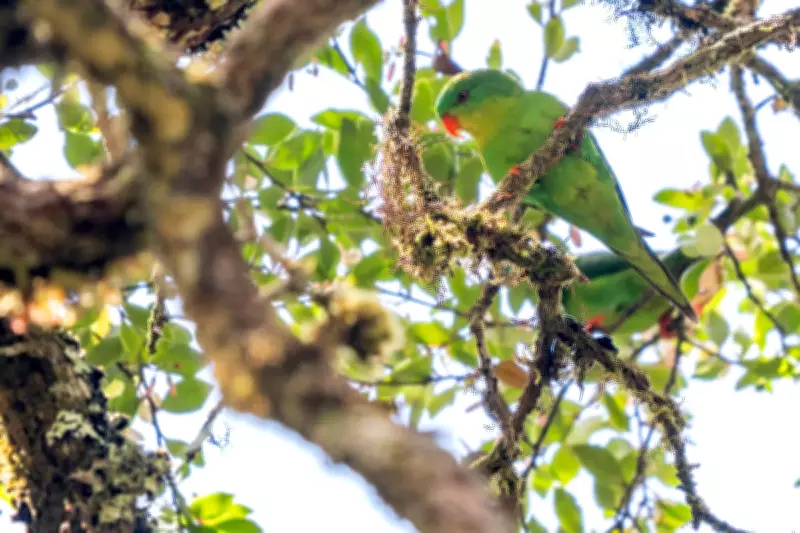
One of Indonesia's most elusive birds, the blue-fronted lorikeet, has been dramatically rediscovered on the remote island of Buru after a century of near-total obscurity. Known previously from a single 2014 photographic record and a handful of museum specimens, the dazzlingly colourful parrot was feared lost until a flash of green feathers high on Buru's highest peak confirmed its continued existence.
Expedition Success
The small bird, endemic to Buru and found nowhere else on the planet, was spotted in April during a challenging expedition led by an Indonesian mountaineering group. The team not only captured the first pictures of the lorikeet in 12 years but also made the inaugural sound recordings of its distinctive high-pitched calls, which birds use to maintain contact within the dense forest canopy. Its bright green body, orange bill, blue hindcrown, and pointed tail were key to its identification.
The expedition specifically sought out this species despite slim odds of success. "When you are looking for a bird that's only been documented once in the past century it feels like a long shot," remarked John Mittermeier, director of the Search for Lost Birds at the American Bird Conservancy group.

Historical Background
First described from seven specimens collected in the 1920s, the blue-fronted lorikeet remained one of Indonesia's enduring avian mysteries, going unrecorded for nearly 90 years despite extensive searches in lower and mid-elevation forests, before its brief reappearance in 2014. A long-held suspicion suggested the parrot might not be gone but rather residing at higher altitudes than previous search efforts had reached. The highland landscape where the lorikeet was ultimately found had remained largely inaccessible until local climbers recently mapped a way into the mountains.
Mr Mittermeier highlighted the extreme difficulty of the terrain, citing "steep limestone terrain, cliffs, sharp boulders and no water" as major obstacles. He confirmed the certainty of their find. "There are no other birds on the island that look like the lorikeets, so when we saw them we knew immediately what they were." The team observed at least nine individuals during the trip.
Challenging Conditions
James Eaton, a birder involved in the expedition, described the gruelling conditions, including "rain, jagged limestone, river torrents and lack of trails", which meant that anyone attempting to reach the peak needed "a strong, or crazy, reason to even attempt it". For them, "this bird was our reason for doing so".
The moment of discovery, after a week of hardship, was profound. "To actually photograph our holy grail suddenly made all the hardships disappear," he recalled, "it's a feeling adrenaline junkies would know well."
He said that years of preparation felt "totally justified". "It makes you feel alive, a justification for your dedication."
Conservation Implications
The blue-fronted lorikeet is currently listed as data deficient by the IUCN Red List. It was recognised in 2024 as a lost species by the Search for Lost Birds. Mr Mittermeier stressed that further work was essential to determine the bird's population size and potential threats, noting that a finding like this was "the first step to being able to protect it".
For Mr Eaton, the rediscovery provided a powerful reminder of the natural world's hidden wonders. Amidst a constant stream of negative news, he reflected, "these moments of joy and discovery are a healthy reminder of what a beautiful world is there". "This small green parrot," he said, "was here long before humans stepped foot on the island, just like birds living in your garden at home. They have more right to be there than you or I."