
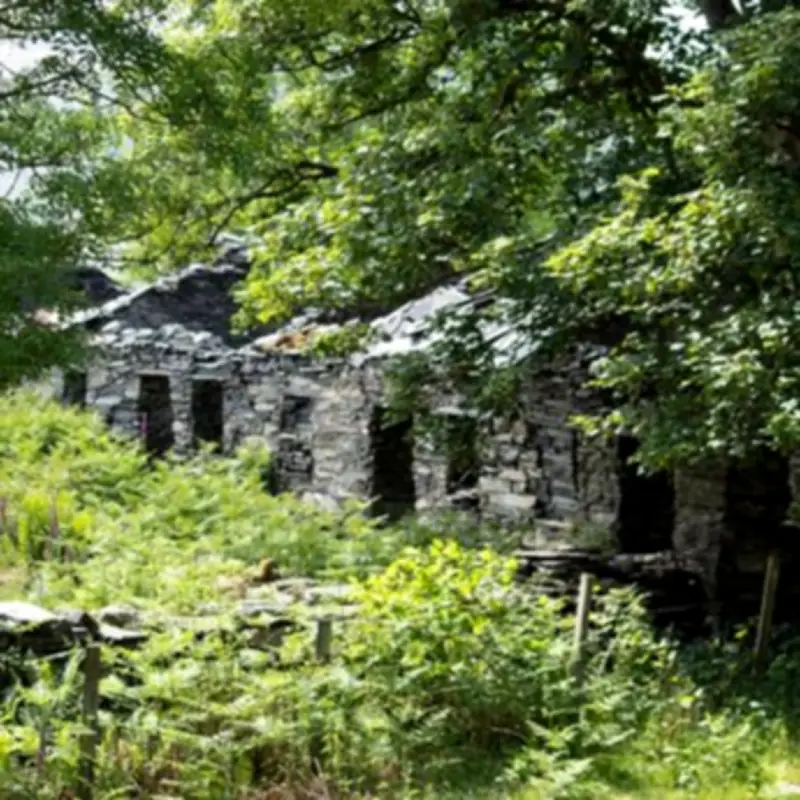
An entire community was uprooted after its 2,000 residents were compelled to relocate. All that remains of the once-thriving settlement are buildings completely overtaken by greenery and almost wholly engulfed in moss and undergrowth.
The Rise and Fall of Talysarn
The abandoned village of Talysarn, situated in Gwynedd's Nantlle Valley in North Wales, is a former community swallowed by the natural world as decades rolled by. It once accommodated workers and industrial premises supporting the neighbouring slate enterprise, Dorothea Quarry.
Throughout the 19th century, these quarries offered work for thousands of people across Wales, but as the excavations grew larger, the community needed to expand with them. As a result, when 1927 came around, officials chose to move thousands of residents to an entirely new settlement.
Dorothea Quarry's Expansion
By the 1840s, production at Dorothea had reached a remarkable 5,000 tonnes each year, though that number would soon climb much higher. By the 1870s, output had surpassed 17,000 tonnes, marking more than three times the amount recorded 30 years before.
While the quarry's future looked bright, it battled serious water problems. This became clear in 1884 when multiple workers perished after the site became flooded while they were working there, reports North Wales Live.
Subsequently, the waterway was rerouted and excavated to control the current, and while it addressed the pressing issues, it sparked complications downstream. To tackle the predicament, a Cornish beam engine was erected on site to replace the waterwheels, and it stands there still today.
This certainly represents one of the deserted settlement's most striking attractions - a colossal structure with its original equipment still preserved.
Plas Talysarn Manor
Another centrepiece of the former community is its 18th-century manor house, left undisturbed since 1946, which now exists as an ivy-clad edifice, heavily covered in graffiti and deteriorating masonry.
The forsaken village in its entirety has become a major magnet for keen adventurers and hikers looking to discover its concealed mysteries and snap haunting images of the overgrown remains. Presently, the location lies within the UNESCO Slate Landscape of Northwest Wales and is protected as a historical fragment, suspended in time.
Wild Guide Wales writer Daniel Start recorded what endures of the spot, likening the remnants to a Welsh Angkor Wat. He remarked: "Only the baboons are missing. It's a vast, wild site with many fascinating, overgrown ruins, including a Cornish beam engine and the overgrown remains of the chapel at Plas Talysarn."
The Quarry's Legacy
The quarry finally shut down in 1970 and has since become flooded, forming a lake that reportedly plunges to depths of over 100m in some spots. This also makes up part of the Slate Landscape of Northwest Wales World Heritage Site.
Amongst those captivated by the village's ruins is photographer Tony Harnett, who runs the website Gems of Snowdonia. He previously told WalesOnline: "I'd seen photos of Plas Talysarn and knew it was an interesting place, but I thought that's all there was.
"When I went there, I did not expect to find so many other old buildings in the area. Some I just stumbled across, others I could see in the distance but didn't have time to visit.
"I arrived late in the day, for the golden hour for photography, so I only had two hours there. But I could easily have stayed for the whole day, there's so much to explore."




