The 2026 World Cup has become a rebuke to Trump's homogeneous vision of America, revealing a tournament – and a US team – shaped by migration and diversity. Following the Department of Homeland Security on social media is a bit like wandering through a casino at 4am. Sooner or later, you’ll see something that makes you go: How did we get here?
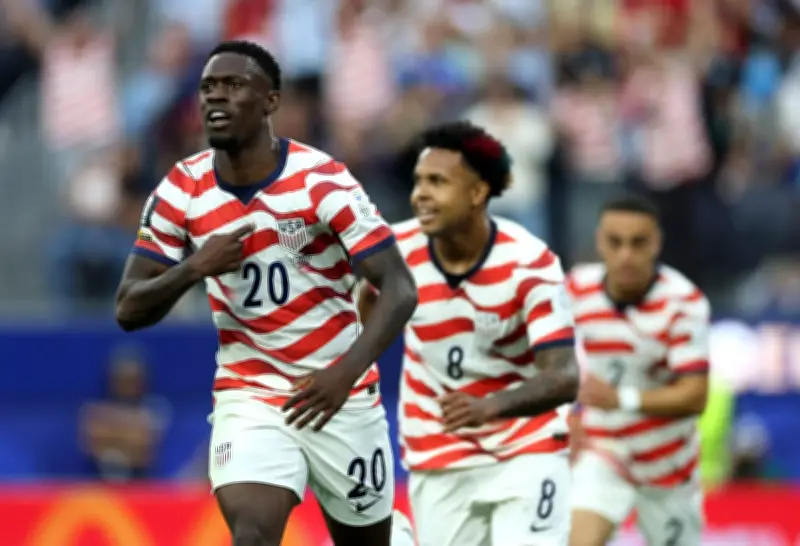
There was one of those moments earlier this month. Days after the US opened their World Cup campaign with a 4-1 romp over Paraguay, DHS marked the occasion by posting an image of Chris Richards, Sergiño Dest and Folarin Balogun exulting beneath the headline “DEFEND THE HOMELAND” and the caption “OUR SOIL”.
The irony of the message – posted on the emancipation holiday Juneteenth, of all days – was unmissable. The same department that turned back a leading referee from Somalia, that has kept Iran’s players on a day-to-day visa footing in this tournament, that has in effect tried to sabotage the conditions under which this World Cup takes place, now finds itself reveling in it.
Diversity at the Core of the USMNT
The same administration that is currently mounting a hare-brained challenge to the 14th Amendment in the Supreme Court is making American exemplars of Dest, a Netherlands-born Brooklynite; Richards, a military brat raised in Europe; and Balogun, the British Nigerian who owes his American passport to birthright citizenship. Indeed, World Cup fever appears to have overcome the Make America Great Again crowd. It can only end in disappointment.
That’s not a knock on the USMNT, who, despite a 3–2 loss to Turkey on Thursday, have advanced to play Bosnia and Herzegovina in a last-32 matchup next Wednesday. It’s to say that Americans who loudly dismiss soccer as a “sissy sport” real sports fans couldn’t care less about, and then jump on the bandwagon when momentum shifts, have long had the wrong idea about the World Cup. To them, the tournament is simply another arena to project an image of American strength. What they struggle to appreciate is that the same tournament that presents itself as a contest between monolithic nation-states is, in truth, a monument to global migration.
A Global Tournament Reflecting Migration
It isn’t just the USMNT who resist the jingoistic framing. The Netherlands’ nine goals in the tournament so far have been scored or assisted by players of African or Indonesian descent. Belgium’s roster is stuffed with sons of Congolese, Senegalese and Ghanaian immigrants who face racist abuse whenever they thwart expectations. The face of Spain’s national team is Lamine Yamal – a ridiculously gifted teenager who proudly touts his Moroccan and Equatoguinean ancestry, and is hardly an outlier in an increasingly global squad. France, despite pushback from extremist corners, have tripled down on the Black-Blanc-Beur experiment that netted World Cup triumphs for Les Bleus in 1998 and 2018.
A good portion of England’s players, it seems, could have opted to play for Ireland or countries in Africa or the Caribbean. That depth, in turn, is part of what allowed the USMNT to land a fine young striker in Balogun – who was born in New York and bypassed US residency and the grassroots soccer pipeline on his way to becoming the team’s leading scorer at this tournament.
Diaspora Power and Fan Diversity
If anything, the USMNT’s commanding start pales in comparison to the real story of the tournament: the power of the diaspora. During England’s match with Ghana, fans on social media said the quiet part out loud – that no game between colonizer and former colony can ever be “just a game”. Morocco, South Africa, Côte d’Ivoire, Cape Verde (!) and possibly Senegal advancing to the round of 32 is yet more confirmation of the extraordinary talent flowing from Africa into Europe’s top leagues.
Even DHS policies that have restricted travel to the US for the World Cup have ended up revealing the rich diversity already within its borders: Haitian, Congolese and Cape Verdean fans overwhelming stadiums in Philadelphia, Houston and Miami, flags flying proudly in the stands. I was minding my business in downtown Atlanta on Wednesday when I ran into a horde of Morocco fans pregaming before their match against Haiti – and judging from their numbers and the sprinkling of American accents, there was no chance all of them crossed the Atlantic for the occasion.
Soccer as a Unifier
The same countries that see immigration as an existential threat are bearing witness to a World Cup that makes the opposite plain – underscoring not only the short-sightedness of exclusionary political movements, but the dereliction of leadership within Fifa itself. If the governing body wasn’t so busy kowtowing to authoritarian regimes and fleecing workaday fans, it could be the greatest force for global good since, well, the advent of international flight.
This tournament has proven that soccer, when politics and cultural posturing are set aside, can indeed be the great unifier – turning Japanese fans on to the wonders of chips and salsa, sparking a bromance between the people of Scotland and the city of Boston, and keeping Brazil’s supporter mob in a mood to party with New York Knicks fans. It’s kept the nation’s big box stores and fast food joints humming. At an Oakland watch party for Cape Verde, Jill Tucker – who taught English in the country as a Peace Corps volunteer – was stunned to find one of her old students among the cheering section. Together, the connections are a stark reminder that sharing a flag doesn’t mean sharing a worldview, least of all one imposed from on high.
Historical Context of US Soccer Diversity
Therein lies the frustration for this administration: even as it seeks to rewrite the rules on who can and can’t be an American, diversity remains inseparable from national identity. In a country that owes so much of its cultural and economic strength to diversity, equity and inclusion – from Einstein to Oprah – soccer is no different. European and Latin-American newcomers established the game in industrial hubs and mill towns in the US midwest and southeast. Sustained immigration over the better part of a century turned soccer into a national pastime – one with staggering participation, impressive TV ratings and seemingly limitless potential for growth. The fact that US viewership for this year’s World Cup is as robust on Telemundo as it is on Fox speaks to the millions of American soccer fans who have long been comfortable following the game in Spanish.
The USMNT has spent decades trying to build rosters around talents who were as much of the world as they were American. David Regis, a French-born defender who played professionally in Germany and spoke little English, was fast-tracked into the USMNT’s 1998 World Cup squad after marrying a US citizen and obtaining expedited citizenship. For much of the early part of the century, the great American soccer hope was Freddie Adu – a Ghana-born son of a green card lottery winner who became the youngest player to appear for the USMNT in a senior international match. Mauricio Pochettino, the Russell Crowe doppelgänger leading the US by way of Argentina and European football, is the latest in a long line of worldly USMNT managers that span from Scotland’s Robert Millar, the head man for the US’s landmark third-place finish in the 1930 World Cup; to German soccer institution Jürgen Klinsmann, who shaped his World Cup roster in 2014 around American military brats.
When the US beat Australia 2–0 last week, among the heroes was Alex Freeman – a 21-year-old who might well have ended up in American football if soccer weren’t so entrenched. (His father, Antonio Freeman, was a standout NFL receiver and Super Bowl champion with the Green Bay Packers.) That a Black man named Freeman could score a World Cup goal for his country on Juneteenth weekend was not an anomaly in a country that retreats from diversity. It was, in its own way, inevitable.
The World Cup's True Message
Soon enough, the World Cup will leave our shores, and American sports fans will go back to obsessing over the NFL season and baseball’s playoff push – not before the US president closes the show by inserting himself into the spectacle. But that’s as much on brand for Donald Trump as it is consistent with history. From the beginning, the World Cup has been particularly susceptible to being repurposed as a grand platform for jingoistic mythmaking, often at the hands of authoritarian regimes that understood its symbolic power all too well. But the DHS posts have had the opposite effect – revealing the lie of American homogeneity and delineating the gulf between the government’s framing and lived reality.
If nothing else, the current North American World Cup has made this much clear: the world shows up not to affirm borders, but to dissolve them. The flags are mere mileposts pointing back to how we got here and ahead to where we may go next – another place where “our soil” is little more than an elaborate construct.