
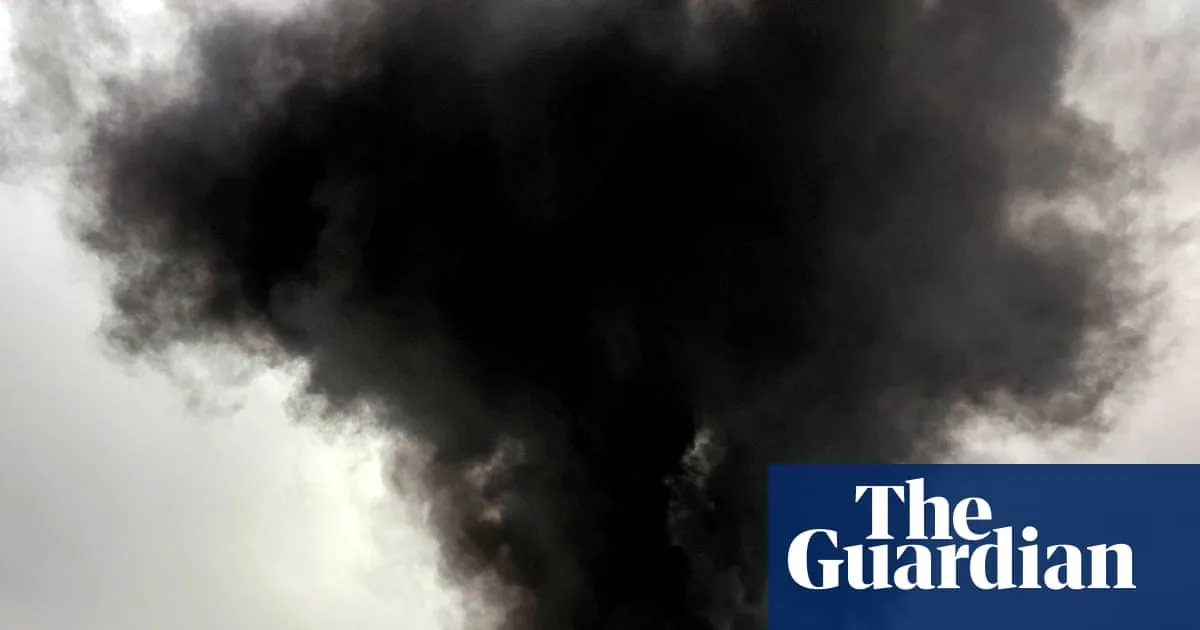
The military conflict between the US and Israel against Iran has generated an estimated 5 million tonnes of greenhouse gas emissions in just 14 days, according to a new analysis shared exclusively with the Guardian. This amounts to more than the combined annual emissions of 84 low-emitting countries, draining the global carbon budget at an alarming rate.
The analysis breaks down the emissions into several categories. Destroyed civilian buildings account for the largest share, at 2.4 million tonnes of CO2 equivalent (tCO2e), based on Iranian Red Crescent reports of 20,000 structures damaged. Fuel consumption from long-range bomber missions, including flights from the west of England, contributed 529,000 tCO2e. Massive oil fires—such as those from Israeli strikes on fuel depots near Tehran—released an estimated 1.88 million tCO2e. Destroyed military hardware (172,000 tCO2e) and munitions (55,000 tCO2e) complete the total.
“Every missile strike is another downpayment on a hotter, more unstable planet,” said Patrick Bigger, research director at the Climate and Community Institute and co-author of the study. Fred Otu-Larbi, lead author from the University of Energy and Natural Resources in Ghana, warned: “We expect emissions to increase rapidly as the conflict proceeds… Burning up the annual emissions of Iceland in two weeks is something we really cannot afford.”
The global carbon budget for a 50% chance of limiting warming to 1.5°C stands at 130 billion tonnes of CO2, which at current rates will be exhausted by 2028. Bigger cautioned that the war’s disruption to fossil fuel supplies may trigger a surge in new drilling, mirroring historical patterns following US-led energy shocks.




