
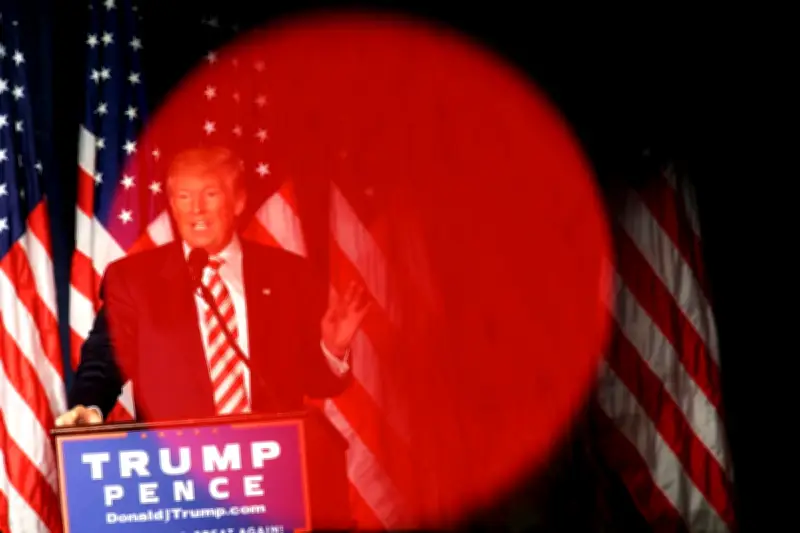
Donald Trump, shaped by the cold war of his childhood, has revived anti-communist rhetoric in a series of high-profile addresses in 2025, warning of a 'communist menace' in the United States. Speaking at Mount Rushmore on July 3, he vowed to 'vanquish communists quickly' and 'send them into exile,' drawing on fears that defined his early years.
Trump was born three months after Winston Churchill's 1946 'iron curtain' speech in Fulton, Missouri, which inaugurated the cold war. The ensuing red scare, fueled by Senator Joseph McCarthy, led to executions of convicted spies like Julius and Ethel Rosenberg. Roy Cohn, McCarthy's chief counsel who prosecuted the Rosenbergs, later became Trump's mentor in real estate.
State Department Report Fuels Rhetoric
A new 100-page State Department report titled 'Cuba: the Capital of 21st Century Communism' echoes Trump's warnings. It claims the Cuban regime has 'waged a sustained campaign of subversion against the United States' and that 'the highest reaches of the U.S. government have been infiltrated.' The report says the network maintains ties to 'powerful leftist nonprofits, anti-ICE collectives, socialist groups, and Marxist militant organizations.'
The anti-communist push gains traction after recent Democratic primary wins by candidates endorsed by the Democratic Socialists of America (DSA), including Darializa Avila Chevalier, who ousted New York representative Adriano Espaillat in June. Chevalier faced scrutiny over a now-deleted Twitter account praising Marxist ideology and figures like Vladimir Lenin.
Critics Dismiss 'Communist' Label as Outdated
Historian Ruth Ben-Ghiat called the new party line 'not subtle,' associating communists with every crime to justify a rightwing crackdown. Alexandria Ocasio-Cortez, a DSA member, called the communist label 'very silly,' noting that other developed countries have better systems at lower cost.
Cara Tobe, a DSA spokesperson, said the organization's members range in political beliefs but are united under democratic socialism. She expressed concern about Trump wanting to send opponents into exile but noted that 'socialism beats fascism.'
Experts Debate the Threat
Harvey Klehr, an emeritus professor at Emory University, said the DSA has a 'very significant communist component.' He noted that a provision excluding democratic centralists was repealed, allowing an influx of radical members, akin to the Trotskyite entryism in Britain's Labour party in the early 1980s. 'A significant number of people who unapologetically call themselves Marxist-Leninists or communists have moved into DSA and attained some significant positions,' Klehr said.
Bill Galston, a Brookings fellow and former White House adviser under Bill Clinton, questioned whether Trump's 'communist' tag resonates beyond his Maga base. He cited a recent Economist/YouGov poll: 18% of voters called communism a 'major threat,' 25% a 'minor threat,' and 33% said it was 'not a threat.' Galston said Trump is 'preaching to the choir' of older Americans who remember the cold war, part of a base mobilization strategy.
Galston also attributed the resurgence to an American failure to distinguish political terms. Klehr argued the trend signals a broader threat to democracy from both extreme left and far right, similar to rightwing extremists entering the Republican party. 'The memory of communism is fading,' Klehr said, 'and yet some of the things they call for, it's like they've forgotten the history.'




