Hundreds of trees are being planted at Loch Katrine in rural Stirling as part of a major restoration scheme. The planting programme will see more than 4,000 hectares of trees across the catchment by 2040, helping to protect the water supply for over a million people in Glasgow.
Project progress and scale
Two years on from the kick-off of delivery, the project is already taking shape as around 600 hectares of native woodland are regenerating on the hills above the loch. This took place alongside 100 hectares of new tree planting and the installation of more than 25km of deer and seed island fencing. Over a million new trees are expected to be growing at Loch Katrine by 2030 as work progresses.
Contribution to the Great Trossachs Forest
The site also makes an active contribution to the Great Trossachs Forest – an initiative driven by Forestry and Land Scotland (FLS), Woodland Trust Scotland, Loch Lomond and the Trossachs National Park Authority and the Royal Society for the Protection of Birds (RSPB). This will see a rich and diverse mosaic of habitats full of wildlife stretching 16,500 hectares from Callander in the east to the shores of Loch Lomond in the west.
Peatland restoration
Alongside the woodland creation project, over 200 hectares of peatland has also been restored to further bolster the resilience of the catchment, with further phases to come.
Expert quotes
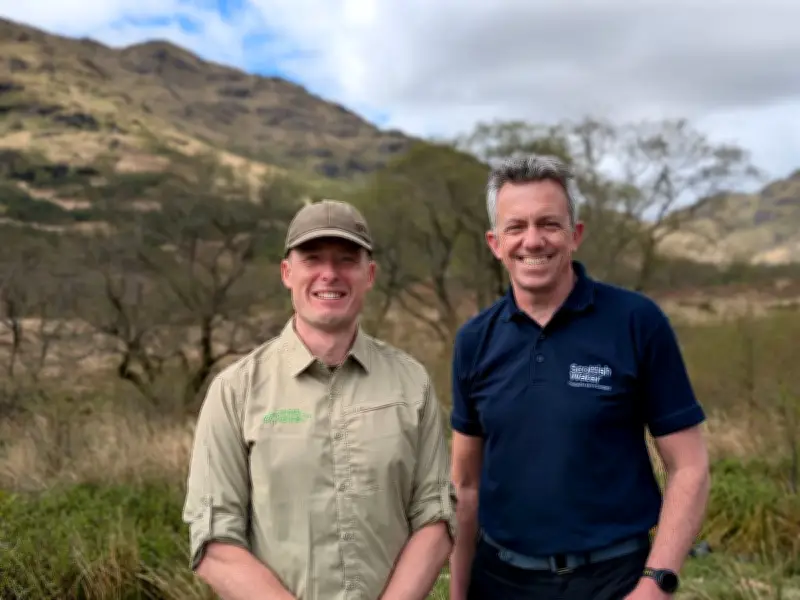
Dr Mark Williams, Scottish Water’s Head of Sustainability and Climate Change, said: “We are increasingly looking at nature-based solutions as a vital asset in protecting our water sources and adapting to future environmental challenges. The woodland creation and natural regeneration work at Loch Katrine are key to helping stabilise the landscape, protect soils and allow nature to take its course. Along with our work on peatland restoration, this is making the catchment more resilient to climate change.”
James Hand, Operations Forester at Forestry and Land Scotland, added: “We’re seeing natural regeneration already beginning to spread from existing native seed sources along the loch shore, although this process takes time. Using locally sourced species is key to long-term resilience, and our approach combines larger deer-fenced planting areas with smaller ‘seed islands’ to encourage woodland to establish and spread naturally. Managing grazing pressure is critical. By reducing deer populations and protecting key areas, we’re enabling woodland to recover gradually while also safeguarding important habitats and species.”