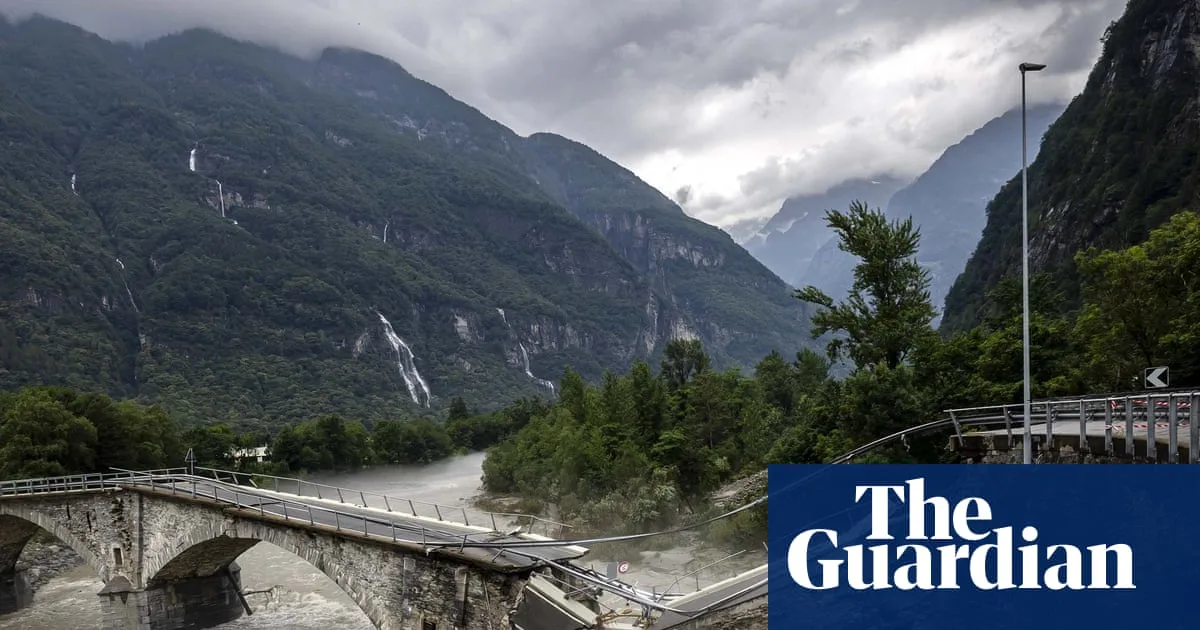
On a small ledge in the Swiss mountains, 200 people were enjoying a summer football tournament. As night fell, they had no idea what was coming. In the wake of a natural disaster, certain metrics are used to categorise the event: the buildings destroyed; the cost of repair to the nearest million; a single number for the loss of human life. Yet these figures obscure the truth of such events. They make the outcome seem fixed, somehow proportionate. But disasters are chaotic. Their extreme violence magnifies the consequences of every decision: to stay or to move; to run or to hide. Things could have turned out another way. And how would we talk about them then?
In Locarno, Switzerland, on the northern shore of Lake Maggiore, lies the mouth of the Maggia river. Follow it north-west and it winds past sandy, tree-shaded beaches, through rocky gorges and into a broad, glacial valley where, for much of the year, long waterfalls drop down forested mountainsides. Just over 20 kilometres upstream, at the foot of the Pizzo di Brünesc mountain, the river splits in two. This is the upper Maggia valley. To the west runs Val Bavona, with its historic villages of stone-roofed houses. To the east, equally steep and green, is Val Lavizzara. And in the upper reaches of Val Lavizzara, at an altitude of 1,000 metres, is Campo Draione.
Campo Draione might be the most beautiful football pitch on Earth – or, at least, in Switzerland. It fills a thin shelf of land above a mountain stream, curtained from the road by forest and surrounded on all sides by peaks blanketed with pines. It was laid in the 1950s, on rubble from nearby hydroelectric projects, and since 1970, for one weekend every year, it hosts one of the most popular events in the Maggia valley: a two-day, eight-a-side football tournament of 18 teams from across the canton of Ticino.
Most years, the tournament is on the first weekend in July, but in 2024, it was brought forward, to avoid clashing with a fireworks event in Locarno. So it was on 29 June, a warm Saturday morning, that hundreds of people gathered on and around Campo Draione. There was a family atmosphere; those who weren’t competing were eating ice-cream, buying drinks in a marquee, or swimming in the stream at Piano di Peccia, a village 10 minutes’ walk away, across a narrow car bridge over a deep, green gully.
The highlight would take place that evening: a party under the stars with an outdoor stage and lighting rig, three bands and a DJ, stretching into the early hours, when revellers would drift off to tents set up along the edges of the pitch or in farmland nearby. But that morning, the lead organiser of the event, Daniele Rotanzi, kept looking at his phone. The app for MeteoSwiss, the federal weather office, was forecasting a level 3 storm warning – a “significant hazard” – for the canton. “There was certain to be rain,” remembers Rotanzi, an athletic man who looks younger than his 40 years. He consulted the tournament’s 10-person organising committee – all volunteers – and they decided to build a makeshift stage inside the marquee: a 50cm-high wooden platform. Less glamorous, but sensible, they felt, given the situation.