
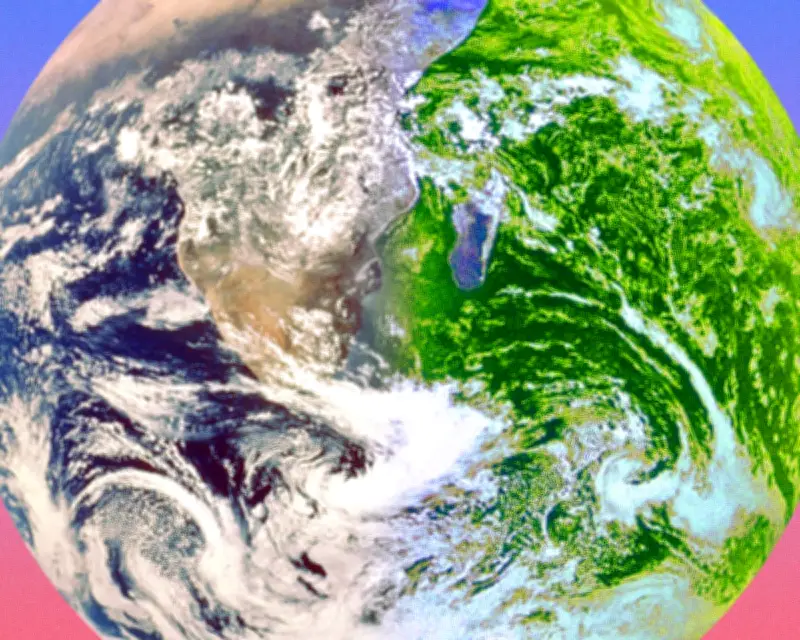
Sarah Wilson’s new book, I Eat the Stars, contains a largely blank page intended as a reprieve—a neutral space for readers to stare at while their feelings catch up. It is a necessary pause in a work that argues the world is in collapse and that it is too late to avoid the worst.
Wilson, an Australian journalist known for bestselling books on quitting sugar, anxiety and the climate crisis, contends we are hurtling toward the same end as ancient Rome and the Mayan civilisation. The collapse is not just about climate but about civilisation buckling under the weight of its own complexity, with worsening inequality, political polarisation, falling fertility, resource shortages and global conflicts.
What collapse means
Wilson describes the present as a liminal moment—the present setup cannot hold, but what comes next is unknown. She compares it to the top of a sharp bell curve, just before the tip downward. Population, wealth and oil prices that have risen steadily are about to dip.
While terrifying, Wilson sees this as a moment of stunning possibility. Historical transitions, such as the Axial Age, produced Judaism, Buddhism, Confucianism, the market system and great art. She argues that uncertainty is the main characteristic; no one can predict when or how collapse will happen. For those alive, things will not keep improving. Life will become extremely uncomfortable over the coming decades.
Why care about the future
Wilson wrote the book because she sees an opportunity: what is collapsing is the post-industrial, colonialist, extractivist, growth-based system. If we distance ourselves from that system and refuse to take part in its worst excesses, we have a better chance. She notes that the ultra-rich and tech bros will take everything anyway, and when the market collapses, revolution may follow.
To avoid turning on each other, Wilson explains complex systems concepts to show there is no cabal of bad dudes plotting. She says people are relieved to hear the reality spelled out brutally. The response has been relief, she says, because once absorbed, people want to understand more.
Practical steps and hope
Wilson has no hope that recycling or returning to the old ways will fix everything, but she has hope that natural systems will force us to be our best selves. She sees collapse as a correction: we took individualism too far, capitalism no longer serves us, and nature will recalibrate. In the process, we are forced to return to what makes us human—art, poetry, messiness.
She advocates fighting for democracy and protest rights, as researchers have found that levels of inequality and polarisation determine the speed and likelihood of collapse. On an individual level, she suggests simplifying life, making consumer choices with minimal trade routes, and going analogue—learning skills like riding a bike or using a compass. She notes that people in Europe have been advised to put together survival kits for heatwaves or war.
Wilson discourages prepper-style individualism, saying if things get that bad, you would need to defend stockpiles with weapons. Instead, she urges collectivism: forming organically grown communities of roughly 20 to 30 families. Studies show that less than 5% of intentional communities last longer than five years, but strong bonds where you already live—joining food co-ops, sharing tools—are effective.
The book’s title comes from a poem by astronomer Rebecca Elson, written as an antidote to fear of death. Wilson says once you are pushed up against the prospect of ending, you want to max the hell out of life. Neoliberalism taught us to save and retire, but this puts a bomb under that. She advises living beautifully regardless, because we are still allowed to have a beautiful life—in fact, there is an imperative now.




