
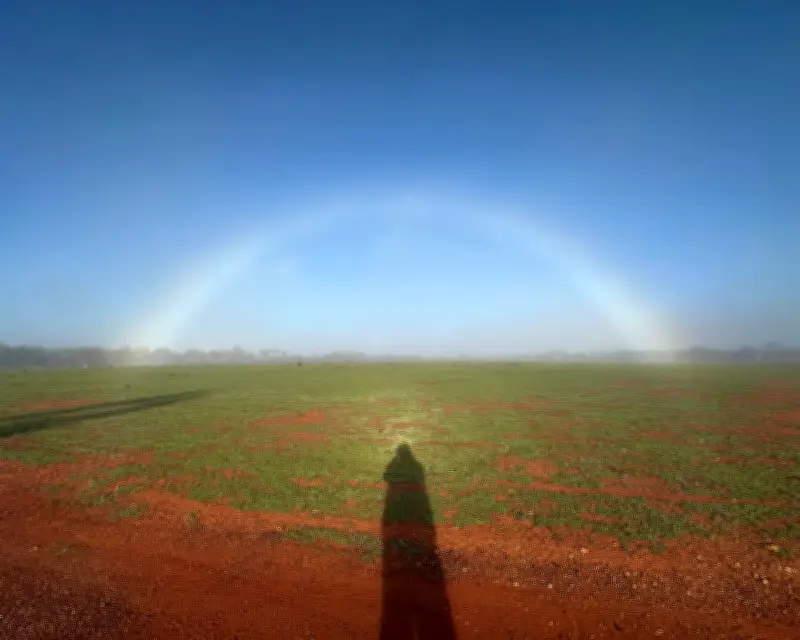
When Marie Johnson woke up one foggy morning, she just had a feeling it would be eye-catching. “It was first thing in the morning, when I was heading into town to work. I just thought I’ll quickly call in, get a photo of the fog with the old house,” says Johnson, who lives on a historic farm in Cobar, in outback New South Wales.
But then she turned around and saw the ethereal archway. “Oh my God, look at that. What is this? It’s like a rainbow, but it’s white,” she says. The optical illusion, known as a fogbow, is rarer than a rainbow.
What is a fogbow?
A fogbow is visible when the sun (or sometimes the moon) is behind you and the fog is ahead, says Ilana Cherny, a senior meteorologist at the Bureau of Meteorology. The light rays shine on the water droplets, which bend and reflect them back towards you. “The fog also needs to be right in the Goldilocks spot,” she says, dense enough for the pattern of refraction and reflection to occur, but not so dense as to actually block it from being visible.
Also known as a mistbow, the fogbow is a similar phenomenon to a rainbow, but the colours are less pronounced because the water drops are smaller.
Where and why do fogbows form?
To see a fogbow you need fog, which sometimes occurs in south-east Australia, particularly during autumn and winter. Fog usually forms overnight and into the morning when tiny water droplets are suspended in the air near the Earth’s surface, bringing an “eerie atmosphere”, says Cherny. The process is in some ways similar to cloud formation, she says, just closer to the Earth’s surface rather than higher in the atmosphere.
“The most common way that fog forms is through radiation. So essentially overnight at the surface we lose heat into space. The temperature really cools down at the ground, and that will also cool down the air which is closest to the ground,” she says. “Eventually that air will cool so that it becomes saturated with moisture, and then that moisture in the lowest layer of the atmosphere condenses and becomes water droplets or fog.”
Dr Kimberley Reid, an atmospheric scientist at the University of Melbourne, says fog tends to fly under the radar as a weather phenomenon, but it can have large impacts on society, especially flight delays and car accidents. For example, in December 2023, more than 20 cars were involved in a multi-vehicle crash north-west of Melbourne, when thick fog blanketed the area.
What about cloudbows?
Sunlight and water in the sky can produce many striking visual effects. A cloudbow is similar to a fogbow, but appears higher up, says associate professor Martin Singh, from Monash University. If you want to see one, the best viewpoint is from an airplane looking down with the sun behind you, he says. “For a rainbow or a cloudbow, you need something for the light to reflect off. With a rainbow, it’s raindrops – that’s falling rain. With a fogbow or a cloudbow, it’s either the tiny droplets of fog, which is cloud near the surface, or the tiny drops within clouds.”
Glories are another striking illusion, he says, which appear rainbow-like, only much smaller and more circular. A shimmering, glittery effect called diamond dust can occur in alpine areas when the weather is clear, calm and very cold, usually below -10C, according to the BoM. Under perfect conditions, ice crystals form spontaneously and slowly fall at ground level.
Another “cool optical phenomenon” is a halo, Cherny says, a bright ring of light in the sky. “Instead of light moving through water, the light is moving through ice crystals in the atmosphere. So often they are associated with high cloud or cirrus cloud, made up of ice crystals rather than water droplets.” And who could forget the double rainbow – made famous by a 2010 viral video – when two reflections inside each raindrop create an additional arch with the colours in reverse.
Fog and fogbows are quite rare in Australia, Reid says. They are also difficult to observe, because it’s so localised. “One of the challenges with fog is that you need people there to observe it. I’m sure we get lots more fogbows that only the kangaroos get to see. So it’s great that we got one where someone was able to take a photo.”




