
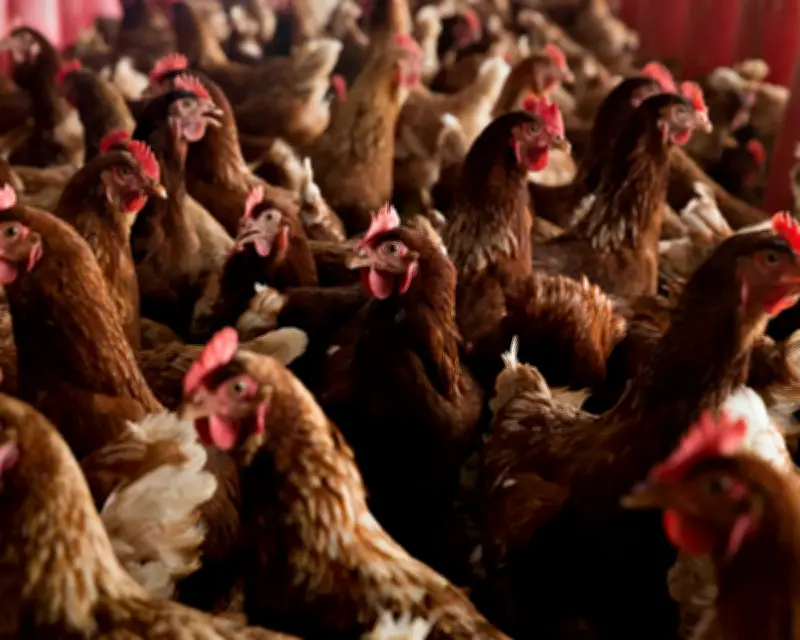
Organic eggs are twice as harmful to the climate as eggs from chickens kept in cages, according to a study. The research suggests that converting the UK's entire egg production to an organic free-range model would result in greenhouse gas emissions equivalent to 2,316,000 tonnes of CO2 (tCO2e). In contrast, a fully caged system would emit 1,184,000 tCO2e.
Efficiency trade-offs
The higher emissions from organic free-range systems arise because more chickens are needed to produce the same number of eggs, as caged birds are generally more efficient. Organic free-range production also performed worst in terms of water eutrophication, acidification, and land use. Additionally, chicken mortality was highest in organic free-range farming, the researchers noted.
However, the study relied on data from 2009–2010, which the researchers acknowledged as a limitation, as it does not reflect recent developments in egg production. The research also did not consider other environmental impacts such as pesticides or biodiversity.
Expert insights
Dr Harriet Bartlett, one of the study's authors and a senior research associate at Oxford University's Smith School of Enterprise and the Environment, said laying hens are the largest group of animals kept in cages globally, and rising egg consumption makes their treatment an important welfare consideration. “I'd say perhaps it's also a little bit of a blind spot when we talk about sustainability,” she added. “Meat and dairy get a bit more attention, talking about environmental sustainability, whereas [egg production] hasn't been as researched.”
The study, published in Royal Society Open Science, involved Bartlett and colleagues examining data from UK poultry farms to calculate environmental impacts such as greenhouse gas emissions, land use, and pollution types. They also looked at welfare indicators including mortality and the number of hens needed to produce a given number of eggs. “Then we did some modelling to work out these environmental and welfare outcomes,” she said.
“We found an important trade-off,” Bartlett added. “It's that, the types of farms that are generally regarded as being better for animal welfare, like organic and free-range, can actually require more birds to produce the same amount of eggs because they're less efficient and they can have higher environmental impacts.”
However, Bartlett noted the research did not present the full picture regarding factory farming. “Organic could come out better on pesticide toxicity, maybe biodiversity on farm as well,” she said.
Industry response
Lee Holdstock, head of regulatory and trade affairs at Soil Association Certification, who was not involved in the study, said the research “highlights some important trade-offs” but gives an “incomplete picture of environmental impact.” He added: “While intensive systems can have lower emissions per unit of output because birds use feed more efficiently, this reflects only one part of the picture. A truly sustainable food system must also consider impacts on nature, soil health, water quality, the use of synthetic inputs, and animal welfare.”
The researchers estimated that under the current regime, where egg production is split between caged, barn-housed, free-range non-organic, and free-range organic systems, emissions amount to 1,439,000 tCO2e.




