
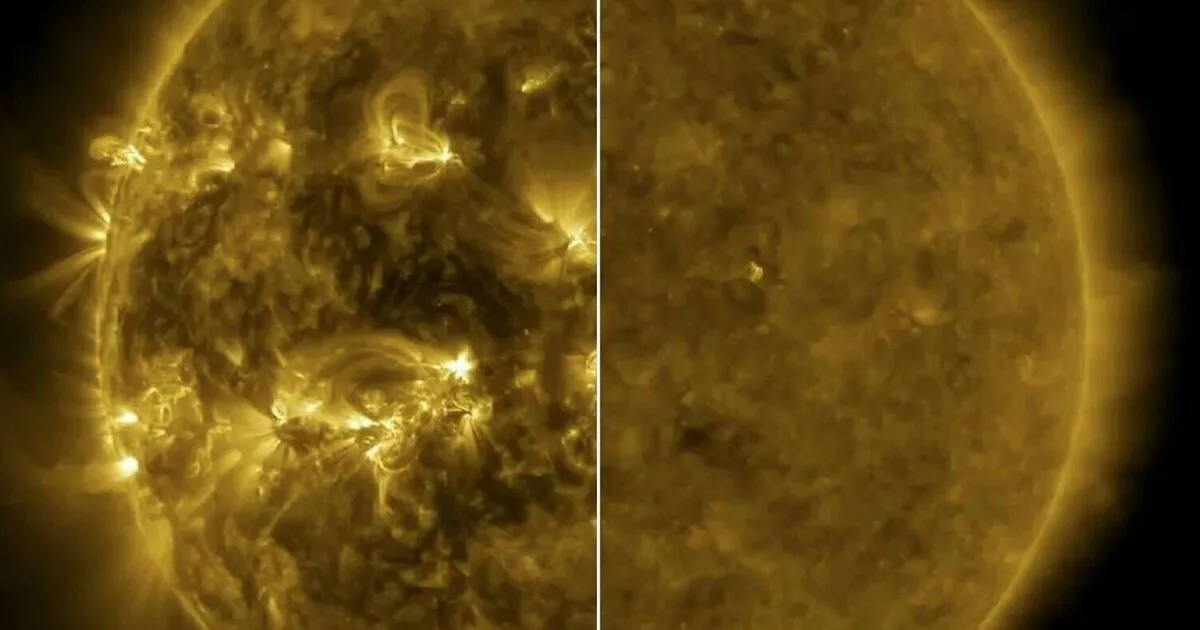
An international team of researchers led by the University of Birmingham has discovered that the Sun's internal rhythm exposes previously hidden changes in solar activity over the past 40 years. The study, published in the Monthly Notices of the Royal Astronomical Society on May 28, 2026, used helioseismic data from six telescopes worldwide to detect minute sound waves within the Sun.
Lead author Bill Chaplin from the University of Birmingham stated: "The Sun has its own 'active biorhythm' creating rising and falling magnetic activity that shapes space weather. However, traditional surface measures don't capture the full story - that the Sun may be entering a different mode of behaviour unfolding over decades." The team found that magnetic activity is becoming more tightly confined near the surface with each solar cycle.
The researchers also discovered that the current solar cycle, Cycle 25, is more powerful than conventional surface measurements suggest. Co-author Sarbani Basu from Yale University noted: "We discovered that the relationship between internal solar oscillations and surface activity has evolved over the past few cycles. This trend cannot be explained simply by weaker magnetic fields. Instead, it indicates a structural reorganisation of how the Sun's magnetic activity is stored beneath the surface."
Understanding these variations is crucial for forecasting space weather, which can disrupt satellites, GPS, communications, and power grids on Earth. The researchers call for further analysis to determine whether the observed shifts signal a systemic transformation in the Sun's activity.




