
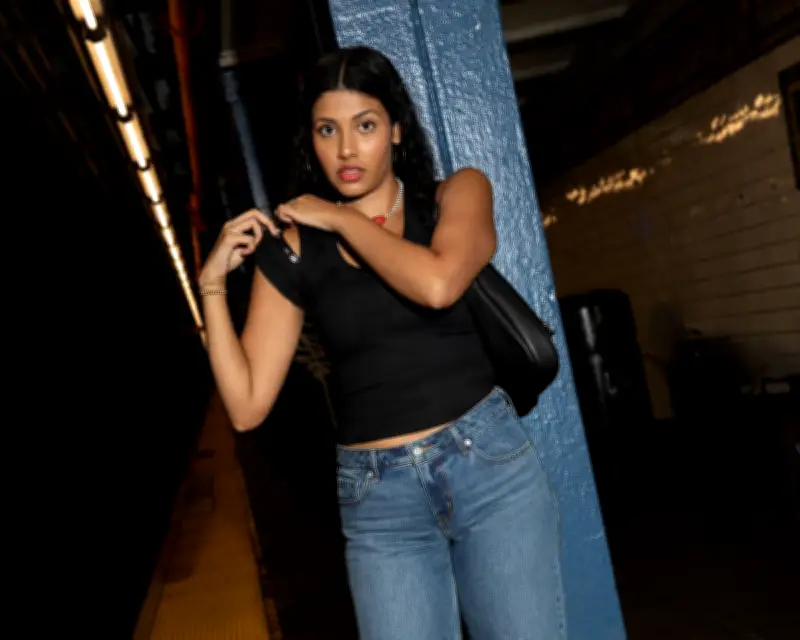
Are multi-way clothes the answer to sustainable fashion - or just another excuse to buy more stuff? Brands are making clothes that can be adapted by the wearer. But with fast fashion giants getting in on the act, perhaps we should just stick to wearing our cardigans backwards.
I'm sitting on my bedroom floor trying to fasten the sleeves back on to a new top that's just been delivered. I haven't had an unfortunate accident with scissors; the removable sleeves are a design feature, part of the growing trend for multi-way clothing that is being championed as a win for sustainability – or for anyone moving from air-conditioned office to outside right now. Brow furrowed, I try to attach the puff of red taffeta to the rest of the frilly blouse using the tiny buttons and loops provided. But I'm not having much luck …
I enjoy messing around with clothes. Aged 10, I pranced around a sun-drenched Greek holiday in a top that was really a skirt. But a top with sleeves that detach? I'd lose them instantly, I'm sure of it. Even if I didn't, would my two-tops-in-one actually curb my rabid appetite for new clothes or would it simply feed the beast; another trend to be devoured and then discarded, just like the sleeves?
Multi-way clothing evolution
Multi-way clothing – clothing designed to be worn in multiple ways – has come a long way since the zip-off trousers made popular by practical hiking dads (as well as girl band TLC) in the early 2000s, or the “infinity” bridesmaid dresses that could be worn 72 different ways and were chosen by indecisive (or, perhaps, size-inclusive) brides of the 2010s.
Today, a number of self-proclaimed slow and sustainable brands, including BUCI NYC, Isabella Vrana, Damson Madder and American brand SAUV – the idea for which came about when founder-sisters Margaux and Euxie were forced to split their shared wardrobe as they headed to separate colleges – are creating clothes built to be altered by their wearers. There are reversible cardigans; blouses that can be worn back-to-front; necklines that can be adjusted with a series of hooks and eyes; midi dresses that transform into minis using loops and ribbon ties.
The thinking is that the aesthetic of multi-way clothing – doing more with less – encourages creativity, inspiring the wearer to adapt garments to fit their individual need, occasion or style, while promoting sustainability. Because, of course, the benefit (or so say the brands) is that we will be encouraged to buy less stuff: it is the ultimate sustainable magic trick, to turn one item into two or three.
Expert opinions
For Emily Chan, senior sustainability and features editor at British Vogue, the idea of multi-way clothing is to be celebrated, “if it encourages people to style their garments in different ways, get more wear out of them, and keep them for longer”.
One fan is Jasmain Farara, a 29-year-old social media manager from London. In a clip on her TikTok account, she can be seen undoing the poppers on the full-length sleeves of her plain white SAUV top, transforming it, in seconds, into a simple sleeveless vest. It's marketed as “the last top you'll ever buy”, though I asked if she has, in fact, bought more tops since and – spoiler alert – she has.
For $135 (about £101), these sets – and other multi-way clothes like them – don't necessarily come cheap, in case anyone thought the cost of living crisis had led to their boom. For that price, shoppers get the 94% organic cotton popper-sleeved vest as a base and one set of detachable short-capped sleeves. Modular fans can then purchase, separately, other types of sleeves with which to build different tops, like the sartorial version of adding your own toppings to an ice-cream sundae: basic long sleeves for $62 (about £47), for example, or sleeves with a flounce at the cuff for $60 (about £45).
But for all of its good intentions, I fear multi-way clothing may, by its very nature, be paradoxical: buy it so you buy less. There is a crushing inevitability, too, to the fact that fast fashion behemoth ASOS is now getting in on the action, selling a (95% viscose) top with a modifiable neckline that can be made wider or narrower with buttons, for just £24. This isn't slow and sustainable, it's a mass-market cash grab, latching on to the aesthetics of multi-wearability and its eco-friendly optics.
Fashion designer and author Orsola De Castro, who co-founded Fashion Revolution, a movement that campaigns for a more sustainable fashion industry, believes multi-way clothing is nothing more than a marketing ploy. “Sustainability-wise, they have absolutely zero merit. They don't discourage [consumers] from buying new things,” says De Castro. “It is a gimmick; just an added layer that makes you consider the longevity of your clothing but doesn't necessarily dictate your behaviour.”
Chan agrees when it comes to trend-driven brands jumping on the bandwagon: fast fashion is fast fashion, whether or not it's multi-use. “If clothes are treated as throwaway items and not made with the environment or garment workers in mind, it's not a sustainable choice,” she says.
None of this, of course, means we can't wear clothes in a multi-functional way. Creative people have been doing this forever, without brands marketing it to them. “Who hasn't worn a cardigan fastened at the back instead of at the front; who hasn't pinched [their] skirt and somehow tucked it under [their] knickers to change its shape,” De Castro says. “To have it as a pre-designed condition somehow can be restricting rather than liberating.”
Back on the bedroom floor, the top is proving fiddly. It's not long before I discard the sleeves, reuniting them with the top in its packaging, ready to be returned: my life is fiddly enough already. Plus, maybe there is a better way to experiment with multi-way clothing. Only yesterday, in fact, I accidentally wore my dress back to front all day. It cost me nothing – except, perhaps, a little pride.




