
Mount Etna Eruption Forces Catania Airport Closure
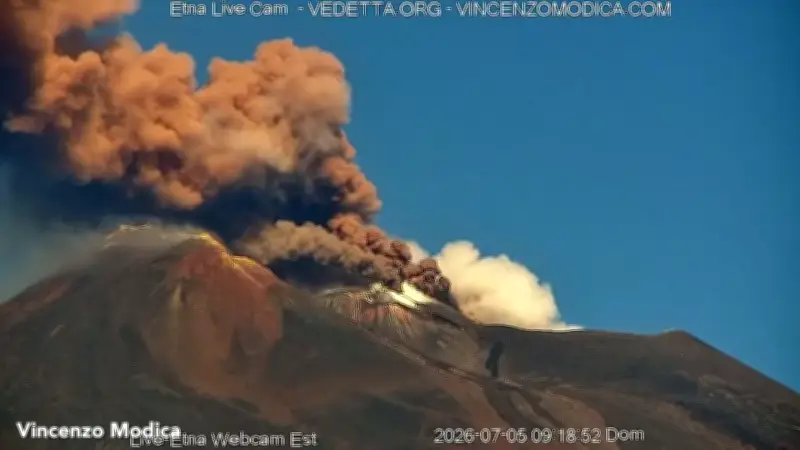
Mount Etna in Sicily erupted on Sunday, July 5, 2026, sending huge plumes of volcanic ash into the sky and forcing the closure of Catania Airport, a major hub for British holidaymakers. The airport suspended all incoming flights on Sunday and remained closed on Monday morning, with operations halted until at least 2:00 PM local time, according to an airport statement.
Italy's national airline, ITA Airways, confirmed that all departing and arriving flights at Catania Airport were either cancelled or rescheduled. The airline stated: "Temporary closure of Catania Fontanarossa airport. Due to Mount Etna’s volcanic activity and the presence of volcanic ash in the atmosphere, operations at Catania Fontanarossa Airport have been temporarily suspended."
Red Aviation Alert and Strombolian Activity
Italy's National Institute of Geophysics and Volcanology (INGV) raised the aviation alert level to red after detecting intense activity at Etna. The volcano produced Strombolian eruptions—short, rhythmic bursts of gas that eject glowing pieces of magma from a volcanic vent, including volcanic bombs, lava clots, lapilli, and ash, typically thrown tens to hundreds of metres into the air.
On Sunday, ash emissions began at around 7:45 AM local time from a vent on the upper eastern flank of the Voragine summit crater. The activity intensified through the morning, with ash plumes rising about 1.5 kilometres (approximately 1 mile) above the summit. By evening, glowing lava fragments were visible. A livestream from afarTV captured the fiery display.
Flight Disruptions and Diversions
Catania Airport's website showed a long list of flights diverted, cancelled, or delayed. Twenty-three flights were diverted to Palermo Airport in northwestern Sicily, according to local reports. Passengers were advised not to travel to the airport without checking their flight status with their airline. A flight from London Gatwick scheduled to land at 7:10 AM was cancelled, and a Luton flight due at 8 AM was rescheduled to 2 PM.
The airport management company stated: "Following today's volcanic activity and due to shifting winds, the area corresponding to the south-west air cloud (sector C1) has been closed until 5am tomorrow morning, July 6. As a result, all evening and overnight arriving flights have been suspended. However, departures for aircraft already on the ground are still operating."
Volcanic Activity and Safety
Mount Etna, Europe's largest volcano, stands 3,350 metres (11,050 feet) above sea level and is about 35 kilometres (22 miles) in diameter at its base. The volcano is located in a continental collision zone between the Eurasian and African plates, with extensional faults allowing magma to rise. Lava flows rarely reach towns due to their viscosity and low speed, according to the Italian Civil Protection Department. Only in long-duration eruptions might flows threaten inhabited areas.
The eruptive vents at the summit—Bocca Nuova, Voragine, and Cratere of north-east and south-east—each have a diameter of about 200 metres. The alert level for Etna remained yellow as of Sunday night, per the Civil Protection Department.
Historical Context and Impact
Etna is in an almost constant state of activity, with its last major eruption recorded on January 1, 2026. In late June, a slow lava flow was observed from a fracture at the base of the Northeast Crater. The volcano has inspired ancient Greek legends, and its eruptions have historically caused significant damage, such as the 1669 eruption that buried parts of Catania and devastated villages.
Despite the risks, Etna's lava flows are largely contained to uninhabited slopes, allowing life to continue in surrounding towns and villages. The volcano supports fertile farmland and attracts tourists. Catania Airport occasionally closes for hours or days when volcanic ash poses a danger to aircraft.




