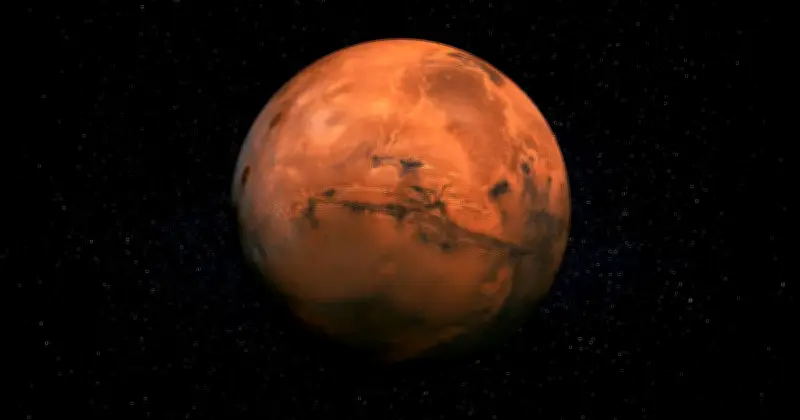
British scientists have discovered evidence suggesting that rivers of molten rock once flowed beneath the surface of Mars. Researchers at the University of Oxford analysed seismic data from NASA's InSight lander, which detected waves from meteorite strikes and earthquakes. Their findings, published in Nature Astronomy, could help prove that Mars had conditions suitable for life and broaden the range of planets that could have been habitable.
Magma Network Discovered
The researchers concluded that a boundary roughly 15 miles beneath Mars' surface was likely created by magma accumulating and spreading across potentially thousands of miles. Scientists previously thought that volcanoes on Mars sat above straightforward, self-contained magma chambers, but the new findings suggest a network beneath the planet's crust.
This system would have been able to produce a chemically diverse crust that could recycle elements through geological processes. This, in turn, could have created and sustained an atmosphere and oceans on Mars' surface, both of which were previously thought to require plate tectonics.
Implications for Habitability
Other planets in the universe that lack tectonic plate activity have been ruled out as potential hosts for life, but the new research suggests this should be reconsidered.
Lead author Dr Tobermory Mackay-Champion said: "We've traditionally assumed that volcanism on Mars was relatively simple compared to that on Earth. But this discovery suggests the planet could sustain massive, long-lived magmatic systems capable of evolving and reprocessing molten rock throughout the crust."
Dr Mackay-Champion added: "Because these systems are known to generate large metal deposits, Mars may hold significantly more near-surface mineral wealth than previously recognised – boosting its potential for future mining, crewed missions and eventually, permanent settlements."
Broader Cosmic Implications
Co-author Associate Professor Jon Wade added: "One of the big questions in planetary science is whether Earth is unique. If Mars could develop this kind of complex crust without plate tectonics, then maybe the conditions needed for habitability can emerge on more planets than we realised, including those previously dismissed based on size or their apparent lack of tectonic activity."