At the old Royal Bank of Scotland building on Grimsby’s Victoria Street, a miracle is unfolding. Over the past three years, a forlorn and forgotten structure has been returned to its former Victorian splendor. Today, King Charles is visiting the premises.
The walnut coffee table gleams with polish. Luxury furnishings and vintage chairs stand ready. The impressively restored ceiling, adorned with Morris and Co’s famous ‘Bird’ wallpaper, lends the space the air of a stately home or a five-star hotel. It is a place fit for a King, yet the CARE hub has been designed for homeless people. Its ‘public living room’ offers a unique approach to homelessness: beauty and dignity.
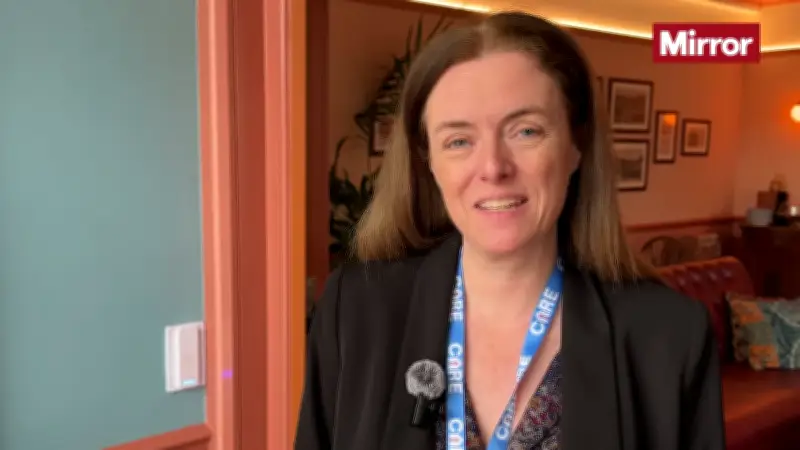
“Beauty is not an indulgence at CARE, but a tool for safety, trust and human connection,” explains CEO Anne Bickerstaffe, for whom creating the hub has been a long labor of love. “We intentionally set out to create a generous, luxurious space – a deliberate move away from the usual institutional feeling of these spaces. Being in a calm, beautiful space reduces people’s stress levels, and breathing slows. It means the space itself can do quite a lot of the work before our staff have said a word.”

There is hard evidence, she says, in the numbers of people the charity now works with. “Since we have opened here, we have gone from 10 people a day to over 100 people a day,” she states. “We have people coming in who wouldn’t otherwise be presenting to services, who may be sleeping in hidden areas.”
King Charles experienced the soothing environment for himself during his visit to the CARE Hub, which also provides a housing program, advice center, food pantry, and a furniture recycling project. Among those who met the King was 26-year-old Liam Atkinson, who came in for a cup of tea after his marriage broke down. Liam said the project had helped him get back on his feet after losing both his house and his job within a year. He now has a flat for himself and his three-year-old son.
“All the staff here are absolutely amazing,” he told the royal visitor. “They changed my life. I feel like I am a human being, and that I matter.” Afterwards, Liam said he found King Charles to be “so down to earth. So kind. So considerate. I can’t believe it. Meeting The King was something my grandmother had always wished for, and here I am!”
The King also unveiled a plaque at the homeless center as part of his visit to Grimsby and Cleethorpes. Scott Maddux, who worked with Anne to design the interior of the hub, remarked, “It was incredible how charming he was.”
When I visited the CARE Hub a few weeks before the King came to Grimsby, a gentle acoustic cover of Freefalling by Tom Petty played on the speakers. A mix of street homeless people and families in crisis helped themselves to free cups of tea at the neat sink area. Crisis Support Worker Briony Chestnut and Crisis Support Coordinator Angel Farmer chatted with people and contacted services on their behalf. In contrast to hostile architecture—sometimes known as “defensive urban design,” where anti-homeless spikes are used by some councils and private buildings—the comfy sofas, uplifting surroundings, and gentle pace provided a balm for traumatized people more used to hard seats designed to deter them from staying too long.
Kevin Klimpton, 75, formerly a first responder with the ambulance service, told me he and his partner Brenda Drifil, 65, had first popped in on the community open day a few weeks ago. He showed me photographs of the damp and disrepair the couple endure in their private rented flat. “It’s disgusting,” he said. “The mould and damp means I can’t breathe. I’ve been disabled since I was knocked through a carpet shop window by a car driver without a license.”
“He’s had COPD since he was two years old,” Brenda added. “He’s got severe asthma, he’s had a triple heart bypass.” The couple’s housing difficulties are compounded by Brenda’s disability and their beloved dog, Evie, a staffie-cross. “She’s my lifeline,” Kevin says. But Brenda has faith. “Angel and Briony are angels,” she told me. “They are going to help us get out of there.”

Anne Bickerstaffe says one advantage of the welcoming space is that “people stop by earlier, before they reach crisis point, or they end up on the streets, and we can do preventative work. In institutional spaces, people are expecting to be turned away. They are always ready to defend themselves. Their stress levels are through the roof. Everything is a threat and they are going to kick off. Here, we don’t just see people as problems to be fixed. We see their worth and potential. We find out the things they are proud of, the skills they have. Even people who have nothing are often proud of their children.”
The £2 million renovation, funded by 16 funders, will eventually include medical and treatment rooms and showers upstairs. The furniture is all second-hand or donated by local people, while Morris and Co, Sanderson, and Clarke and Clarke have generously donated wallpapers and fabrics.
“Too many places build in ordeal and hostility to reduce numbers coming in,” Anne says. “We wanted to create something that is actually an invitation. People don’t have to ask for anything here. It’s up to them to engage or not, that’s the beauty of the space.” Anne says she became interested in “neuro-aesthetics, the science of beauty,” when she ran a previous space for children at a community church in Hull, called The World of Wonder. “It’s not something heard of much in the UK, but it makes a lot of sense to me.”
“At The World of Wonder we created a ‘hobbit hole’, a treehouse, and a wardrobe to Narnia, sharing the power of wonder. We would use 1,000 snowballs from Amazon at Christmas to make a white carpet. Narnia was a thin place between heaven and earth. I think being from a strong faith background, I understand that.”
For Anne, the ornate ceiling of the CARE Hub also holds a deeply personal reminder of how quickly lives can change. Her husband was up a ladder fitting the wallpapered panels when he suffered a brain hemorrhage and was later rushed to hospital. “Thankfully he has recovered now, but it does mean this place holds a lot of significance for me too,” she says.
During his visit, the King chose a wallpaper from his Highgrove Collection for Anne and her colleagues to use in the next phase of the building project. “The King chose the Stumpery wallpaper from Sanderson Design,” Anne says. “It’s gorgeous. So calming. I said to His Majesty that his visit meant so much to our community, because the King visiting gives people value. Having his involvement in choosing wallpapers for the next phase of the building project means our community will know this place is fit for a King.”
For homeless people in Grimsby, the wardrobe door to beauty and dignity is now open.