
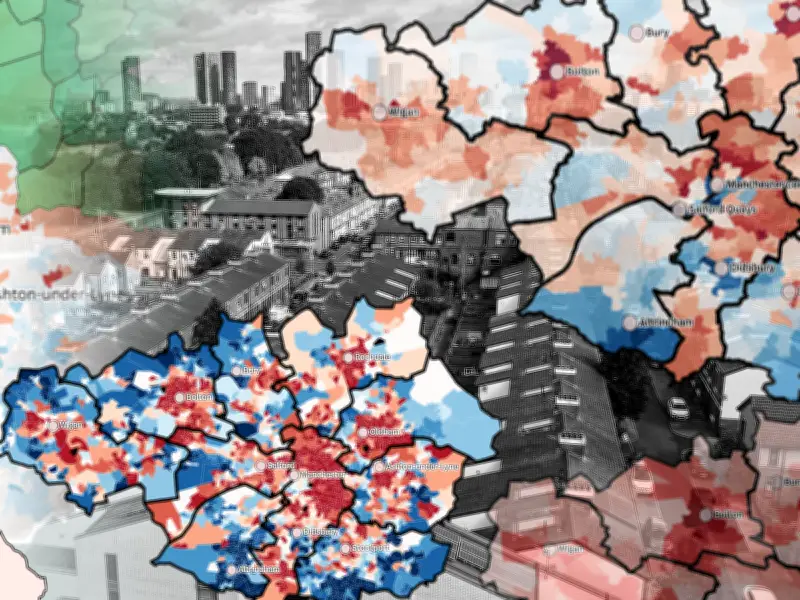
The next mayor of Greater Manchester will take office on Friday evening inheriting what is now considered the most powerful metro mayoralty in England. The role, which propelled Andy Burnham from regional politics to Downing Street, comes with formidable expectations: tackle homelessness, improve public transport, unlock new homes, attract investment, reduce inequality, and convince residents that prosperity reaches every corner of the city region.
This election is expected to be the closest yet, with Labour’s Bev Craig and Reform UK’s Sian Astley leading the race, and a second round of counting likely for the first time under the Supplementary Vote system. Previously, Burnham’s coalitions were resilient; he always won over 50% of first preferences.
Uneven Growth and Prosperity
Greater Manchester has become more influential since the mayoralty was created in 2017, attracting billions in investment. But prosperity has not been shared evenly across the ten boroughs. The wealthiest neighbourhoods are concentrated in Manchester, Salford, Stockport, and Trafford. Salford Quays households had an average disposable income of almost £68,000 in 2023, the richest in the region and 22nd in England and Wales. Yet only a 15-minute walk away, Pendleton recorded just over £23,000 — a gap of about £45,000 a year. Similarly, Castlefield and Deansgate in Manchester had over £50,000, while Longsight East had just over £23,000.
The region’s key debate is how prosperity coexists with persistent poverty, often within the same borough. Labour's proposed Good Growth Fund aims to channel investment into towns that have not shared equally, while Reform argues growth is too concentrated in Manchester.
Deprivation and Left-Behind Communities
Official deprivation statistics show progress, but unevenly. Across Greater Manchester, 29% of neighbourhoods became less deprived compared to 2019, while 14% became more deprived. Stockport performed best: only 4% became more deprived, 46% less. Manchester saw 36% improve, 9% worsen. However, Oldham stood out: 31% of its neighbourhoods became more deprived, only 13% less. No other borough recorded such a negative trend, possibly reflecting ongoing political turmoil.
Child Poverty Persists
More than one in four children across Greater Manchester — 28% or almost 168,000 — live in poverty, a figure that sits awkwardly with the narrative of economic success. Although slightly lower than the previous year, the proportion remains unchanged. Coldhurst in Oldham has the highest rate: 57% of children in poverty, among the highest in Great Britain. Other wards in Rochdale, Bolton, and Manchester also exceed 50%. While the mayor cannot directly control welfare policy, they influence transport costs, housing, and employment opportunities.
Rising House Prices and Affordability
Rapid price increases have become a political headache. In Salford’s M7 postcode, average house prices rose from £113,000 in 2005 to £317,000 in 2025 — a 180% increase. Similar rises occurred in M40 (179%) and M6 (168%). For first-time buyers, each increase raises the deposit needed and pressures rents. Success has made the region more attractive, but rising costs risk excluding the people who helped build that prosperity.
Homelessness: Progress and Unfinished Business
Burnham’s pledge to end rough sleeping defined his early tenure. Rough sleepers fell from 268 in 2017 to 90 in 2021, but have risen each year since. The number in 2024/25 reflects national trends. Temporary accommodation houses over 6,000 households, including more than 9,100 children. Manchester accounts for the largest share: 2,900 households with around 4,900 children. The city’s net expenditure on homelessness more than doubled from £23.3 million in 2021/22 to £58.9 million in 2024/25.
The next mayor inherits a region that is wealthier and more powerful, but with stark inequalities. The office has become the public face of Greater Manchester’s ambitions, and Burnham’s devolution agenda may make the next mayor even more powerful. Using that power to spread wealth from the centre is the task awaiting whoever wins on Thursday.




