
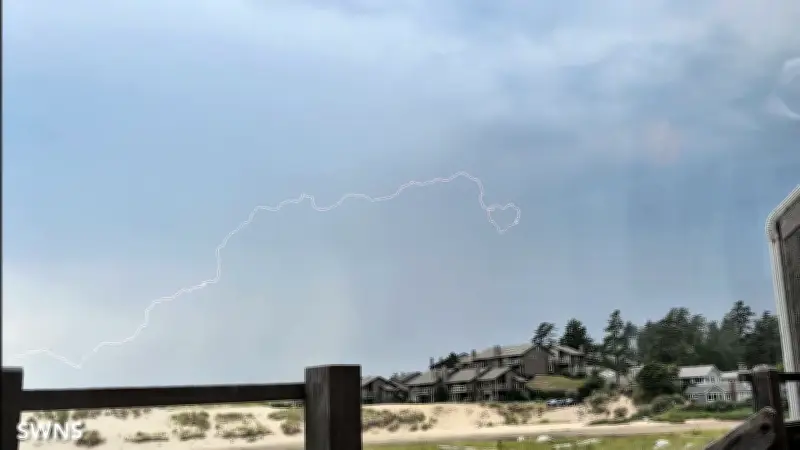
A photographer captured a lightning bolt forming a heart shape over Cannon Beach, Oregon, on July 22. Rebecca Boren, 33, from Seattle, Washington, only noticed the romantic shape when reviewing her footage after the storm.
Rebecca said: "It was just a stormy afternoon at the beach, and I've never seen lightning there before. I put my phone on video with high frame rate and scrubbed through and noticed it afterwards."
Part of widespread lightning activity
The lightning bolt was one of 8,357 strikes that hit Oregon on July 22, which have sparked wildfires in the area. The bolt, when viewed in slow motion, forms a heart shape before shooting off to the left of the frame.
While lightning can be fascinating or even mesmerising it can prove to be extraordinarily dangerous. In the US alone there are about 25 million lightning flashes each year.
How lightning forms and its dangers
Lightning forms when negatively charged particles called electrons at the bottom of a storm cloud try to connect with the ground's positive charge. The flow of the negative charge rushes down toward the ground and when they meet, an electric current forms.
A single lightning bolt can cause the air around it to heat up to as much as 30,000C. The shockwave caused by the sudden heat results in a massive booming sound that we know as thunder.
According to the Centers for Disease Control and Prevention, there were 517 lightning-related deaths in the US between 2006 through to 2025. Men were four times more likely than women to be struck by lightning. Meanwhile, in the UK, the Royal Society for the Prevention of Accidents said there are typically one or two lightning deaths in the UK each year.




