
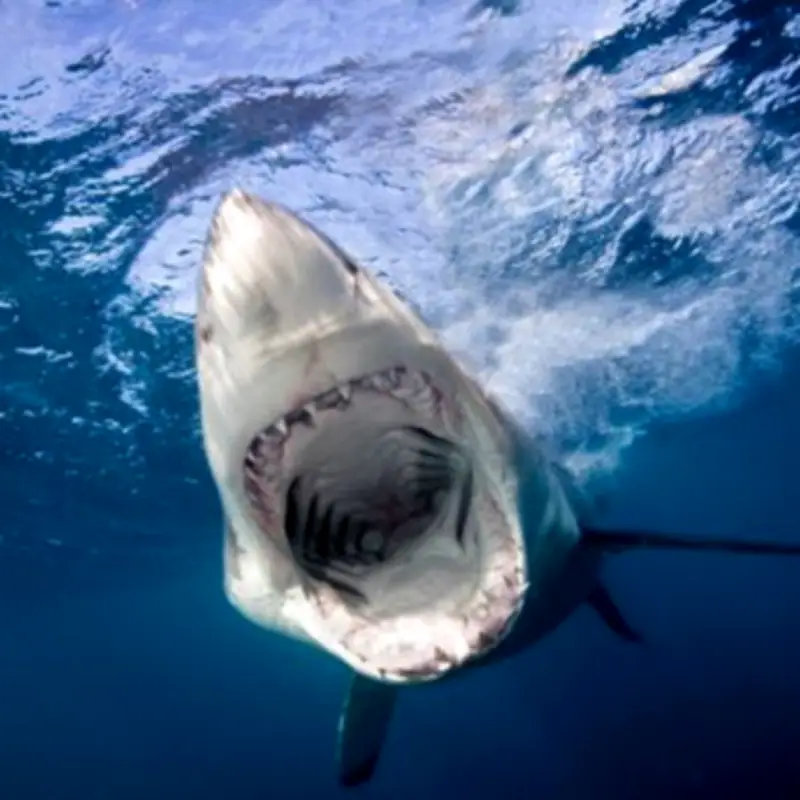
Great white sharks could soon be cruising off Britain’s coastline, according to scientists. Experts say that with climate change warming waters near the UK, it is surprising that one has not appeared yet. The warning follows a rare sighting in the Mediterranean Sea earlier this week, where divers encountered a 15-foot great white shark weighing up to 4,000 pounds.
Inevitability of Great Whites in UK Waters
Dr. Jack Cooper, a shark expert, stated that great white sharks swimming in English waters is an inevitability as seas warm. He noted that it is not a question of if they will appear off coasts like Cornwall, Devon, or Blackpool, but when. “In short, it is an inevitability at our current pace of climate change, but we can’t say for sure when,” he said. “Climate change is causing global sea temperatures to rise, forcing many shark species to move polewards into more favorable conditions.”
Signs of change are already visible in Britain and Ireland. Dr. Cooper pointed to the recent stranding of three smalltooth sand tiger sharks on beaches in England and Ireland, far beyond their usual range. These sharks had never been seen in those waters before, and scientists attributed the shift to increasing temperatures.
Warm Waters and Abundant Prey
Professor Charles Underwood from Birkbeck University echoed Dr. Cooper’s views, saying the idea of great whites appearing around the UK is less far-fetched than many think. “The real surprise is that great whites are not here already—the water is already warm enough for them, and there are loads of seals and increasing numbers of dolphins,” he said. He added that a growing supply of prey, such as tuna and dolphins, could tempt sharks across the Atlantic from the US coast, where they are relatively common.
If great whites do arrive, they are most likely to be spotted around seal colonies and in deeper, clearer water along the west coasts, including Devon, Cornwall, Pembrokeshire, and the Hebrides. The El Niño climate pattern could also accelerate their arrival by warming ocean waters and reshaping marine ecosystems.
Shark Attack Statistics
According to the Florida Museum of Natural History’s International Shark Attack File, there were 65 unprovoked shark bites worldwide in 2025, along with 29 provoked incidents and 105 total interactions. The United States recorded the highest number of cases with 25 unprovoked bites, followed by Australia with 21. Florida accounted for 11 incidents, the most of any American state. Most encounters involved swimming, wading, surfing, or board sports. Researchers note that the number of incidents remains extremely low compared to the number of people entering the ocean.
Conservation Perspective
Dr. Cooper emphasized the ecological importance of great white sharks as apex predators. “The great white shark is an extremely important component of the marine ecosystem. It keeps food webs healthy by keeping prey populations at bay, which keeps the ocean healthy,” he said. However, he noted that great white sharks are threatened, classified as Vulnerable globally and Critically Endangered in the Mediterranean. “We are far more dangerous to great white sharks than a great white shark is to us,” he added.




