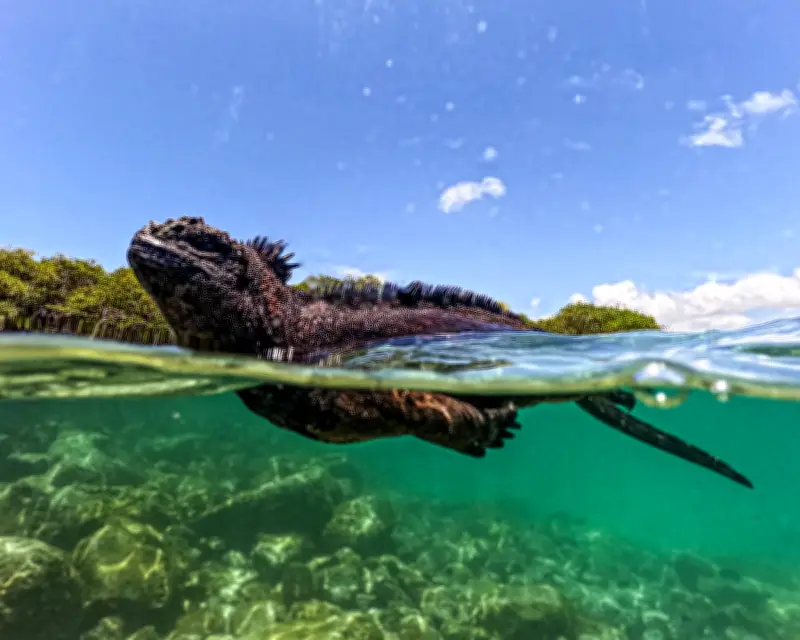
The ocean waters around the Galápagos Islands are hot. Very hot. Observed for centuries in the Pacific by fishers, the El Niño weather phenomenon begins when the prevailing trade winds slow, allowing warm water to spread east along the coast of South America. Right now, the pattern is in full flow and will build from this year into next, likely bringing record temperatures to an already overheating world.
If 2026 is not the hottest year on record, 2027 surely will be – and the Galápagos archipelago is in the centre of this climate crisis.
How El Niño Transforms the Galápagos
In normal conditions, the water in the eastern Pacific is cold: Galápagos penguins and fur seals live on the islands, species more commonly associated with ecosystems closer to the poles. The archipelago is the only place in the world where you can see penguins swimming next to coral reefs.

The arrival of El Niño always signals an abrupt change, effectively giving the marine ecosystem a hot bath: water temperatures rise from around 18C to above 30C, causing a population crash in many fish species as nutrients disappear from the water. The populations of sea birds such as Nazca boobies, penguins and blue-footed boobies also go into freefall, while marine iguanas starve en masse. When temperatures drop in a La Niña year, marine life explodes once again.
Adaptation and Extinction Risks
This pattern has played out for so long that many species on the islands have adapted to such oscillations. Iguanas in the Galápagos can shrink their body skeletons in El Niño years to increase their chances of survival, and regrow them when normal conditions return. But climate change presents a fresh evolutionary challenge as El Niños become more frequent and more extreme in a warming climate. There are fears among scientists that these extremes will drive some species into extinction in the coming decades.
“The Galápagos Islands has some of the highest temperature variability of any ecosystem in the world,” says Jon Witman, a professor emeritus of ecology at Brown University, who has been studying the cycles in the Galápagos for years. “Things are always going up and down with the El Niño-La Niña cycle. There’s an almost total collapse of the marine system during El Niño, and it comes roaring back during La Niña. But how much stress can an ecosystem take?”
A Natural Laboratory for the Future
In the face of future climate extremes, the ecosystem that inspired the theory of evolution has a key role in helping researchers understand how plants and animals will respond. Witman was part of a team that recorded an ulcerative skin disease outbreak in many fish species during the 2015-16 El Niño, with knock-on effects across the food network. During the severe 1982-83 El Niño, several endemic species on the Galápagos went extinct, including the Galápagos damselfish. Witman and his team are bracing themselves for what the 2026-27 El Niño will bring.
“The main question I have is if these climate shocks become so frequent that the ecosystem passes a tipping point and switches to another state of perhaps low productivity and biodiversity,” says Witman. “That happens with ecosystems. They get pushed so far that they end up in an entirely new state. In that sense, it’s kind of a natural laboratory for the future.”
Hope Amid the Extremes
It is not all doom and gloom. These islands have long proved resilient to extremes, and Witman says he is quietly optimistic about what they will be able to withstand, even as the Earth continues to heat.
“We are in a new zone. It’s worrisome, but studying the ecosystem gives me hope,” he says. “In my work studying corals, I have definitely seen changes in the composition of reefs. But they have been towards more resilient species that can recover after extreme El Niños.”