
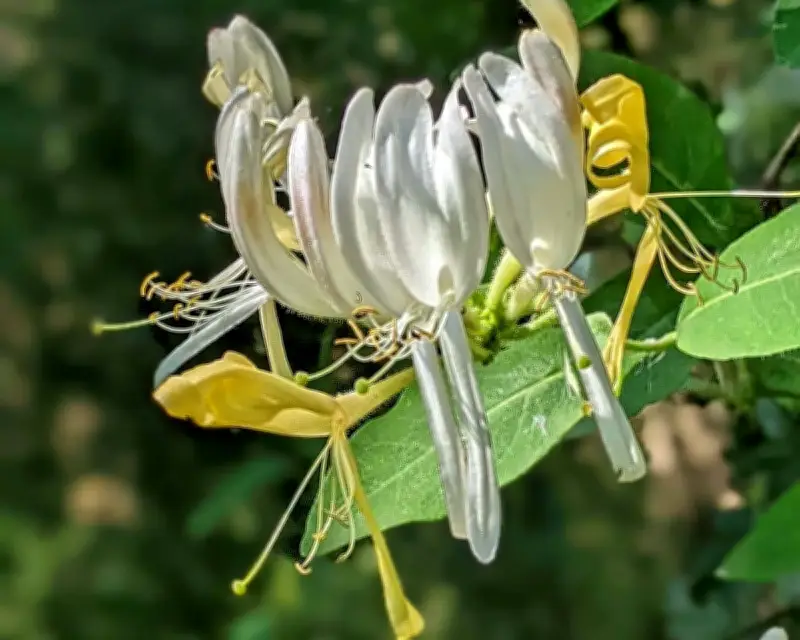
An early morning walk before the heat of the day becomes oppressive. The woodland footpath lies in deep shadow, flecked with sunbeams. A familiar fragrance – honeysuckle – lingers in the cool, still air.
A display of honeysuckle blossom
There are a few Lonicera periclymenum flowers at eye level, but most of the sweet, clove-like perfume comes from thousands of inflorescences that smother the crowns of a hazel and an oak overhead. Lit by glancing rays of the rising sun, they glow golden against a cloudless sky. It’s the finest display of honeysuckle blossom I’ve ever encountered. I trace its origin to a thick, gnarled old stem, rooted at the base of the hazel, ramifying up through its branches.
For all its beauty, there is something a tad sinister about honeysuckle, a vegetable boa constrictor lurking in our flora. This monster specimen would have begun life as a seed inside a tempting crimson berry, eaten then voided by a bird perched in the tree. Germinating in deep shade, but needing sunlight to flower, it devoted its energy to climbing through its host, reaching out with long, sinuous shoots: searching, coiling, twining, sometimes strangling, relentlessly heading skywards. If honeysuckle grips young stems of fast-growing trees like hazel, ash or rowan, its tightening grip can corkscrew their growth: a gift for novelty walking stick makers.
Flowers and pollinators
With nowhere left to climb, a wayward shoot that could find nothing to clasp dangles over the footpath. Its elegant flowers, like ceremonial trumpets, emit a fanfare of scent that will become much stronger at dusk. Then, they’ll turn up the volume to attract crepuscular moths that are said to be capable of detecting it from a quarter of a mile away. As the pollinators hover, probing flowers with long probosces, they cannot avoid touching the protruding stamens and stigma. So the annual cycle repeats: ripe berry, bird, seed, shade, shoots seeking support, reaching for the sunlight to flower.
The day is already becoming uncomfortably warm, so we begin the trudge homeward, but first, something I haven’t done since childhood, sampling the nectar that attracts the moths, plucking a flower and tasting its earthy sweetness on my tongue.




