In just over six weeks, four rough sleepers have died on Victoria's Mornington Peninsula, an area known for its luxury waterfront properties and wealthy suburbs. The deaths have prompted concerns from local outreach workers about the homeless cohort in the region.
Three of the four who died were men, with long connections to the area, some having grown up there. The youngest was 36 and the oldest 65. At least one died by suicide, walking into a truck after being discharged from hospital. Another man's health deteriorated rapidly after he started rough sleeping, leading to his death within months. Their names have not been made public, and even social workers who knew them well are reluctant to share details, fearing that close family members may still not know.
High number of rough sleepers, low number of services
The Mornington Peninsula has the second-highest number of rough sleepers in the state after Melbourne's CBD. A report from Launch Housing shows the area has had 11 rough sleeper deaths since December 2024, with three occurring in September alone. Guardian Australia has confirmed one more death this week. In comparison, analysis from this masthead previously revealed about 14 rough sleepers around the country die each year on the streets.
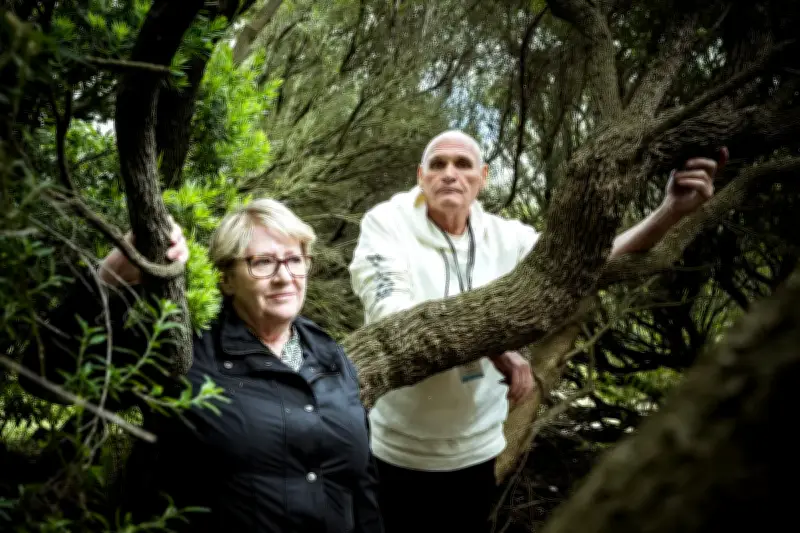
Leonie and Pete, outreach workers for the small, privately funded Southern Peninsula Community Support, count 111 people sleeping rough on the peninsula. They say the cluster of deaths has impacted them deeply. One man who died had only been out of prison for a few months and had gone to rehab, during which his car was impounded. Leonie recalls, "He'd come in here and he'd be crying, saying 'I want my car, it got towed'." Despite his polite and grateful demeanor, the car was destroyed, which Leonie described as "this whole life." Pete notes that despite drug use, this man would not have been considered high risk, saying, "You would never have picked it. It always comes out of the blue."
Lack of crisis accommodation and rising rents
Wedged between the elite suburbs of Mount Eliza and Portsea, the country's richest suburb by taxable income, lies a part of the peninsula where many live in abject poverty. Capel Sound, in the middle, is one of the most disadvantaged communities in the state. The only crisis accommodation, privately funded Ranch 2.0 in Mornington, has just seven two-bedroom units for the entire area. "The challenge for us," Leonie says, "is if we had crisis housing, he could have gone into it and had proper support."
A fifth person died in September—a 57-year-old man who, though housed, was in acute mental distress and crawled under a night rider bus. Pete says he "needed really specialist longterm care, which he was not able to get." The cases in the area are complex: one woman walks 12 hours a day, many people disappear into the bush, and there are mothers with young children, some only two years old. Many are single men who have been on the public housing waitlist for 15 years, struggling with mental health issues and addiction. Others, including a university lecturer and nurses, hold down jobs while waiting for a private rental, a difficult task as rents keep rising.
Data from Cotality shows that between September 2020 and 2026, the median rent in the area jumped from $513 to $723 a week, now higher than Melbourne's $648. The median house price is $1,025,900, again higher than greater Melbourne's $915,119. Across the area, there are five boarding houses, one costing as much as $300 a week, which would leave a person on the jobseeker payment with just $112.45. Pete and Leonie say these boarding houses are so unsafe they won't go there.
Personal stories and calls for action
Leonie recalls knocking on the door of a bus on the Rosebud foreshore in 2024, a stone's throw from luxury beachfront properties. Her client was only days away from getting public housing but had missed his pre-interview. Police said it wasn't urgent and would check on him the next day. "He was dead inside the bus," she says. "It was so sad; he was so excited."
Heidi, who was homeless on the foreshore for about six months with her children, knew Brendan Ryan, another rough sleeper who died in November. He was found alone in his tent. "He was waiting for housing," she says. "He was doing it pretty hard." During Covid, Heidi and her partner, who worked as a butcher manager, could not find a three-bedroom unit they could afford. They slept in tents, washed their kids in outside showers, and applied for 180 properties. "We've got a clean record. We've got no defaults on our names, nothing," she says. Heidi and her family have since secured a spot at Ranch 2.0, giving them a roof over their heads until they get public housing. "To have a roof over your head, it's actually amazing. I can start doing school routines, cooking, just even washing," she says. "I got saved."
Launch Housing chief executive Sherri Bruinhout says the leading causes of rough sleeper deaths are suicide, addiction, and heart disease. "These really preventable illnesses are causing people to die much sooner and much earlier in their lives," she says. "Homelessness is really complicated, right, but the solution to homelessness is actually pretty simple. You need a house, and you need support. On the Mornington Peninsula, there isn't a government-funded housing and support program."
In July 2026, the Victorian minister for housing, Nick Staikos, announced $2.1m for outreach workers for four years. But Bruinhout says a supportive housing facility is needed. "It's a really big gap that the government has in that area." A spokesperson for the Victorian government acknowledged the "tragic loss of life" and extended "our deepest condolences to the families and friends of the people who have recently passed away." They said the state's response to rough sleeping would be improved by a six-point plan, including an online triage system, expanded outreach, improved support coordination, and greater access to housing.
On the foreshore, Leonie and Pete say the number of rough sleeper deaths will continue to grow unless something changes urgently. "If we could get these people earlier," Leonie says, "and get supports in place, maybe this wouldn't be as serious as it is now."