
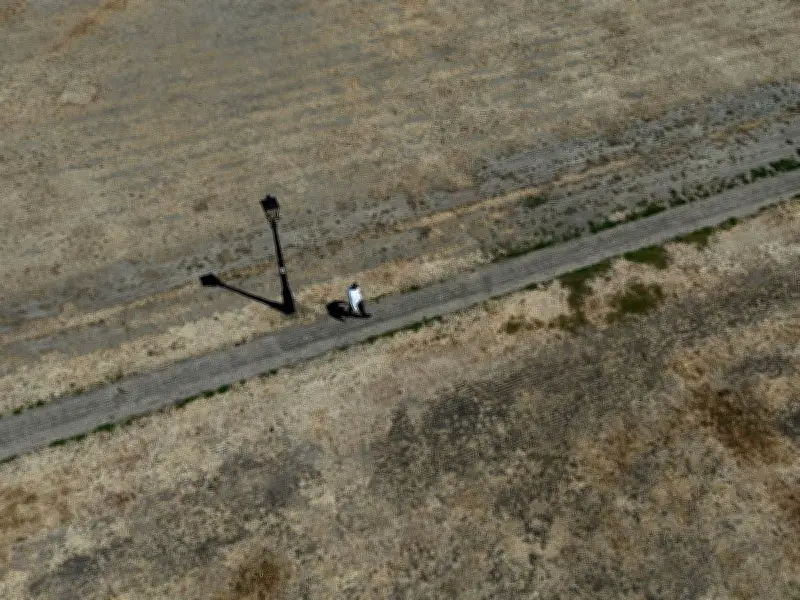
Almost half of England has officially been plunged into drought after a succession of sweltering heatwaves resulted in the driest July on record.
The Environment Agency declared drought across seven regions spanning central, eastern and southern England, warning the country is now using water faster than nature can replace it. The areas now officially in drought are East Anglia, Hertfordshire and London, the Thames Valley, Hampshire and the Isle of Wight, Devon and Cornwall, the West Midlands, and Wessex covering Dorset, Somerset, Wiltshire, and Gloucestershire.
Record low rainfall
England received just 7% of its average July rainfall, while southern England saw only 1% of what would normally be expected. The Environment Agency said the combination of a dry spring, a hot summer and repeated heatwaves triggered a "flash" drought, despite reservoirs and groundwater being replenished by a wet winter.
The announcement comes as parts of the UK endure a fourth heatwave of the summer, with temperatures climbing into the 30s. Three earlier heatwaves have already fuelled wildfires, damaged rivers and wildlife, hit agriculture and prompted hosepipe bans affecting millions of people.
Farmers warn of shortages
Many farmers say the impact is already severe. Paul Francis, of Long Farms in Suffolk, said the lack of rainfall had significantly reduced yields of rapeseed, potatoes, onions and carrots, with vegetables also expected to be smaller than usual. "You feel helpless," he said. "England is usually good for enough rain for crops and we work hard to grow them but the weather can spoil it." He warned there could be shortages of baking potatoes and onions this year, adding that supermarkets should increase prices to better support farmers facing mounting losses.
National Farmers Union deputy president Paul Tomkins said: "Farmers and growers have always had to contend with the weather, but what they are experiencing now is climate change in action. Across every sector and every part of the country, farmers and growers are seeing first-hand the impact of dry weather and drought, with more extreme conditions making it harder, riskier and more costly to produce the nation's food."
Calls for action
The NFU is urging ministers to make it easier for farmers to build reservoirs and store water by simplifying planning rules and introducing more flexible water abstraction licences. Water minister Emma Hardy said: "Our climate is changing, droughts are becoming increasingly common, and we need to be prepared for this new normal. We're delivering long-term change in the water industry and driving record investments in infrastructure, including nine new reservoirs. We expect water companies to follow their drought plans, to go further and faster to reduce leaks, and to ensure supplies are not disrupted even in the driest of weather."
Robert Palmer, deputy director of climate and campaign organisation Uplift, said: "For weeks we've watched wildfires destroy homes, crops and wildlife. Half the country is now suffering from drought. Climate breakdown is no longer a threat in the future – it's here now. Yet politicians are still considering new oil and gas drilling – the very thing driving the climate crisis. Rather than listening to the fossil fuel lobby and Donald Trump, our leaders must follow the science, which shows that the world already has far more oil and gas than can ever be safely burned. Every new oil and gas field approved, particularly on the scale of the Rosebank oil field, will lead to more harm – more severe drought, worsening wildfires, more floods. Governments need to act now, not just on how we adapt to these frightening changes, but to stop them from getting worse. That means standing up to the oil and gas firms and saying no to new drilling and Rosebank."
Weather outlook
Forecasters say little meaningful rain is expected before next week, and even then only small amounts are forecast. Met Office meteorologist Liam Eslick said the high-pressure system dominating the UK's weather is likely to persist into August and the first half of September. "We want a good soaking, a good long period of rain to come, but in the forecast at the moment, especially over the next few days, there's not actually a lot going on for England," he said. "The only time we may see a little bit more in the way of extensive rain is possibly on Sunday evening into Monday. There may be some heavier bursts, but it's not going to be long-lived. It's not going to provide anything substantial for England."




