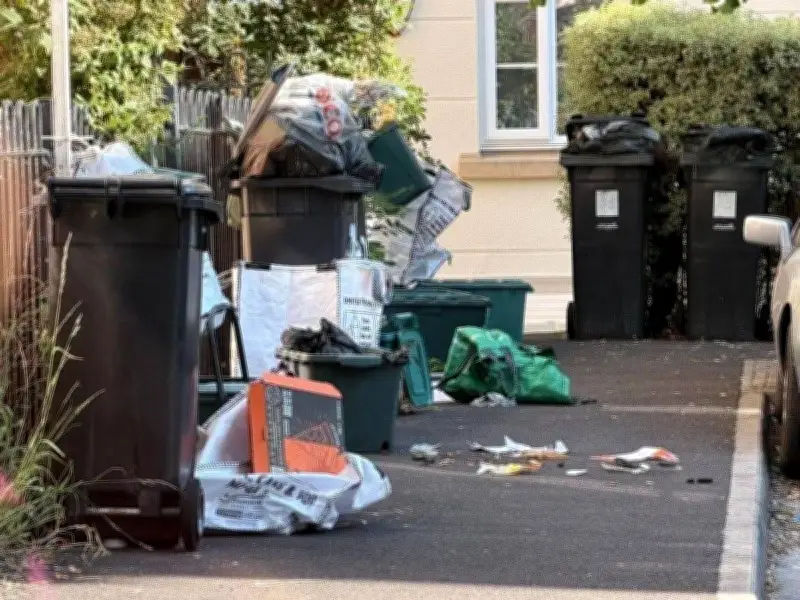
Residents living close to the University of the West of England (UWE) campus in Filton are preparing for the return of students, with locals claiming that rubbish routinely accumulates outside houses in multiple occupation (HMOs). Those living in areas including Cheswick Village, Scholars Chase and Stoke Park say they find themselves caught in a relentless cycle; waste spills over from bins or is simply abandoned on the pavement, frequently drawing vermin, prompting a wave of complaints before the mess is finally dealt with.
Locals call for coordinated effort
Locals are now demanding a coordinated effort from UWE, South Gloucestershire Council and Bristol City Council to prevent the problem from arising in the first place. "They need to work together and get a proper solution or get some extra manpower to clear the bins and waste because that is the main issue here," said Srini Boinapally, chairman of the Stoke Park and Cheswick Parish Council. "Even last year, we proposed that we were going to put extra bins out at a cost to our parish, but we didn't get permission from South Gloucestershire Council."
Mr Boinapally added: "So we are trying (on) our side where we can, but unfortunately, you know the people who are supposed to work from South Gloucestershire and also Bristol City Council, UWE, they are not doing their proper jobs. If you speak to any resident, they will say the same thing, I believe. (They should be) adding extra bins or stricter rules for the HMOs, but we can't do anything because they've already got a licence. But as I say, adding extra bins or monitoring some of these HMOs with the local estate agents would help as well."
Student numbers and waste pressure
Bristol's student population has surged dramatically over the past two decades, with more than 30,000 individuals enrolled at the University of Bristol and UWE boasting in excess of 38,000 full-time students. While they contribute significantly to the city's economy through expenditure on accommodation, food, transport, entertainment and educational materials, they also put pressure on local services, including refuse collection.
Mr Boinapally suggested that responsibility for the difficulties didn't automatically rest with students, many of whom he believed were attempting to act responsibly. Oli, who resided in Cheswick Village for a year while studying at UWE, explained that problems stemmed from inadequate bin provision for HMOs and South Gloucestershire's three-weekly collection schedule. "I lived in a house of 6 students, we only had 2 black bins," he said. "It's no wonder these are overflowing by the end of 3 weeks with the amount of people living in many of these houses, especially during the end of terms when people are moving house and doing larger cleans. This is much more of an issue recently; when I first moved into the area, the black bins were taken every two weeks, (even) when it was this frequent they would often still be completely full. As well as this, there were numerous occasions where the bins were just not taken, this just amplified the issue massively, as now you had 6 weeks (worth) of six people's rubbish, going off and trying to fit it into two bins."
He added: "With the proximity to the woods, if any scent of food was left on any packaging, foxes would be out of the woods immediately making a huge mess of the area, this isn't anyone's fault but just increases the issues with the bins in that area."
Landlord oversight and university response
Another complication stems from inconsistent oversight by certain private landlords. Multiple residents informed Bristol Live that the standard of landlords fluctuated considerably in their neighbourhood, with some maintaining strict supervision of their tenants while others showed little interest in how properties were being looked after.
A spokesperson for UWE confirmed they were collaborating with councils and landlords, as well as engaging directly with students to emphasise their obligations. "We are working closely with partners including Bristol Council and South Gloucestershire Council's waste and environment teams and letting agents to resolve this issue," the spokesperson said. "The university has developed a joint action plan with partners to ensure a collective and accountable response to this issue affecting our local community. We have been providing updates to residents on a weekly basis to keep them informed on progress relating to key issues. We also provide our students with information and advice on how to look after their environment and be considerate neighbours when living in private accommodation. A number of student ambassadors will be visiting students' homes at the start of term to promote responsible behaviours around waste management."
Residents demand action
Sejal Hampson, a resident of BS16, has been campaigning against the university and local authorities for more than five years. For her, the moment has come for concrete action to follow the rhetoric. "What is particularly frustrating is that everyone seems to recognise that there is a problem, yet nobody appears willing to take responsibility for breaking the cycle," she said. "Students move out, waste is left behind, residents complain, the councils respond, and then the next academic year arrives and the process starts again. UWE, South Gloucestershire Council and Bristol City Council all have important roles to play here. Residents are not asking for special treatment or for students to be blamed. We are asking for those organisations to work together on a proper preventative strategy, enforce the rules that already exist, and recognise the impact this recurring cycle is having on established communities."
Last year, UWE appointed a dedicated community liaison, in part to tackle concerns surrounding waste management in houses in multiple occupation. A spokesperson for South Gloucestershire also confirmed the local authority was treating the issue seriously, though acknowledged there was scope for improvement. "We continue to investigate reports of waste-related issues and respond to requests for information, while recognising that these challenges are not unique to South Gloucestershire and require ongoing effort due to the annual turnover of students," the SGC spokesperson said. "While there is more work to do, we remain committed to working with UWE Bristol, landlords, managing agents, residents and neighbouring authorities to minimise impacts and deliver sustained improvements for local communities." Bristol City Council was contacted for a response.