
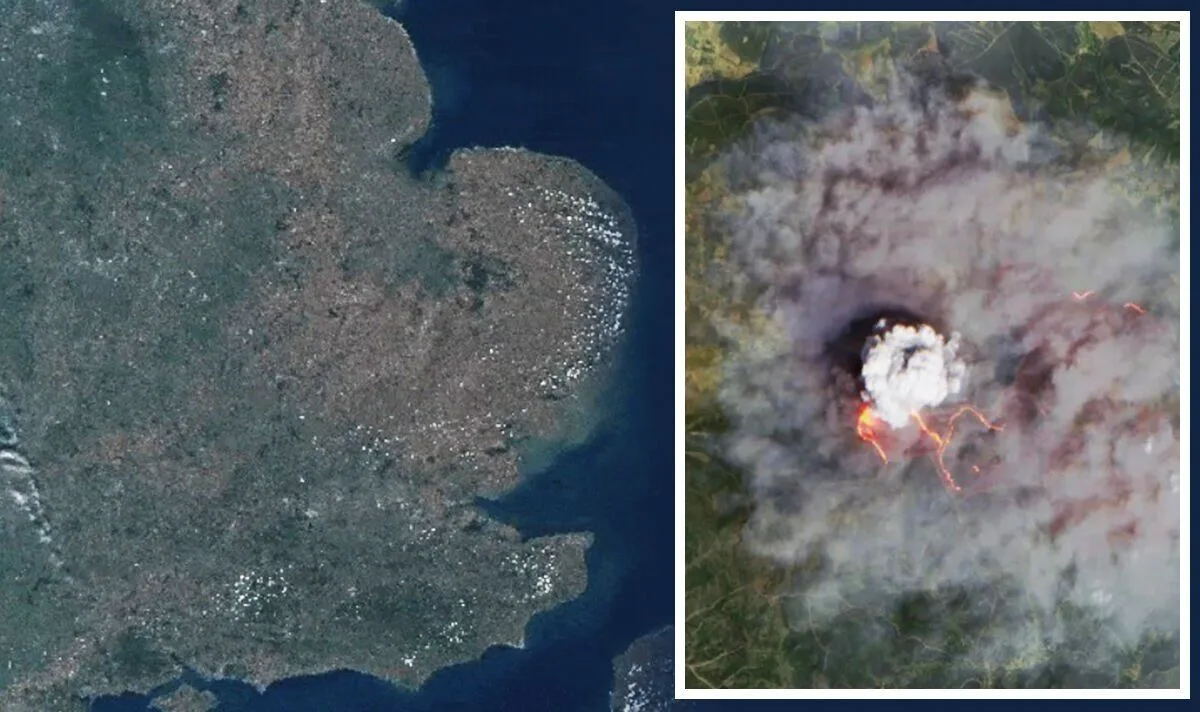
A new record for the hottest day in the UK was set on Tuesday, with temperatures reaching 40.3°C in Coningsby, Lincolnshire, surpassing the previous high of 38.7°C in Cambridge three years ago. Fire brigades in London, Leicestershire, and South Yorkshire declared major incidents as dozens of fires broke out across the country.
London Fire Brigade urged people to stop having barbecues as 110 fire engines battled blazes across the capital. In the village of Wennington, a large fire destroyed homes and threatened a church, while grass fires around London sent smoke over major roads. Satellite images show the UK's usually green landscape turned brown due to the heat.
Across Europe, wildfires are devastating several countries. In southwestern France, the Gironde region is experiencing its largest wildfire in over 30 years, with 19,300 hectares burnt and 34,000 people evacuated since July 12. A man has been detained on suspicion of arson. Elsewhere, fires are raging in Croatia, Greece, Italy, Portugal, and Spain. Near Athens, a wildfire fuelled by gale-force winds forced evacuations of nine areas and a hospital.
Europe is warming faster than other parts of the world, with average temperatures already 2.2°C above pre-industrial levels, according to Copernicus data. This exceeds the global limit of 1.5°C that countries aim to stay below to mitigate climate change. June 2022 was the third warmest globally and second warmest in Europe.
Climate experts link the increase in heatwaves to human-induced climate change. A study in Nature found heatwaves in Europe have increased three to four times faster than in other northern mid-latitudes due to changes in the jet stream. Scientists warn that temperatures will continue to rise unless greenhouse gas emissions are cut, and current policies are insufficient to meet the Paris Agreement goals.




