
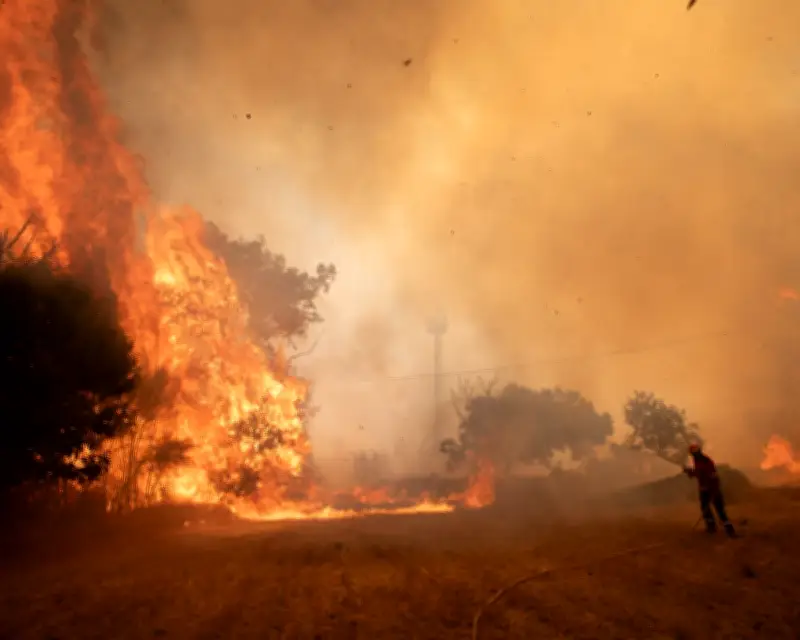
Spain has changed immeasurably since I arrived 10 years ago as the Guardian's Madrid correspondent. Over that time, the push for Catalan independence has exploded and faded; Covid hit with ferocity; and upstart parties rose and fell. But one change has eclipsed all others: the climate emergency. A decade ago, I could never have imagined how much time I would spend reporting its effects here and in Portugal, nor that things would get this bad this fast.
Europe is the fastest-heating continent, warming at more than twice the global average, and the Iberian peninsula has become the frontline. The wildfires still burning in Spain and France – which have led to the evacuation of about 330,000 people since last week – are merely the latest manifestation.
Autumn 2024: A Turning Point
In September 2024, I walked through the northern Portuguese municipality of Albergaria-a-Velha, seeing blackened trees and ruined houses. Fires killed nine people, injured dozens, and razed 100,000 hectares across northern and central Portugal, fuelled by strong winds and temperatures over 30C (85F). It brought back memories of the 2017 blazes that claimed 66 lives. João Oliveira, the head of the civil protection agency there, said: “The amount of energy the fire created, the amount of damage it did and the intensity and violence of the fire, were something we’d never seen before.”
Four weeks later, I stood in Utiel, eastern Spain, after floods killed more than 230 people in the Valencia region. Ruined houses, wrecked cars, and a carpet of thick mud. The only reference points were the super El Niño in Peru in 1998 and the Nepal earthquake in 2015. But now, such destruction is becoming an almost annual fixture in Europe.
Warnings from Across the Continent
Helena Smith, the Guardian's Greece correspondent, recalled Eleni Myrivili saying in 2021, “Heat will be the story of the next decade.” She added: “It was inconceivable it could be worse. And, yet, every year it is: testimony to the irrefutable fact that the climate emergency is our runaway train.”
Angelique Chrisafis, the Paris correspondent, told of a 10-year-old boy whose top-floor school classroom reached 40C, and whose flat left his mother dizzy and struggling to breathe. Three weeks ago, I spoke to Jeanne Henny, a British woman who would have burned to death in her car had she not risked a three-point turn while fleeing flames in Almería. On Saturday, I visited evacuees west of Madrid; one man said: “The sky turned orange and looked very apocalyptic. It felt like the end of the world.”
Two Unforgettable Stories
In Utiel, Miguel Aleixandre described the night of the floods: as waters rose to three metres, he saw elderly neighbours signalling with candles at windows, hoping for rescuers who sometimes arrived too late. He heard windows breaking as floodwaters poured into homes of people who would soon drown, trapped.
Fifteen months earlier, in Tábara, I heard about Ángel Martín, a 53-year-old builder who climbed into his excavator to dig a firebreak in the Sierra de la Culebra. Within minutes, he and the vehicle were swallowed by flames. Video of him emerging, his clothes consumed, went around the world. He suffered burns to 80% of his body and died three months later. His friend Montse Fernández Blanco said: “He would have done it again because that’s what he was like.”
Four years after Martín's death, and two years after the Utiel floods, the same arguments, denial and political point-scoring continue to hamper preparation. We can hardly say we weren't warned.




