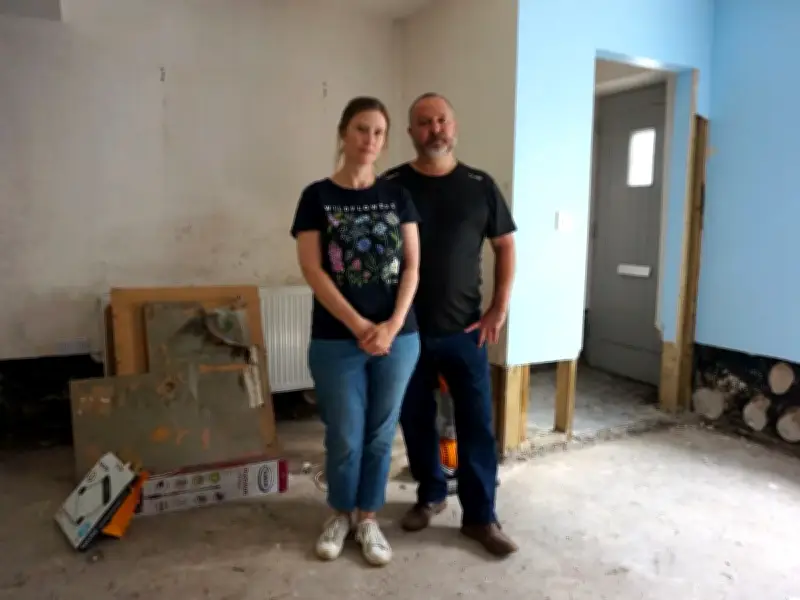
Tina Honeyfield and Ralph Connor, whose home on Woodland Terrace in Cwmtillery was severely damaged in the coal tip slide of November 2024, are still unable to return nearly two years later. The couple, who have two teenage children, face a bill of more than £51,000 for damp treatment and replacement flooring before they can move back, and that figure does not include the new furniture and appliances they need. Repairs have been delayed by contamination checks.
Their home was one of many damaged when the coal tip slide left the street and numerous homes submerged in mud and filthy water on 24 November 2024 during Storm Bert.
Call for lessons from Aberfan
Ralph told the Stories from Round Our Way podcast this summer: “Luckily it was just the edge of the tip that came down. If more had come down, we wouldn’t be speaking with you today. After Aberfan, you would have expected all tips to be dealt with so that could never happen again, but it hasn’t.”
He added: “In the past these were once in a lifetime weather events, but Storm Dennis and Storm Bert only four years apart … a visible result of changing climate. If nothing is done about climate change, communities like this - the poorest communities - are always going to be the ones that suffer the most. We are going to have more devastating floods and more landslides if people and governments don’t start thinking in a long-term way.”
Category D tips and ongoing risk
There are four coal tips in a ring around Cwmtillery, one of which is rated as Category D, the highest risk category, meaning it has the potential to impact public safety and requires twice-yearly inspections. Wales has 85 Category D tips and 368 in Categories C and D.
Tina and Ralph work as directors of a local community organisation, Pentref Tyleri. Standing in her gutted living room, Tina said: "I never thought my daughter would hear the same sound the Aberfan children heard that day."
The 51-year-old described the event: “We’d not seen rainfall like that before. I didn’t recognise the street anymore. I couldn’t make sense of what I was seeing. There was a river of mud up to our windows, and a huge tree had come down. Then our daughter came downstairs saying she’d heard something ‘like a low flying jet’, a really big rumbling. Reading the reports from the Aberfan disaster, that’s exactly what people said, it sounded like a ‘low flying jet’.”
Moments before, Tina had been going through old family photos on their living room floor. The family moved everything valuable upstairs and were evacuated, leaving behind their beloved cat.
Government funding and new authority
The Welsh Government has been lobbying for funding from the UK government to pay for the nation's coal tips to be made safe. Next year, the Disused Tips Authority will be established to take over all safety functions currently held by a number of different bodies. It has estimated that the cost of coal tip remediation will be at least £600m over the next 15 years, though this is only an initial estimate. So far, the UK Government has committed to provide £39.3m a year from 2026 to 2029.
Daniel Therkelsen of Coal Action Network called for the Welsh government to go further. He said: "We welcome the new Coal Tips Safety Authority, but it has a very narrow remit on tip safety. We work with valley communities who continue to feel not enough is being done more generally about the safety risks and environmental condition of opencast scars on their landscape, and complain that the derelict condition of coal tips can attract anti-social behaviour. The new Disused Tips Authority won’t address these concerns with its current remit – we need the Welsh Government to commit to taking action."
Context of past landslides
In 2020, Tylorstown in Rhondda Cynon Taf was hit by 60,000 tonnes of spoil in another landslide during Storm Dennis. That event triggered the Welsh government to map and categorise coal tips for the first time.
Cabinet Minister for Rural Resilience and Sustainability Llyr Gruffydd called the Tylorstown landslide a “wake-up call” and called for “vigilance” in the face of climate change’s impacts. He said: “We know the industrial legacy that we have across Wales in terms of disused tips. But we also know that whilst we presume that the tips have been stable for many years, climate change is introducing a new challenge. We have longer periods of heavy rainfall, drought and dry weather, which have a destabilising effect on what might have been safer tips in the past. That’s why this programme of monitoring, maintenance and management is being put in place and it's exactly why the Disused Tips Authority is coming into being. The new authority will be charged directly with oversight of this to give us confidence that where we need to act, that absolutely happens to make sure that those communities living nearby aren't put at any risk.”
After the 2024 landslide, Blaenau Gwent Council secured £1.3m for swift remediation work on Cwmtillery, installing new drainage systems to avoid waterlogging the tip, while £3m will be spent over the next two years on reprofiling and landscaping.
Elsewhere in the Valleys, some have transformed their coal tips from a public safety risk into nature reserves, recreational areas for local use, or art such as Sultan the Pit Pony, made of coal shale on the site of Penallta Colliery near Caerphilly.
A spokesperson for Blaenau Gwent council said: “The tip is inspected at six-monthly intervals which is the established inspection frequency for Category D tips, and prior to named storm events or weather warnings. The cause of the slip was directly related to the intense rainfall during Storm Bert, which caused a breakout of water in the hillside immediately above the tip. This saturated the material resulting in the slip. Prior to this incident, there was no evidence of any water issues within the slip area of the tip and this was a one-off unpredictable event directly related to the storm. Together with the Mining Remediation Authority, we continue to monitor the tip closely, and even more frequently before and during forecasted significant weather events.”
The question remains of whether the Cwmtillery tip will stay a memorial to a terrible day, or be reclaimed into something entirely new.