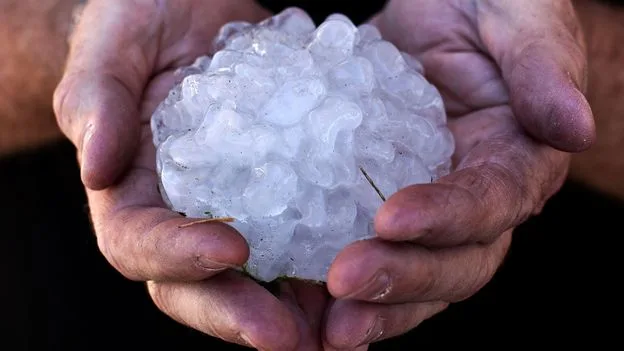
A warmer world will likely make bigger and more damaging hail, a new study has found. Because climate change from the burning of fossil fuels should create more high-energy unstable air conducive to hail formation, global storms pelting roofs, cars and the ground with hail larger than a large marble will increase between 38% and 47% by the end of the century, depending on the amount of heat-trapping gas emitted, according to research published in Wednesday's journal Nature. Storms producing smaller hail will shrink by 4% to 8%, the researchers discovered.
Hail's Economic Toll
Hail generally does not kill people, but it is expensive. It already costs the United States about $10 billion annually and around $80 billion globally, said study co-author John Allen, a meteorology professor at Central Michigan University. Hail causes more damage than tornadoes and generally costs "more than a couple hurricanes a year now," Allen said from Guymon, Oklahoma, before heading out with scientists who drive into the heart of hailstorms to understand their formation. "We've seen record hailstones in recent years. I find this extremely concerning because we are not really building our environment to be resilient to hail. We do not include this in our design standards, for example, for built homes in the U.S. or indeed internationally."
Bigger Stones, Bigger Problems
Allen's computer simulations show the proportion of larger stones will grow with climate change. These are the ones that cause more damage, he and outside scientists said. Bigger stones weigh more and fall through the air faster, striking with greater force. While small hail can damage crops, large hail around 2 inches (5 centimeters) "can cause major damage to vehicles, roofs, solar panels, and other infrastructure," said Andreas Prein, a climate scientist at ETH Zurich, who was not involved in the study. One hole in a roof from a single hailstone can be patched, but many large stones hitting a roof usually means an expensive replacement, Allen explained.
The Science Behind the Increase
Warmer air holds more water vapor — nearly 4% more per degree Fahrenheit (7% per degree Celsius) — and "that increases the available energy to the atmosphere, so we tend to get stronger updrafts," Allen said. "And that leads to more thunderstorms with updrafts capable of producing hail." However, with warmer air, there is less cold at high altitudes for smaller hailstones, causing them to melt more, whereas larger ones do not, Allen noted. Previous studies have mostly focused on hail in the United States, which experiences the most hail, and did not employ the three-dimensional modeling of hail formation that this new study has done, with lead authors from China. Other studies have examined potential increases in frequency rather than size.
A Global Problem
Argentina, Europe, Canada and the U.S. Northern Plains will likely see the biggest increase in larger hail, while parts of the tropics should experience a reduction due to smaller stones melting, Allen said. "Hail is not just a U.S. problem," he added. "Yes, we do see large losses here, but the global hail losses seem to be something that is really spiraling in recent years." Study authors examined hail larger and smaller than 1.2 inches (30 millimeters) in diameter, roughly between a marble and a golf ball, and about the size of a U.S. 50-cent coin. They considered three scenarios based on carbon emissions from burning coal, oil and gas. In a slightly optimistic scenario with less carbon pollution, larger hail increases by 38%. In a more pessimistic scenario, where temperatures rise nearly 2 degrees Fahrenheit (1 degree Celsius) warmer than the other scenario, larger hail jumps by 47%.
"This is a meaningful climate signal," said Walker Ashley, a Northern Illinois meteorology professor not involved in the study. "But disaster losses are not driven by the peril alone." As more people, houses, solar farms and infrastructure move into areas prone to hail, the risk and damage increase, Ashley said. He added: "Climate change may be increasing the potential for larger, more damaging hail in some regions, but the future loss signal will also depend heavily on where people build, what they build, how resilient those structures are, and how land use changes."






