
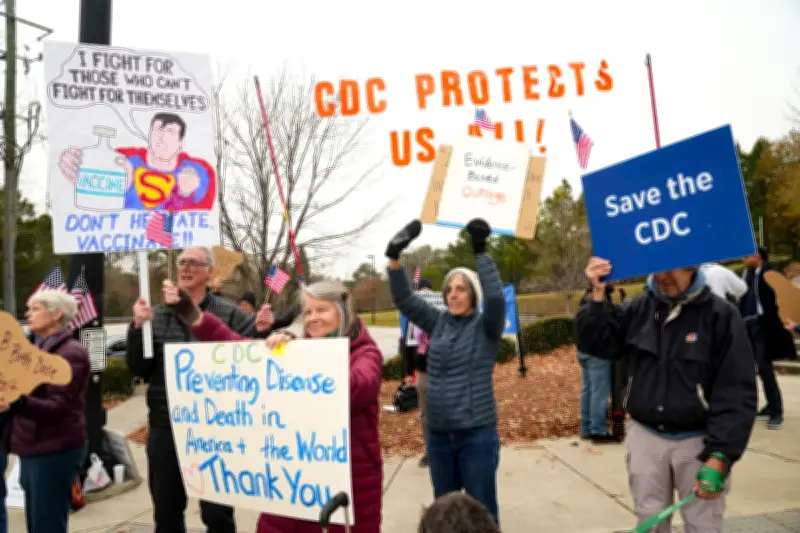
A series of health challenges – hantavirus, screwworm, Ebola, cyclospora, measles, whooping cough, bird flu – are exposing widening gaps in America’s ability to prevent, identify and halt infectious disease outbreaks, according to former top CDC officials.
The rapid dismantling of the US public health system at all levels means the US is in worse shape than it was before the Covid pandemic, they say.
Funding and Staffing Losses
The US Centers for Disease Control and Prevention (CDC) lost much of its funding for battling parasites in the last year. Experts tasked with monitoring potential outbreaks – such as cyclospora – saw their funding decimated, and many were laid off or resigned without being replaced.
“Are we ready for the next big pandemic? My answer is no,” said Dan Jernigan, former director of the CDC’s National Center for Emerging and Zoonotic Infectious Diseases.
Debra Houry, former chief medical officer of the CDC, told the Guardian: “Unfortunately, we’re really moving in the wrong direction.”
Some 80% of senior leadership positions at the CDC still have no permanent officials appointed, and between 25 and 30% of the CDC’s entire staff are gone.
“Those are boots on the ground,” Houry said. “When you have Ebola, hantavirus, measles, and throw cyclospora in there – staffers were already spread thin, and now they’re spread even more thin.”
Impact of USAID Cuts
When the Trump administration effectively dismantled the US Agency for International Development (USAID) last year, the CDC lost around $40m in funding to fight malaria and neglected tropical diseases. That meant 35 employees – out of 73 – were laid off from those divisions. The program clawed back $4m but faces an uncertain future.
“We’re not where we would have been with parasitic diseases because of the changes that happened to USAID,” Jernigan said. “The laboratory methods you use and the expertise and the microscopy and all of that stuff is the same… So the expertise in parasitic diseases has dropped.” The CDC laboratory specializing in cyclospora, for instance, has fallen from 11 people to three.
It’s the same with other pathogens: very few mpox and Ebola experts remain on staff. Millions in funding for mRNA vaccines, which would be “significant” for battling the next pandemic, has been cut, Jernigan said. More than half of US states have passed laws limiting public health actions during emergencies, and the US just surpassed last year’s measles tally.
Conflicting Guidance
Leaders’ ideological approaches make the confusion worse, Jernigan said. “When confronted with complex situations where decisions need to be made quickly, their gut response might be one driven by ideology rather than by what the data is actually showing.”
Take hantavirus: first, officials said passengers from the MV Hondius could quarantine at home, but then required some to stay in a biocontainment facility. Even when a CDC medical officer said home quarantine would be sufficient, Robert F Kennedy Jr, secretary of the US Department of Health and Human Services (HHS), overruled the decision.
“When you have conflicting messages, how do states then respond to things like CDC guidance?” Jernigan said.
A similar story is playing out with Ebola. Between 100 and 150 people land in the US every day needing monitoring. New travel guidance adds confusion: American travelers from the Democratic Republic of Congo must quarantine in a third country for three weeks, but travelers from the region also must monitor symptoms for three weeks after entering the US.
Precarious Time for Public Health
“It’s difficult for states to implement this guidance that isn’t based on science and often not on logic, coupled with the staffing and budget cuts,” Houry said, calling this a “precarious” time for public health.
Those who remain at the CDC are working hard, but their ability to manage complex crises – including a multi-state response like the cyclosporiasis outbreak – has been compromised. The US will continue seeing pathogens that could have been contained earlier or prevented altogether because of these cuts, Houry said.
“When you’ve got 30% less workforce, that’s 30% less people able to respond, and when you’re losing specific experts with backgrounds in some of these rare diseases, there’s not the capacity then,” Houry said. It’ll take time to rebuild that expertise even when the CDC is re-funded.
There were cuts under the so-called “department of government efficiency” (Doge), like ending a program to bring in early-career laboratory and epidemiology staff, but some employees also retired early or left and were not replaced, Houry said. “We lost a lot of our lab scientists, and some of our specialized experts on things like rabies – those you can’t replace overnight.”
While officials have focused on getting the CDC back to its size before Covid, the pandemic revealed the need for the opposite approach, Houry said. “During the Covid pandemic, that’s where we saw we didn’t have enough staff to go around the nation to respond to outbreaks, and public health was already significantly understaffed in state and local health departments. It was a time to try to get right-sized, not oversized. And unfortunately, reverting back to more of the 2019 size leaves us woefully underprepared to respond to outbreaks, as we’re seeing.”
Regional Alliances Step In
In the absence and confusion of federal leadership, other organizations are taking the lead. The Association of State and Territorial Health Officers coordinates regular calls for state health officials, and regional organizations like the Northeast Public Health Collaborative and the West Coast Health Alliance – for which Houry is a consultant – have formed to collaborate on vaccination and crisis management.
“Now you’re starting to see more regional alliances forming to better track things,” Houry said. “Like with measles – we very much see that it doesn’t stay within a city or state. So as a result of this moment, we’re seeing others step in to fill the gap.”




