
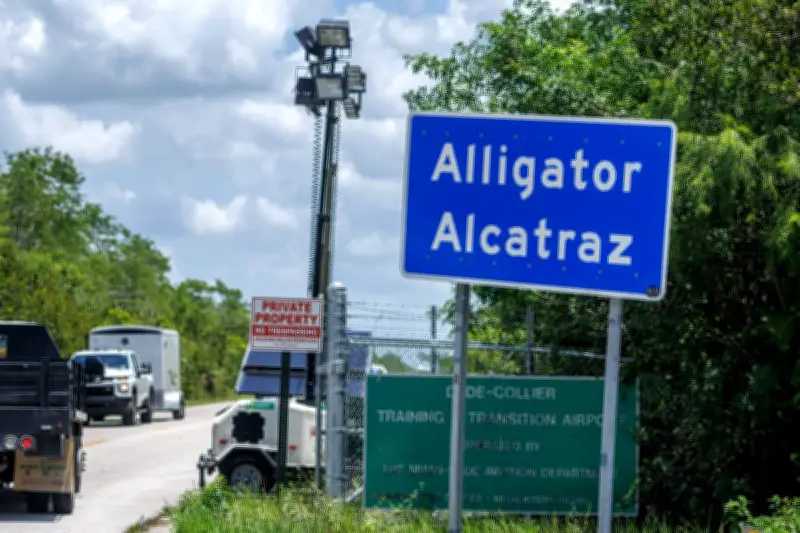
Environmental groups and immigrant-rights advocates are calling for an independent investigation into the environmental damage inflicted by the Alligator Alcatraz migrant detention center, even as they welcome its recent closure. The demand was made at a news conference on Friday outside the shuttered facility in Ochopee, Florida, attended by the Friends of the Everglades (FOE), the Miccosukee Tribe, and the Florida Immigrant Coalition.
Environmental Harm Documented
FOE executive director Eve Samples condemned the camp as “a failure, an obscene waste of taxpayer dollars and an abuse of the Everglades.” Her non-profit filed a lawsuit in June 2025 to halt construction at the site, which the Miccosukee Tribe joined to defend tribal rights. The $608 million facility was built to detain undocumented immigrants during the second Trump administration’s immigration crackdown.
During four days of hearings in a federal courthouse in Miami in August 2025, FOE presented evidence of significant environmental harm, including the paving of 20 acres (8 hectares) without required permits and the installation of new fencing and high-intensity lighting. The bright lights were shown to directly impact an estimated 2,000 acres (800 hectares) of Florida panther habitat, as the big cats are displaced by unnatural lighting during nocturnal movements.
Ongoing Hazardous Waste Hauling
Speakers at Friday’s news conference noted that hazardous materials continue to be trucked into the former premises, while vehicles containing human waste are still leaving the site. Florida Governor Ron DeSantis, in announcing the formal shutdown on Thursday, defended the hiring of sanitation vendors to haul waste, stating the high construction cost was partly due to the facility’s design as a “self-contained” operation. He claimed, “They did a really good job of keeping this contained so that it didn’t have that impact on the surrounding environment,” especially “given what we’ve done to support Everglades restoration.”
Location and Ecosystem
Alligator Alcatraz was built in the middle of the Everglades ecosystem, opposite an airstrip about 45 miles (70km) west of downtown Miami. It is surrounded by the Big Cypress National Preserve, a 720,000-acre swamp managed by the US National Park Service. The preserve is home to alligators, crocodiles, eastern diamondback rattlesnakes, bobcats, coyotes, and Florida panthers, whose population is believed to be about 200. The mosquito-infested preserve features a wet cypress forest, though few giant cypresses remain. Native American villages and airboat tour operators line the Tamiami Trail, and anglers frequent a canal parallel to the two-lane highway known as Alligator Alley.
Human Toll Highlighted
Ana María Hernández, civic engagement director for the Florida Immigrant Coalition, highlighted the human toll of the detention center. She described her cousin’s husband, Wilson, a Cuban immigrant who entered the US at the start of the century and had legal status under the Cuban Adjustment Act. For 25 years, he routinely renewed his status with ICE, but in January 2025, he was arrested without explanation during a routine visit and transferred to Alligator Alcatraz. There, he was allowed to shower only every three or four days, and on one occasion was issued underwear stained with feces. After more than five months of being shunted between facilities in Texas, Louisiana, and Florida, Wilson was released in June 2025. Hernández said the experience shattered her trust in the US, stating, “In Florida people are being detained because of the color of their skin or because they speak English with an accent. This is how people who have legal status or are US citizens end up in custody.”




