
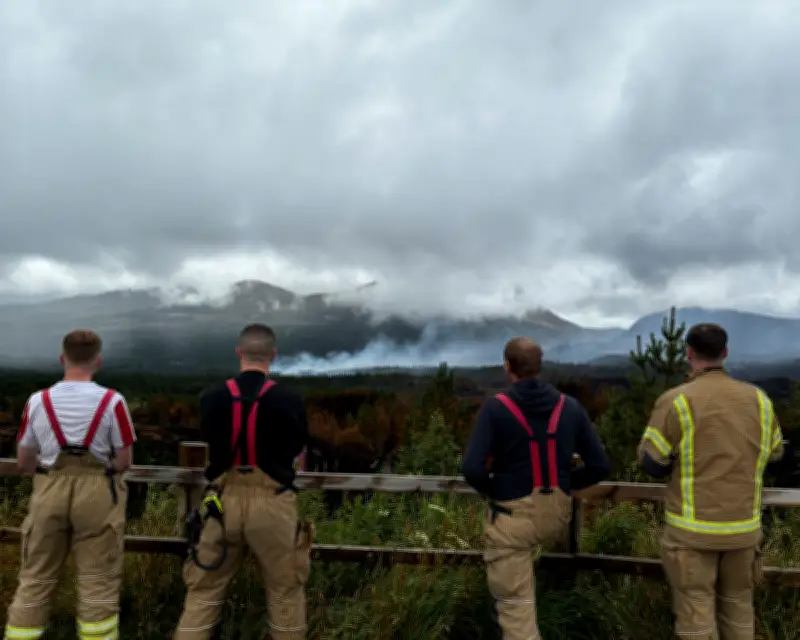
Swathes of the Cairngorms national park are unrecognisable after 12 days of what has been described as its worst wildfire. Blackened land and smoke billowing from still-burning areas were visible as low cloud cleared on Sunday. The sky glowed an eerie orange in the evening.
Months to extinguish, decades to recover
Authorities have warned the danger is far from over. It will be weeks, if not months, before the blaze is fully extinguished, but emergency services hope they can stop it spreading much further. The damage so far is significant and will take decades to put right.
Damage to Caledonian pinewood forest
Flames have claimed areas of the Caledonian pinewood forest, which contains Scots pine trees up to 300 years old. However, most of the older forest was saved by fire breaks urgently bulldozed in the early days. Ian Allsopp, Forestry and Land Scotland planning manager for the north region, said: 'For rare habitat loss, it really is a challenge.' Larger animals like deer would have escaped, but smaller mammals, lizards, insects and ground-nesting birds would have perished.
Worst fire in park history
Grant Moir, chief executive of the Cairngorms national park, told the Guardian: 'The fact that this is right in the centre of the Cairngorms, in the actual Cairngorm mountains and Abernethy – it is such a precious place.' A national park bylaw introduced in April bans campfires and barbecues over the summer to reduce ignition points. The cause of this fire is still unknown, but the vast majority of UK wildfires have a human origin, such as a discarded cigarette or abandoned glass bottle.
Response and community impact
Police Scotland said on Saturday night it was no longer treating the fire as a major incident. However, anxiety remains high, especially after residents of Nethy Bridge were evacuated on Friday night when strong winds fanned the flames despite earlier reports it was 'contained'. Residents have now been told they can return home. The Nethy Bridge community centre is being used as a base for emergency services, with donated food and volunteers working tirelessly.
Sandy McCook, a retired press photographer from the village, said: 'It's absolutely heartbreaking. The flames on Friday were cataclysmic.' He also expressed anger, showing a photo of the fire when it was only the size of a tennis court. 'Had we had a helicopter there on government contract to deal with such incidents, that fire could have been dealt with within two hours of it being reported,' he said. He wants a model similar to the Scottish air ambulance, with a specialist firefighting helicopter and crew able to scramble.
Helicopter assistance and calls for public aircraft
Three private helicopters have been contracted to provide assistance, depositing approximately 750,000 litres of water a day on hotspots. Allsopp said it was 'so lucky' the helicopter companies could assist in water-bombing what he called an 'inferno'. The Cairngorms area is an 'extremely challenging landscape', including steep mountains and forest, and 'access is so difficult, you just can't get people up here'.
On Monday, the Scottish Green party called for publicly available firefighting aircraft during the wildfire season, saying Scotland 'cannot continue to rely on a patchwork of private operators and borrowed resources'. The UK government offered military support on Sunday but said it had no access to specialist firefighting helicopters requested by the Scottish government.
Ongoing operation and weather
Firefighters said an 'intensive operation' was still under way, but better weather conditions, including heavy rain and low winds, had slowed the fire and limited its spread. More than 75 firefighters remained at the scene, the Scottish fire and rescue service said on Sunday. Light rain has brought some relief, but Allsopp said: 'Wet weather is not enough to put out the fire on its own.' It requires helicopter water-bombing 'for days and days and days' to contain it.
The operation is a massive coordinated effort between Forestry and Land Scotland, the national park authority, police, fire service, RSPB, Highland Council and other partners, with assistance from the Scottish and UK governments. Allsopp noted that each organisation has worked well together. 'Even our accountants are here, running errands and getting water and sun cream for people,' he said. 'At times, it has been completely overwhelming and we've been struggling to keep up. It feels like a war strategy.'




