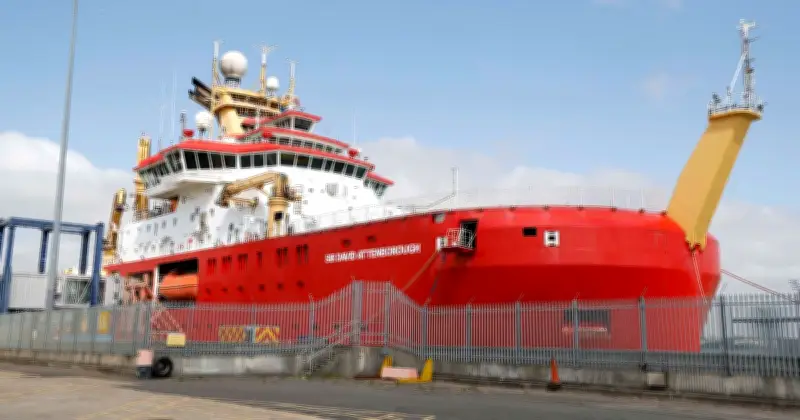
The UK's £200 million polar research ship, RRS Sir David Attenborough, has set sail on a six-week expedition to Greenland to study one of the most pressing questions in climate science: how rapidly melting ice sheets are pushing vital ocean currents toward collapse.
Cutting-Edge Technology Deployed
The vessel, which left Harwich International Port on Thursday, carries a fleet of airborne drones, marine robots, satellites, and sensors to collect data on glaciers near Kangerlussuaq Fjord and the surrounding ocean. Advances in technology allow scientists to examine the ice sheet in ways unimaginable just a few years ago.
Boaty McBoatface, the world-famous autonomous underwater vehicle named by the public in 2016, will be deployed from the ship for the first time as part of what the British Antarctic Survey (BAS) calls "the James Bond of science missions." Two senior scientists on the voyage have been given the codenames "Q" and "M," after the gadget-loving quartermaster and MI6 chief in Ian Fleming's James Bond stories.
Key Questions About Ocean Heat and Ice Melt
Dr. Kelly Hogan, a marine geophysicist at BAS, stated: "We're in a moment where our tools have finally caught up with our questions." She added: "Our biggest question, probably, is how heat in the ocean is getting right up against the Greenland ice sheet and melting it or causing it to make more icebergs." This process can impact ocean currents that bring heat to the UK.
Dr. Hogan explained: "We have so many cool, frontier technologies working autonomously. That means they are launched from the ship and piloted from here on pre-planned missions. We're using those to go right up against the ice. This is an area we don't have many measurements from because it's too dangerous for people to go in ships."
AI and Autonomous Systems at Work
The mission also employs artificial intelligence and computer simulations to understand how ocean heat reaches the ice and causes melting. For the first time, any craft will venture into the dark, dangerous waters beneath icebergs in front of crumbling glaciers, known as ice mélange.
A group of researchers will camp near the glacier to collect additional data on ice behavior. An instrument called Adios will be installed on the glacier to measure its speed, and Geo Pebbles—GPS-enabled seismic sensors—will record cracking and calving events. A first-of-its-kind instrument, Meltstake, will be lowered into the water by a remotely operated boat to drill into ice 100 meters below the surface and measure heat transfer.
Impact on UK Weather and Agriculture
Dr. Hogan emphasized: "What happens in Greenland really affects what happens in the UK. So if you melt more ice in Greenland, you get more freshwater into the North Atlantic, that can slow down the transfer of heat to Europe. And in the short term, like in 10 years, what could happen is that would change where it rains in the UK and it would be more stormy in our winters. That's a real problem if you're a farmer, if you're looking at where our reservoirs are located, if you count on fish stocks in the North Atlantic for your job."
Early Warning System Development
Researchers aim to develop a prototype early warning system to provide advance notice of rapid glacier change. Ocean scientist Professor Paul Holland of BAS uses computer simulations to understand ice loss and climate change impacts. He said: "We're going to watch with satellites the icebergs retreating backwards. If we see the glacier really start to speed up, and emit a lot of icebergs and fresh water into the North Atlantic, then that would trigger an alarm and it's that process of alarming that we're trying to work on."
Giant Project and International Collaboration
The fieldwork is part of a five-year project called "Greenland Ice sheet to Atlantic Tipping points" (Giant), a collaboration of 17 international partners led by BAS and funded by the UK's Advanced Research and Invention Agency. The vessel made global headlines in 2016 when nearly 125,000 public votes chose the name Boaty McBoatface. Officials decided against naming the ship that, instead giving the moniker to a yellow remotely operated sub-sea vehicle. Sir David Attenborough, who came fifth in the vote, hoped everyone would feel inspired to follow the ship's progress.
Dr. Hogan noted: "We will have 82 people on board. About half are scientists, the other half crew and officers. We will spend about six days to get to Greenland and then about 30 days working." A helicopter will join to transport people to shore as part of 24-hour science operations. The data collected will be available in easy-to-understand formats for experts in other fields, such as defense.