
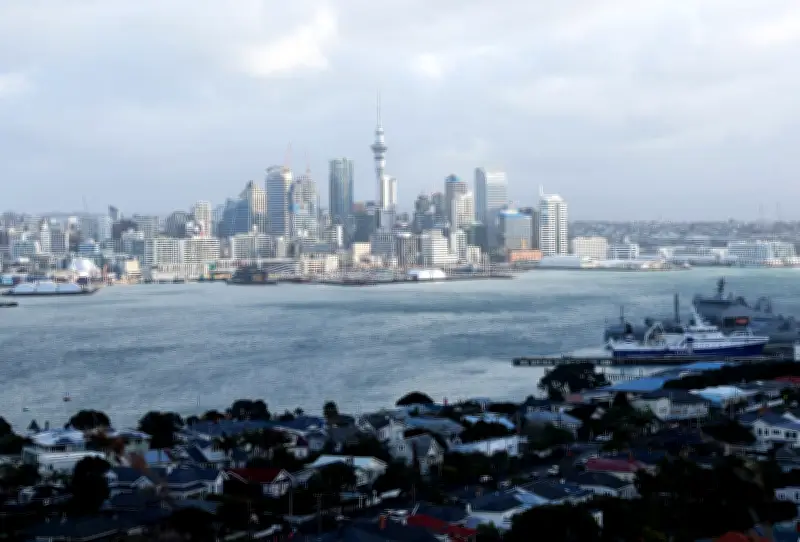
Most of New Zealand’s earthquakes occur in the south, but a new study suggests the northern city of Auckland could have a greater risk than previously thought.
Auckland Sits Near an Active Faultline
Auckland sits near an active faultline, new research suggests, raising questions about what next for New Zealand’s biggest city. The city is exempted from earthquake building rules due to its northerly location, but a study of the Mangatangi Fault has thrown that into question.
A fault line south of Auckland is active and could trigger a devastating earthquake, new research shows, dispelling the region’s long-held belief it was largely immune from intense seismic activity. The research has also raised questions over the recent decision to exempt Auckland from earthquake building regulation.
The Mangatangi Fault
The Mangatangi Fault, which runs along the Hunua ranges, is situated roughly 50km south-east of Auckland’s central city and is close to the southern suburbs Pukekohe, Drury and Takanini. Research published in the New Zealand Journal of Geology and Geophysics shows the fault has ruptured in the past 10,000 years and could cause a 6.8 magnitude earthquake. A fault that has moved in the past 125,000 years is considered active.
“If the whole fault ruptured, there would likely be serious consequences for people living in South Auckland, and possibly further into central Auckland as well,” said geologist Dr James Muirhead, a senior lecturer at the University of Auckland and co-author of the research.
Seismic Risk Context
Auckland has a lower risk of shaking compared to other regions, according to the national seismic hazard model, which was updated by crown research institute GNS Science in 2022. A single study may not change those results. However, it marks the first time a faultline in Auckland or the Hunua Ranges has been radiocarbon dated, which reveals exactly when a fault last ruptured. The study showed how little is known about the region’s seismic history, Muirhead said.
Anna Kaiser, the chief scientist for earthquake hazards at Earth Sciences NZ, a public research organisation, said the study alone may not change the bigger picture of Auckland’s seismic risk relative to other regions but was important for building local knowledge and refining the national seismic hazard model. “It’s best not to worry if we can but it is best … to really use the evidence, the information we have, to be better prepared for the case of future earthquakes.”
New Zealand’s Earthquake Activity
New Zealand sits on the boundary between the Australian and Pacific tectonic plates, and the country experiences roughly 20,000 earthquakes a year. Of these, roughly 250 will be strong enough to be felt. Some have been catastrophic, including the 6.3-magnitude earthquake that struck Christchurch in 2011, killing 185 people and reducing 80% of the city centre to rubble.
Most earthquakes occur in the South Island and the lower parts of the North Island, and while Auckland experiences very small earthquakes, it was thought to be at low risk of greater seismic activity.
Building Regulations Under Scrutiny
That belief led Auckland’s mayor, Wayne Brown, to lobby the government to change building regulations for Auckland in 2023, saying there had been no earthquakes in the past 100,000 years. In 2025, the government announced it would exempt the city from rules for earthquake-prone buildings, meaning no strengthening work will be required.
But Auckland’s hazard risk may now be “significantly higher” than the public and policymakers believe, Muirhead said, and further research into Auckland’s faultlines is needed to determine whether the government’s settings are fit for purpose. “We could see that the risk is actually lower than what we think right now, but we could also collect data and find actually it’s a little bit higher, and at that stage…we should really think about whether we have the right legislation for buildings in the city.”
In a statement, the minister for building and construction, Chris Penk, said emerging research on Auckland’s fault lines will be considered but “a single study does not in itself warrant an immediate change to the proposed classification or regulatory approach”.
Brown, meanwhile, called the research “nonsense” in a statement to the Guardian. He said: “What you’ve got around the harbour is sedimentary sandstone right along the cliffs. That’s the same stuff that’s underneath my city. There may be a fault line a long way from here, but it’s quite different geology from what’s in my city.”
For researchers like Muirhead, investigating whether other faultlines are active and looking for evidence of prior earthquakes in Auckland is a way to safeguard the city from what happened in Christchurch. “We currently don’t know if there is another Christchurch-style event waiting for our city, and we really need to check that.”




