Antarctica's Ice Loss Equivalent to Eight Greater Londons Over 30 Years
A comprehensive scientific study has revealed that Antarctica has lost an area of ice more than eight times larger than Greater London over the last three decades. Using satellite data collected since the early 1990s, researchers have meticulously mapped the frozen continent's shrinking borders, uncovering alarming patterns of ice retreat.
Grounding Line Migration Reveals Concentrated Ice Loss
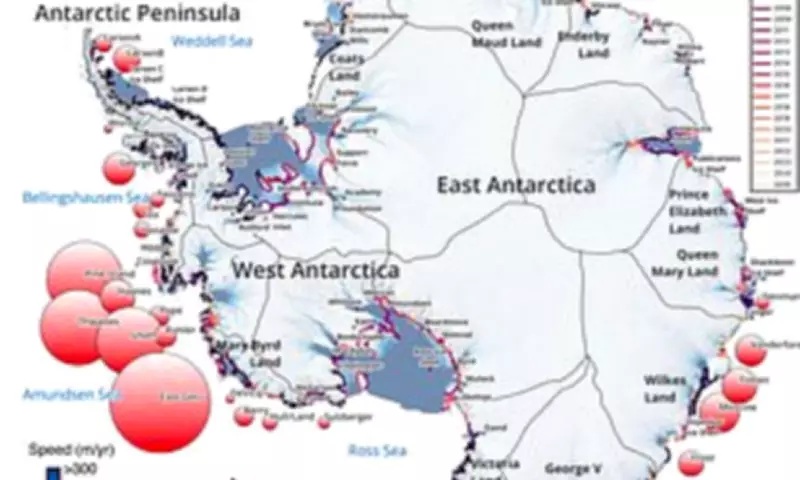
The research team focused on measuring grounding line migration – the change in location where the continental ice shelf meets the open ocean. This approach revealed that Antarctica's ice loss is far more concentrated than scientists had previously estimated. Surprisingly, 77 per cent of the continent's ice sheet has remained relatively stable since 1996, showing no significant grounding line migration.
However, the remaining 23 per cent has experienced dramatic changes. Extremely rapid ice loss has been concentrated in three primary regions: Western Antarctica, the Arctic Peninsula, and specific areas of East Antarctica. This concentrated melting has resulted in a total loss of nearly 5,000 square miles (12,820 square kilometers) of grounded ice – equivalent to an average annual loss of 170 square miles (442 square kilometers).

Professor Rignot's Balloon Analogy
Lead author Professor Eric Rignot from the University of California, Irvine, offers a striking analogy: 'It's like a balloon that's not punctured everywhere, but where it is punctured, it's punctured deep.' Professor Rignot and his international team compiled data from satellites operated by space agencies worldwide, including NASA and the European Space Agency.
For the first time, this comprehensive dataset reveals exactly how Antarctica's grounding line has responded to warming ocean temperatures over three decades. 'We've known this is critically important for 30 years, but this is the first time we've mapped it comprehensively across all of Antarctica over such a long time span,' Professor Rignot explains.
Most Dramatic Changes in Western Antarctica
The most dramatic transformations have occurred in West Antarctica's Amundsen Sea and Getz regions, where glaciers have retreated by six to 25 miles (10–40 kilometers). Specific glaciers show particularly alarming retreat:
- Pine Island Glacier: retreated 20.5 miles (33 kilometers) since 1996
- Smith Glacier: retreated a staggering 26 miles (42 kilometers)
- Thwaites Glacier (the 'Doomsday Glacier'): moved back 16 miles (26 kilometers)
This glacial melting is particularly problematic because it adds fresh water to oceans that would otherwise remain trapped on land, directly contributing to sea level increases. Recent research estimates that ice loss on the Antarctic Peninsula could contribute up to 22 millimeters to sea level rise by 2100 and up to 172 millimeters by 2300.
Sea Level Rise Projections
Previous studies have estimated catastrophic sea level rise potential from specific glaciers:
- Thwaites Glacier collapse could cause global sea levels to rise by 2.1 feet (65 centimeters)
- Pine Island Glacier (responsible for 25 per cent of Antarctica's ice loss) could cause 1.6 feet (0.5 meters) of sea level rise
Professor Rignot explains the pattern: 'Where warm ocean water is pushed by winds to reach glaciers, that's where we see the big wounds in Antarctica.' However, the research also reveals puzzling ice loss in the Northeast Antarctic Peninsula where warm water proximity doesn't fully explain the retreat. 'Something else is acting – it's still a question mark,' Professor Rignot acknowledges.
Additional Glacier Retreats
In this mysterious region, several major ice shelves had already collapsed before 1996, while many glaciers have shown rapid retreats in recent decades:

- Hektoria Glacier: lost 13 miles (21 kilometers)
- Green Glacier: lost 10 miles (16 kilometers)
- Evans Glacier: lost 5.6 miles (9 kilometers)
Despite these alarming changes, the researchers offer a sobering perspective. Professor Rignot concludes: 'The flip side is that we should perhaps feel fortunate that all of Antarctica isn't reacting right now, because we would be in far more trouble. But that could be the next step.'
Global Sea Level Projections
Separate research indicates that global sea levels could rise as much as 1.2 meters (4 feet) by 2300 even if nations meet the 2015 Paris climate goals. This long-term change will be driven by thawing ice from Greenland to Antarctica, threatening coastal cities worldwide from Shanghai to London, Florida to Bangladesh, and entire nations like the Maldives.
Every five years of delay beyond 2020 in peaking global emissions would mean an extra 8 inches (20 centimeters) of sea level rise by 2300. As Dr. Matthias Mengel of the Potsdam Institute for Climate Impact Research notes: 'Sea level is often communicated as a really slow process that you can't do much about ... but the next 30 years really matter.'